
 E-Paper



Rail fracture may be behind Bihar train accident, say officials
The derailment of the North East Express in Bihar’s Buxar district on Wednesday night, which killed four people and left 30 others injured, may have been caused by a rail fracture, two officials aware of the investigation said on Thursday.

 Prefer HTon Google


The derailment of the North East Express in Bihar’s Buxar district on Wednesday night, which killed four people and left 30 others injured, may have been caused by a rail fracture, two officials aware of the investigation said on Thursday.
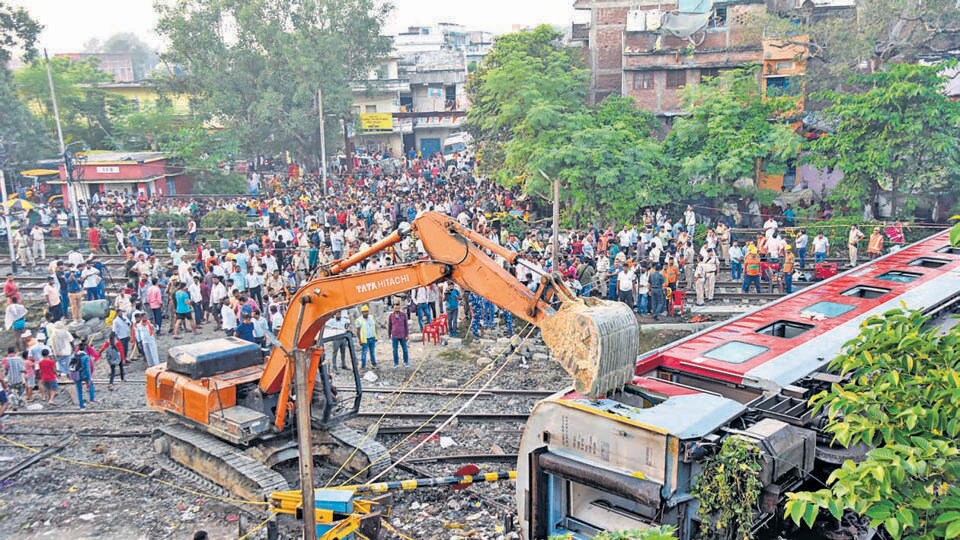
All 23 coaches of the superfast train from Delhi’s Anand Vihar Terminus to Assam’s Kamakhya derailed near Raghunathpur station in Bihar’s Buxar district on Wednesday night. The commissioner of railway safety is investigating the incident.
Two senior railways officials said that the cause of the derailment seemed to be a fault in the tracks, specifically a rail fracture, or a gap in the tracks.
“As of now, it looks like the cause of the accident to be a rail fracture,” one of the officials cited above said on the condition of anonymity. “Over 1,500 passengers were on board the train,” he added.
A spokesperson for the Railways didn’t offer a comment. ‘Deepest condolences for the irreparable loss. Will find the root cause of derailment,” railways minister Ashwini Vaishnaw posted on X early on Thursday.
“The loco pilot and the gate man, both, reported heavy vibrations and abnormal noise when the engine crossed the gate. All coaches were derailed. Moreover, coaches M1, B7 capsized, M2 partially capsized, B1 and H1 coaches tilted and one general coach partially tilted,” said the second official quoted above.
A third official in the know of the matter appeared to point at gaps in track maintenance. “Some of the preliminary observations have revealed that the tracks were longitudinally broken near Raghunathpur station,” he said.
He also said that the train was running at full speed when the incident took place. “The accident spot is around 90 km away from Buxar station and the train was running at 128 kmph when it derailed,” he added, requesting anonymity.
Shri Prakash, a former member of the Railway Board, explained that no small gap could have caused such a major accident. “Rail fracture is usually seen during early mornings when there is a sudden drop in temperature. The Railways conducts a visual inspection once every 24 hours to check for any fractures, especially during winters. However, no hairline crack can lead to such a derailment,” he added.
The accident came months after errors in the automated signalling system led to the Coromandel Express colliding into a stationary goods train, with some of its bogeys then crashing into the oncoming Yeshwantpur-Howrah Express in Odisha’s Bahanaga Bazaar, leaving 296 dead and over 1,000 people injured in what was India’s worst rail disaster in two decades.


