
 E-Paper



Rain, clouds dampen plans to view eclipse in some regions
In Haridwar, most places of worship remained closed in the morning. After solar eclipse ended at 2:51 pm, temples were cleaned with a sprinkling of Ganga water, which is considered holy.

 Prefer HTon Google


People in many parts of north India were unable to view the solar eclipse on Sunday due to a thick cloud cover and rain in some parts.
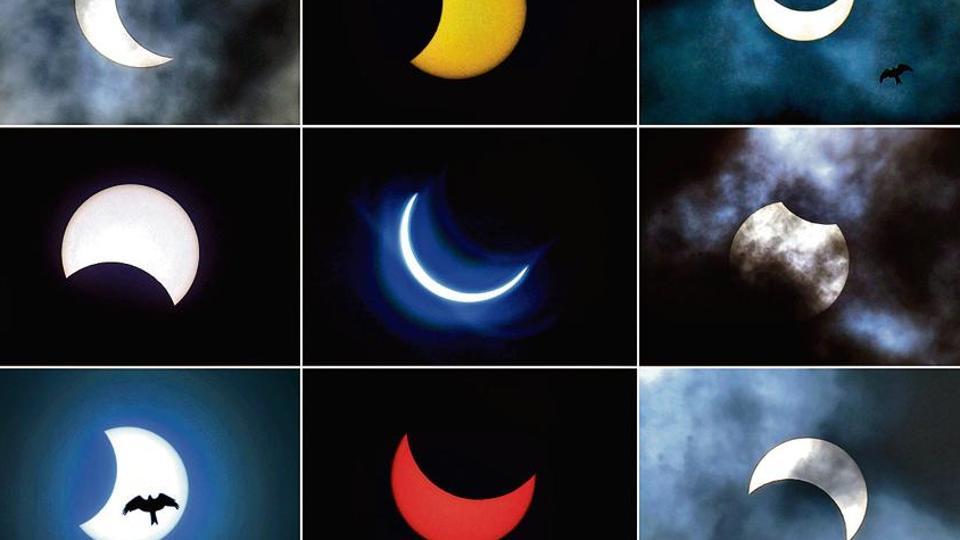
Scientists had predicted that the eclipse, that happened after a gap of 14 years, will be visible in Suratgarh in Rajasthan, Sirsa and Kurukshetra in Haryana, Dehradun, Uttarkhand and in Tapowan in Himachal Pradesh.
At the Aryabhatta Research Institute of Observational Sciences (ARIES) in Nainital, where scientists had made arrangements for live streaming of the eclipse, weather played a spoilsport.
Wahab Uddin, senior scientist at ARIES said clouds cleared briefly at around 12.10 pm, when the eclipse was live streamed on YouTube. “Had weather been good, we would have witnessed a good crowd,” he said.
Since an eclipse is considered inauspicious, temples were shut in most parts of Uttarakhand in the morning.
In Haridwar, most places of worship remained closed in the morning. After solar eclipse ended at 2:51 pm, temples were cleaned with a sprinkling of Ganga water, which is considered holy.
In Madhya Pradesh, people watched solar eclipse in groups while also maintaining social distancing, amid the Covid-19 pandemic.
“It was a great experience to watch the ring of fire very clearly amid clouds. I made all arrangements including spectacles and telescope so that common people could enjoy the moment. Spectacles were not allowed to be exchanged due to COVID-19 situation but telescope was sanitised properly,” said science enthusiast Sarika Gharu.
Viewers in the state called it an “amazing experience”. “It is for the first time I saw a solar eclipse and I got enthralled while watching moon covering sun,” said Ashok Singh, a banker in Gwalior.
“I was hesitant to see solar eclipse with naked eyes. However, I saw it for a few seconds, though not looking directly at the Sun. It was an amazing experience,” Sandhya Kesari, a homemaker in Bhopal, said.
In Kolkata, students and astronomy enthusiasts thronged the Birla Planetarium to watch the eclipse. “This was one of those moments for which people have to wait for years,” said Debiprasad Duari, director, M P Birla Planetarium.
The Birla Industrial and Technological Museum in south Kolkata recorded and live-streamed the eclipse. Science clubs in several districts also arranged viewing sessions for their members. “I wish the sky was clear. We could have had a full view of the eclipse,” said Ananta Majumdar, a star gazer from Bhawanipore.
In Rajasthan, astronomers and mediapersons assembled in Patroda village of Sriganganagar where the solar eclipse was said to be most clearly visible.
An astronomy student said the sun was almost 99% covered at around 11.50 am in a strip of 20km between Ghadsana and Anupgarh. Anupgarh MLA Santosh Bawri made arrangements for people to view the rare celestial event.
In Jaipur, however, people returned disappointed from the Birla planetarium because it was closed for the public due to the Covid-19 situation in the state.
(With inputs from state bureaus)


