
 E-Paper



Rajasthan elections 2018: Cow politics rivals promises of development in eastern part
For some, the “injustice” to these youths is a political issue; for others, their vote in the December 7 elections will depend on the development work done by the ruling Bharatiya Janata Party (BJP) government and what the rival Congress promises.

 Prefer HTon Google


As one enters Lalwandi village in eastern Rajasthan, two issues dominate voters’ minds — the arrest of three people over the death of cow trader Rakbar Khan on July 21 and the lack of development. For some, the “injustice” to these youths is a political issue; for others, their vote in the December 7 elections will depend on the development work done by the ruling Bharatiya Janata Party (BJP) government and what the rival Congress promises.
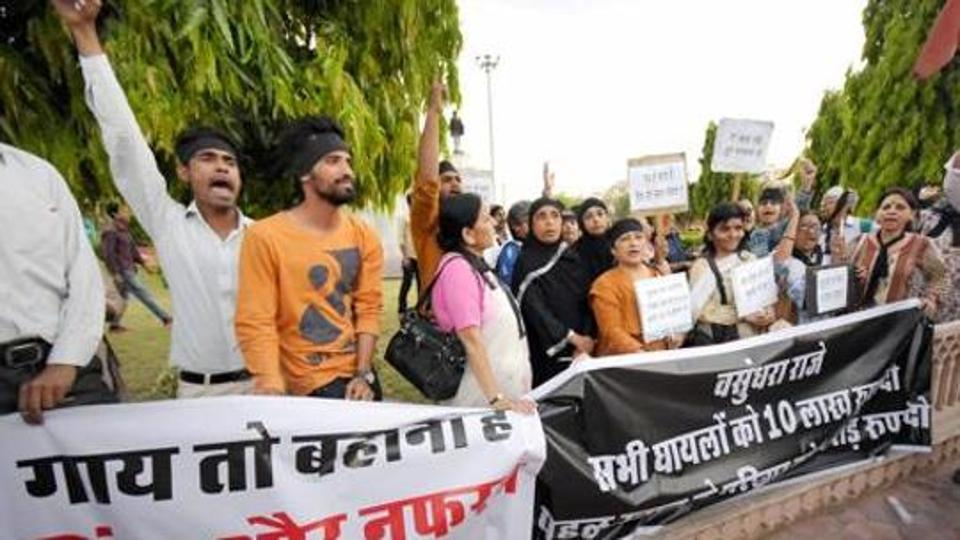
The BJP, which won 15 of the 17 seats in Alwar and Bharatpur in the 2013 state elections, has dropped 13 legislators. The Congress has also brought in at least nine new faces. “Both parties are looking to attract the aspirational younger generation here,” said retired Alwar College principal Jug Mandir Tayal.
Lalwandi falls in the Alwar-Bharatpur belt of eastern Rajasthan, the focal point of clashes between the Meo-Muslims, engaged in cow business and the so-called cow vigilante groups. Before Rakbar Khan, two deaths were reported in 2017 – that of Umar Mohammed in November and of Pehlu Khan in April. Till August 2018, 12 cases a month on average were registered against the so-called cow smugglers in Alwar and Bharatpur districts.
“Many of these incidents are not registered with police as the issue gets settled between the vigilantes and cow traders,” said Shifat Khan, president of the Mewat Kisan Panchayat.
Read: Unemployment dole, jobs in BJP manifesto for Rajasthan
The Alwar and Bharatpur districts, bordering Haryana and Uttar Pradesh respectively, have special check posts to track “cow smugglers”. The BJP has promised to set up more. The Congress has promised cow shelters.
According to Khan, the rise of cow protectors has adversely hit the finances of the Meo-Muslims, who constitute about 4% of the population and have influence in at least five of the 17 seats.
The region has three dominant communities – Meo-Muslims, Gujjars and Meenas. The Meo-Muslims and Gujjars are in cattle business, while the Meenas (a hunting tribe) became prosperous because of bigger land holdings and jobs under the Scheduled Tribe quota .
Enter the Meo-Muslim dominated Islampur village in Dausa – it was once the Lok Sabha seat of Rajesh Pilot, father of state Congress chief Sachin Pilot – and one is greeted by cows and buffaloes. Niyat Ali, 82 , recalled the days when herding cows from his village to Nuh, in Haryana, was not a political issue. “My grandchildren tell me they cannot take the cows to Nuh anymore,” he said. “There is nobody to speak for us.”
Read: Congress manifesto focuses on agrarian crisis, job creation
However, Babulal Jangid, vice-president of Rajasthan’s Gau Raksha Dal, said, “We want all, including Meo-Muslims, to take care of cows like we Hindus do.” The real election issues, said Amit Kumar, 28, from Lalwandi, were condition of roads, lack of jobs and farm distress, not cow protection. “For me, getting a job in the government is more important,” he said. In Islampur village, Amin Ali, 24, could not agree more. “Naukri milegi to ghar chalega (If I get a job, I will be able to run my house),” he said.
“Development is an issue like elsewhere, not cow protection. The newer generation wants jobs and meeting their aspirations is the latest challenge for political parties,” said analyst Jeevan Singh. Congress leader Jubair Khan, whose wife Sophia Khan is contesting from Ramgarh said, “It (cow protection) is not working as the people will vote looking at how their incomes have dipped because of the policies of the Vasundhara government.”
Gyandev Ahuja, Ramgarh BJP legislator who was denied a ticket for backing so-called cow vigilantes, denied that a particular community was the target. “We are fighting on the development done by the Vasundhara Raje government. A lot has been done for infrastructure development and the farm sector in the region.”


