E-Paper



Range of sounds deployed to spook elephants in Assam amid incidents of human conflict
In the past 10 years, human-elephant conflict in Assam has claimed lives of 800 people and around 250 pachyderms, according to government data

 Prefer HTon Google


GUWAHATI:
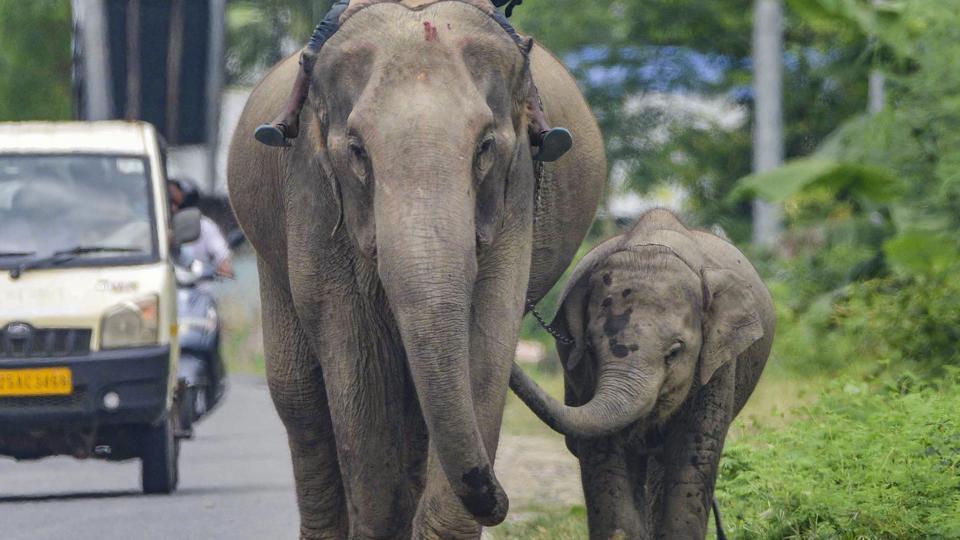
One person was killed and five others injured by a herd of elephants in Khairani village of Baksa district of Assam on September 17. The pachyderms had come out of a nearby forest in search of food. When the villagers tried to frighten the animals away, the elephants attacked.
A few days earlier, a wild elephant was killed by a goods train near Hawaipur in Hojai district of Assam on September 8. The elephant was crossing the railway tracks when the accident took place. Though it is required for trains going through elephant corridors to slow down, the rule is usually flouted, according to locals.
These incidents, though tragic, are not uncommon in Assam. In the past 10 years, human-elephant conflict has claimed lives of 800 people and around 250 pachyderms, according to government data. Now a new project that uses sounds that spook the elephants could be able to reduce the conflict to a large extent.
Last year, 70 elephants died in the state. While 24 of these deaths were due to natural causes, three were due to electrocution, three because of poisoning, four in train accidents, one due to injury, 18 due to lightning and 17 because of “unknown” causes, official numbers show. During the same period, 61 people were killed by elephants.
The conflict peaks during winter, when the pachyderms leave forests and come out in search of food. Angry villagers who want to save their homes, crops and lives try to electrocute or poison the pachyderms. Assam (5,719) has the second highest population of wild elephants after Karnataka (6,049), according to a 2017 census.
Measures such as anti-depredation squads, erection of solar-powered electric fences to prevent elephants from moving towards human habitations, and patrolling to monitor their movement have been undertaken to reduce conflict in the past years, as per the forest department.
Sounds to the rescue
While these measures undertaken by the forest department have helped a little, they haven’t been able to drastically reduce casualties due to human-elephant conflict in the state. But new research by a team of independent researchers could help address the problem in the coming days.
Called the Elephant Acoustics Project, it aims to mitigate conflict using sounds made by pachyderms to alert villagers about presence of the animals in the area, and using noises elephants are scared of, to drive them away in other directions away from human habitation and crops.
“We have developed a device that will work in three stages. First, it will be able to detect sounds of wild elephants in the area and record them. Once that is done, nearby villagers and forest officials will be alerted by the device through the mobile network about presence of the pachyderms in the area so that they can take safety measures,” said Seema Lokhandwala, a wildlife biologist and research head of the acoustics project.
“Mere detection of presence of elephants isn’t enough. Once the device detects presence of elephants through noises made by the pachyderms, it will emit recorded sounds of bees, tigers and leopards, insects and animals the elephants are scared of, to scare them away so that they move away from villages and crops,” she added.
In 2018, a similar project by the Indian Railways tried to keep elephants away from railway tracks. A device that amplifies the sound of bees, which was downloaded from internet, was kept near the tracks.
The pachyderms, which were able to hear sounds made by the device from nearly 600 metres away, initially stayed away from the tracks. But the elephants were soon able to figure out that the sounds posed no real threat of stings.
“Sounds of bees work fine, but elephants are intelligent animals. After few weeks, they get used to the same noise and are able to understand there’s no threat from it. But our device will play sounds of bees, tigers and leopards in a round-robin manner so that the elephants will get confused and not get used to a pattern,” said Lokhandwala.
The researchers have made a conflict map of around 50 villages near the Kaziranga National Park and Tiger Reserve and placed three devices tied to trees in places that are not on elephant corridors. The results of tests done in past months have been encouraging, and the team hopes to formally deploy the devices in December.
“The device has been able to record low frequency elephant noises, which are not audible to human ears, sometimes from as far away as 2km. We have tried the experiment with captive elephants using calls made by them and also used sounds to scare them away,” said Lokhandwala.
“Lokhandwala has been working for some time on this project which could be a solution for human-elephant conflict. Research on a particular subject is just one aspect of the issue. But we need to understand that not all things related to research might be applicable in the field,” said Ramesh Gogoi, divisional forest officer, Kaziranga.
From software to elephants
While she has a team of engineers, conservationists and scientists helping her in the project, it is the brainchild of Lokhandwala, a software engineer from Surat in Gujarat, who changed track and combined her background and passion to try and help reduce human-elephant conflict.
“Since childhood, I was drawn towards elephants and wanted to study sounds made by them. Soon I came to learn about human-elephant conflict and wanted to figure out how I could use by training in engineering to help address the issue,” she said.
Lokhandwala studied about similar work done abroad, especially about the use of acoustics to help detect presence of whales and use the sounds to avoid collision with ships, and realized something like this could also be used to reduce human-elephant conflict in Assam.
“I started working on the project since 2015 and achieved considerable success. We were supposed to start deployment in 2020, but our field work and other scheduled tasks got delayed due to the Covid-19 pandemic. Hopefully, we will be able to launch soon,” she said.
Lokhandwala, who is a PhD candidate at the Indian Institute of Technology, Guwahati (IIT-G), is aided by a core team of five members and a several interns. In order to fine tune their device, the team is looking for good engineers who are interested in conservation work.
“As somebody who has worked with elephants for a long time, I can say that the Elephant Acoustics Project is a very doable thing. Even as a layman, we can see how we react to sounds made by animals and how animals react to sounds made by other animals,” said Kaushik Barua, a conservationist and founder of the Assam Elephant Foundation.
“When this is studied in a scientific manner, as is being done by Lokhandwala and her team, there is very strong possibility of it being successful in reducing human-elephant conflict in Assam,” Barua said. “If we know the different kinds of sounds made by elephants, and also about noises that spook them, we will be able to ward off conflict to a great degree.”
Both Lokhandwala and Barua are hopeful that once the project becomes successful in Assam, it can be replicated in other areas across India where there’s human-elephant conflict.