
 E-Paper



Ranthambore tiger reserve has 18-35 caracals, says Rajasthan forest dept
Only few records of the species have been reported annually, mainly in the Ranthambore landscape though it was also found in Sariska until recently.


Rajasthan’s Ranthambore tiger reserve has 18 to 35 caracals aka Siyagosh, a secretive wild cat, according to a report by the state’s forest department.
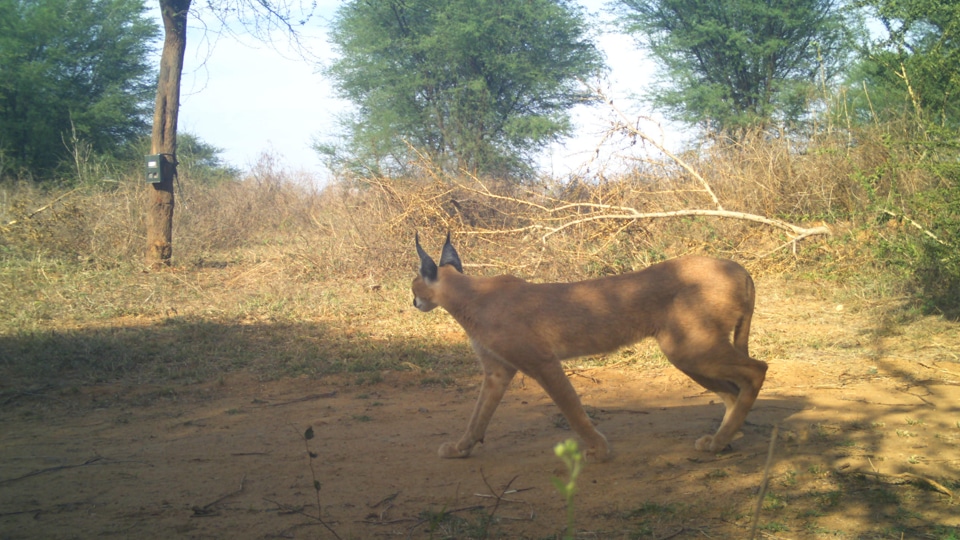
The Indian caracal is an endangered animal and listed as a schedule-I species in the Wildlife Act, 1972. The caracal is a medium-sized wild cat native to Africa, the Middle East, Central Asia and India. It has a slender build, long legs, a short face, long tufted ears and long canine teeth.
The report on status of species by Manoj Parashar, Field Director, Ranthambore Tiger Reserve states that the species earlier was found in drier parts of Punjab, Haryana, Uttar Pradesh, Rajasthan and Kutch but its habitation has now shrunk to parts of Rajasthan (Ranthambore tiger reserve) and Kutch in Gujarat.
Only few records of the species have been reported annually, mainly in the Ranthambore landscape though it was also found in Sariska until recently. The decline in its population and distribution in India is a matter of concern.
Parashar said caracals were tamed and used for hunting in ancient Egypt. In India caracals and cheetahs were tamed and trained for hunting small and large game respectively. In India caracal is known as “Siyagosh”.
“The main threat to the species is the loss of habitat although there have been reports of retaliatory killing of the species by shepherds in Rajasthan as they are known to kill lambs and kids,” Parashar said.
Typically nocturnal, the caracal is highly secretive and difficult to observe. It is territorial, and lives mainly alone or in pairs. The caracal is a carnivore that typically preys upon small mammals, birds, and rodents. “In Ranthambore tiger reserve seven species of wild cats are found, of which the caracal is the rarest and least known in terms of status and ecology,” states Parashar.
The phase – IV monitoring in Ranthambore was conducted from January to April this year during which some of them were camera trapped.
Parashar said there has been no proper attempt to estimate the abundance of caracals in any area. “It was decided that we will process our camera trap capture data to initiate some population estimation exercise and arrive at an estimate of individuals present in the area. Due to the presence of tigers outside the tiger reserve especially in Dholpur, Karauli and Bundi, camera trap data of these areas could also be included in this exercise,” he said.
Based on the data from all the different camera trap stations, it was concluded that there were at least 18 different individuals and the population could range from 18 to 35 individuals.
The forest department predicts that a sizeable population of caracals could be present in the adjoining forest areas of Karauli, Dholpur and Bundi as well as in the ravines of the National Gharial Sanctuary along the Chambal River.


