
 E-Paper



Rescuers closer to trapped Uttarkashi tunnel workers
After 11 days of being trapped in an under-construction tunnel, 41 workers are close to being rescued as an American auger machine drills through debris.

 Prefer HTon Google


At 3:45am on Tuesday, Jaimal Singh Negi had cheered when he saw the first visuals of 41 workers — among them his elder brother — who have been trapped inside an under-construction tunnel in Uttarkashi for the past 11 days. Twenty-two hours later, at 12.45am on Wednesday, Negi cheered even louder as an American auger machine began drilling into the debris for the first time in four days. By Wednesday evening, officials announced to an excited group of family members and colleagues that there were only 18 metres of an estimated 57 metres of debris left to drill through, making the possibility of a reunion, and the successful end of a painstaking multi-agency rescue operation, a real possibility.
The 41 men have been stranded inside a 2km stretch since November 12, when a portion of the 4.5km Silkyara-Barkot tunnel on the National Highway in Uttarkashi district collapsed. Since then, there have been multiple attempts to engineer methods to evacuate the workers, including the use of an American auger machine to drill through close to 60 metres of debris from the Silkyara end. Last Friday, drilling was halted with only 22 metres of the process completed, after efforts were stymied because of the damage to the bearings on the machine after it hit rock formations, and fears about a collapse in the tunnel.
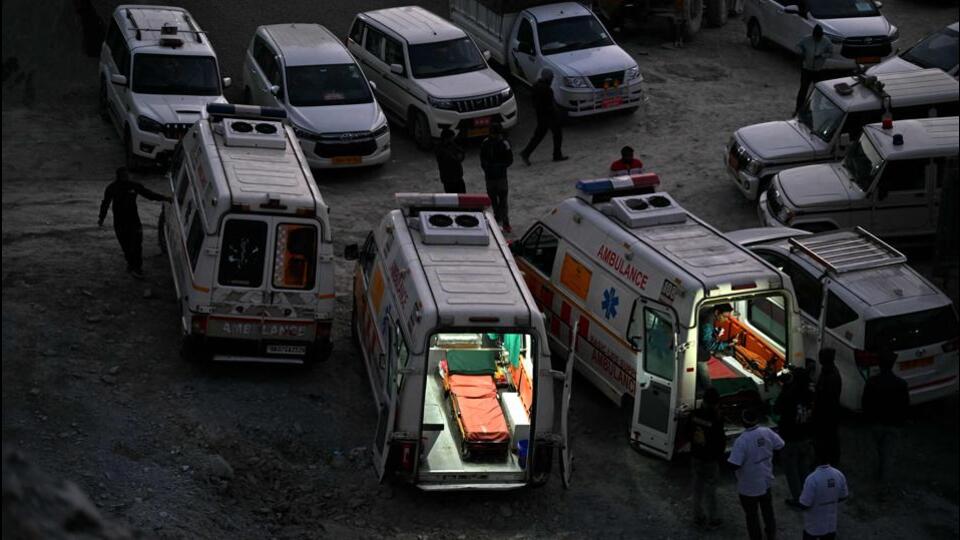
READ | 30 ambulances at spot; NDRF personnel enter Uttarkashi tunnel as rescue op intensifies. Top updates
But even as multiple experts were called in and four other avenues from where drilling could begin were identified, after technical modifications over the past five days, the auger machine from the Silkyara end restarted operations late on Tuesday night, and steadily made progress through Wednesday. By 4am, officials announced that it had navigated a distance of 33 metres. At 11.30am, there was more encouragement, with it reaching 39 metres. And by Wednesday evening, officials announced that a successful end may be near, with 45 metres completed.
Mahmood Ahmad, managing director of the National Highways and Infrastructure Development Corporation Ltd, said that as rescuers are drilling, they are using a “telescopic method” to push in pipes that are 800mm wide, inside 900mm pipes. This essentially means drilling an outer bore, inserting an outer conduit into it, and then inserting an inner pipe into the existing conduit. On Wednesday evening, Bhaskar Kulbe, special officer deputed to the Uttarakhand tourism department, said, “I am delighted to announce that we have been able to move forward by another six meters (reaching 45 metres)… drilling could be completed around midnight or a little later.”
Officials, however, said that they were continuing to remain cautious, and wanted to ensure few mistakes in this crucial last stretch. “We estimate that we will make the breakthrough to the other end at 57 metres, but it could be a little more as well. Somewhere between 60 and 65 metres. So at the very least, there are still 18 metres to go. Beyond that, there will then be an exercise to prepare the pipes to bring the stranded men back slowly,” one official said, asking not to the named.
However, officials said that at around 8pm a metal girder blocked the path of the augur machine. “Efforts are on to cut it manually using metal cutters. Once the obstacle is clear we will push the machine further,” the officials said.
On Wednesday evening, at the Silkyara end, there was a buzz of activity as multiple teams prepared for the final evacuation of the men, with National Disaster Relief Force (NDRF) personnel near the mouth of the tunnel, with oxygen cylinders strapped to their backs. Officials said that once the pipe is securely through the debris, a team of NDRF will crawl through the other side, setting a rope as they go.
“Then a team of doctors and paramedics will be sent inside on a makeshift stretcher that has wheels. They will check the vitals of the trapped workers. Based on their health condition, they will then, one after another, be pulled out on the stretcher. It will likely take one minute each for the men to come out,” a second official said.
Just outside the tunnel, the state government has stationed 12 ambulances, with the plan to keep ready a fleet of 40 by the time the men emerge. A makeshift eight-bed hospital has been set up right outside the tunnel, with another 41-bedded hospital readied at Chinyalisaur, 32km away. “From here, they can also be taken to AIIMS Rishikesh, if needed,” the second official said.
Officials said that they were continuing to work on other approaches into the tunnel, as a fail-safe if the drilling from Silkyara suffers a setback. These include vertical drilling from the hills atop the tunnel, and drilling from the Barkot end, where rescuers will have to navigate over 400 metres of debris. “Horizontal drilling from the Barkot side, with 3 blasts and 8 metres progress, is underway,” Ahmad said. By evening, however, this process was halted to focus on the primary Silkyara plan. “We don’t want vibrations to disturb our main activity,” a third official said.
The breakthroughs come a day after rescue workers were successful in pushing through a second “lifeline” six-inch pipe through which cooked food and other relief material, and equally importantly, an endoscopic camera with a microphone was pushed through. Till then, there was only a four-inch pipe that could accommodate the passage of soft food such as puffed rice and nuts.
Since Tuesday morning, chapattis, vegetables, khichdi, and fruits have all been sent through the pipe. “The microphone and speaker sent through the six-inch supply pipe enabled conversations, and addressing workers’ health concerns,” Neeraj Khairwal, secretary, Uttarakhand government, said. “Medical support, including medications for constipation, and essential items like undergarments, towels, and toothbrushes, were provided. Additionally, a comprehensive meal, including daal, mixed vegetables, roti, and rice, was sent in plastic bottles and aluminum foils,” he added.
So, at 10am on Wednesday, when Jaimal Singh Negi spoke to his 51-year old brother Gabbar Singh Negi, who is stranded inside, there was a sense of confidence. “I conveyed to him that the drilling has progressed significantly, and he would be brought out soon. Even though he never lost hope in all these days, there was happiness in his voice and I could hear him telling everyone else inside,” Jaimal Singh Negi said.
Half a day later, in the cold at 8:15pm, Jaimal Singh Negi had not moved from outside the tunnel. He stood behind the security barricades, peering into the din of activity. “I will stay here. Hopefully Gabbar comes out soon. These have been 11 long days, and I cannot wait to see him in the flesh.”


