
 E-Paper



Revanth holds ‘Praja Darbar’, positions himself in the mould of YSR
This was first time since the formation of Telangana state nearly 10 years ago that such an initiative was taken, and the CM’s camp office has been thrown open to the public to submit their grievances


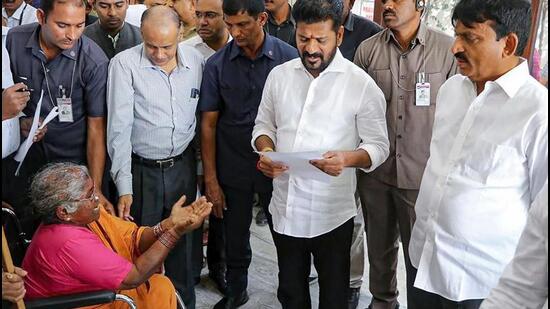
Hyderabad: On his first day in office as Telangana chief minister, A Revanth Reddy held a “Praja Darbar” (people’s court) at his camp office in Hyderabad where he received applications from the public for redressal of their grievances.
Special help desk counters, manned by officials from government departments, were set up at the sprawling office, renamed as Jyotirao Phule Praja Bhavan, to help people in submitting their applications in proper format.
As promised during the oath-taking ceremony on Thursday, the chief minister, accompanied by his cabinet colleagues and senior officials, arrived at the venue and personally accepted the applications and heard the grievances from the people. The applications were then forwarded to the departments concerned for follow-up action.
“I have come to meet the chief minister seeking compassionate appointment for me as per the government policy. My father died 10 years ago but the previous government did not clear my case even after the high court’s direction to provide job for me on compassionate grounds,” said Praveen Kumar from Bhadrachalm in Kothagudem district.
Clutching the papers in her hand, a daily-wage earner from Hyderabad, Srilakshmi, said her family was promised a double bedroom house by the previous government but her application has been pending for nearly 10 years. “We are hopeful that the new CM will do justice to us and to many others like us,” she said.
A youth from Adilabad district said he had successfully cleared a competitive test and interview for a job in the state-owned coal company, Singareni Collieries, but the appointment letter was not issued on some flimsy technical grounds. “I hope that CM’s intervention will solve my problem,” Arun Ram said.
This was the first time since the formation of Telangana state nearly 10 years ago that such an initiative was taken, and the CM’s camp office has been thrown open to the public to submit their grievances. The chief minister announced that ‘praja darbar’ would be held every Friday.
As many as 15 desks were set up at the camp office for registration of grievances, a release from the Chief Minister’s Office (CMO) said. A special mechanism has been developed to register the petitions online and issue a unique Grievance Number (ID generated) on each petition. A printed acknowledgment would be given to the applicant, which would also be sent to them via SMS, the release said.
While addressing the gathering at Lal Bahadur Stadium soon after taking the oath, Revanth had said the iron barricades around “Pragathi Bhavan”, as the CM’s camp office was named earlier, would be dismantled to make it “accessible to the general public”.
“We will usher in a true democratic Telangana unlike the feudal Telangana of the past. We are not rulers of people but their servants,” he said.
Even as the swearing-in ceremony was in progress, several bulldozers, tractors and construction workers were seen outside the “Pragathi Bhavan” in Begumpet, a few kilometres away, uprooting the iron rods. During his poll campaign, Revanth had promised that the Congress, if voted to power, would order removal of barricades.
YSR mould
“Revanth’s style of functioning and his brand of politics are reminiscent of former Congress chief minister late Y S Rajasekhar Reddy,” said K Ramesh Babu, analyst and author.
From aggressive campaign style, striking an instant chord with the crowds, to relentless focus on populist policies and decentralisation of administration, Revanth has striking resemblance to YSR, as the former chief minister was popularly known. YSR too used to hold ‘Praja Darbar’ at his camp office in the combined Andhra Pradesh.
YSR had led the party to two successive wins in 2004 and 2009.
Like YSR, Revanth infused energy and dynamism into a moribund organisation that was bogged down by infighting and groupism and steered the party to victory, dislodging the two-term Bharat Rashtra Samithi (BRS) government headed by K Chandrashekar Rao.
Soon after taking the oath as CM in 2004, YSR had signed the first file on free power to farmers, a hugely popular policy continued by the successive governments. Revanth, on the other hand, signed two files, one pertaining to the implementation of ‘six poll guarantees’ of Congress— including free bus travel for women, pension for widows and single women, financial aid, free power and loan waiver for farmers—and another providing a job to a physically challenged woman as per a promise he made to her during the campaign.


