
 E-Paper



Amid row over new voters, J&K parties say ploy to alter region's demography
Chief electoral officer Hirdesh Kumar Singh told reporters on Wednesday that the ongoing special summary revision of electoral rolls is likely to add around 2.5 million voters


The proposed addition of 2.5 million names to the electoral rolls in Jammu and Kashmir stirred a political hornet’s nest on Thursday, with local parties saying it was a ploy to alter the region’s demographics and the government dismissing allegations that “outsiders” will influence electoral outcomes.
Also Read: Around 25 lakh new voters likely to be enrolled in Jammu and Kashmir
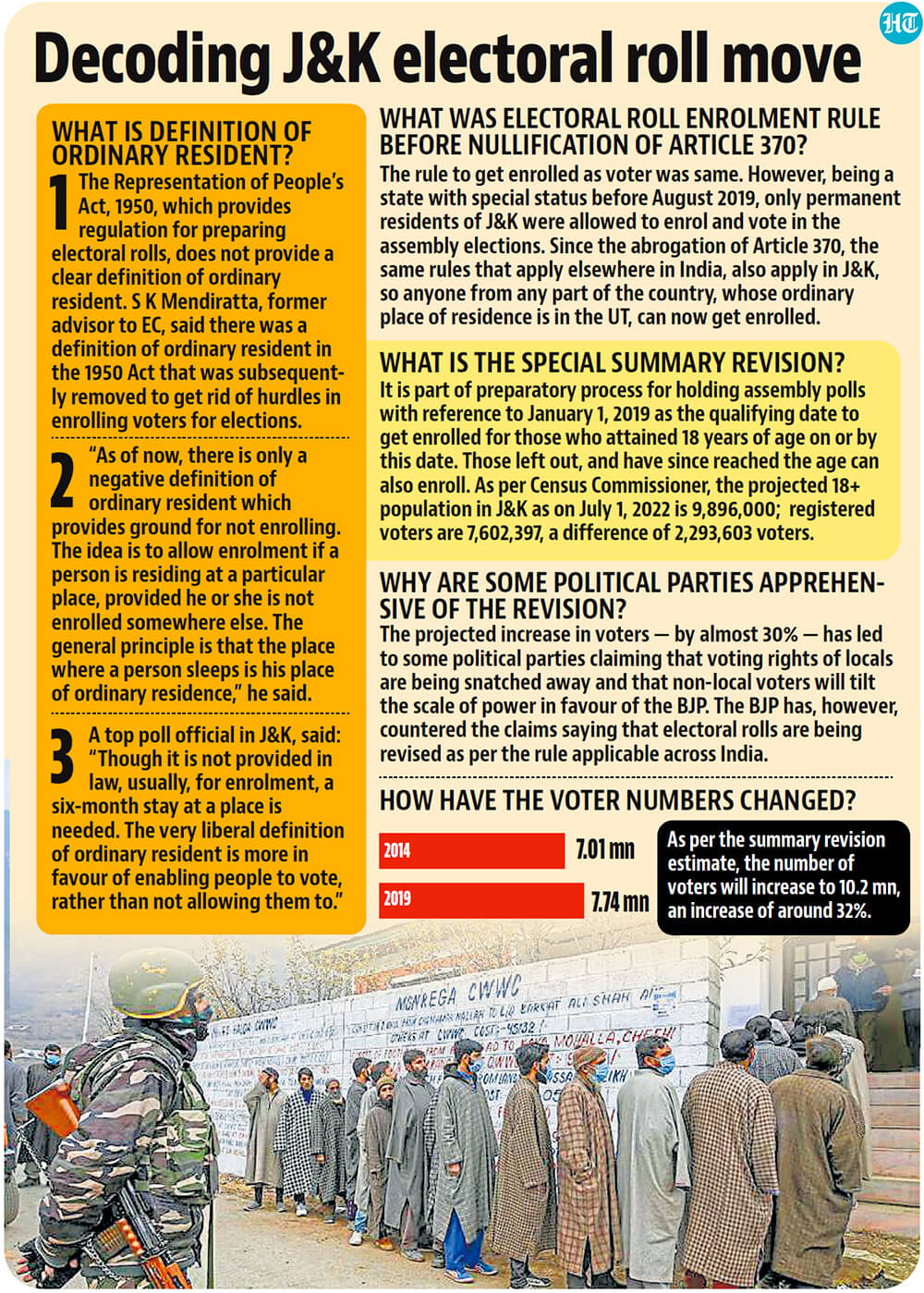
Chief electoral officer Hirdesh Kumar Singh told reporters on Wednesday that the ongoing special summary revision of electoral rolls — a process seen by analysts as a preparatory move for the region’s first assembly election in eight years — is likely to add around 2.5 million voters. The jump, he explained, was because the exercise was being held after three years, a period in which the region’s special status was scrapped. This allowed the inclusion of “ordinary residents” — and not just permanent residents — in the electoral rolls. The state’s special status previously did not allow this.
“After the abrogation of Article 370, many people who weren’t voters in the assembly can now be named on the voters’ list to cast their vote... and no person needs to be a permanent resident of the state/UT,” Singh said.
But the large increase — at 2.5 million, it represented nearly a third of the 7.7 million people registered to vote in the region in 2019 — prompted parties in Kashmir to express concerns.
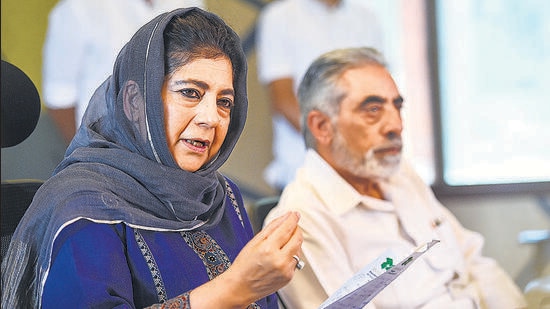
“This is the last nail in the coffin of electoral democracy. A Muslim-majority state chose India. They wanted to be part of secular India. But people have lost confidence in voting. Everything is happening in the BJP’s interest,” said former chief minister Mehbooba Mufti.
“Is the BJP so insecure about support from genuine voters of J&K that it needs to import temporary voters to win seats? None of these things will help the BJP when the people of J&K are given a chance to exercise their franchise,” said former chief minister Omar Abdullah.
National Conference patriarch Farooq Abdullah invited leaders of all political parties for a meeting to discuss the development on August 22.
Also Read: JKNC chief Farooq Abdullah seeks all-party meet over ‘non-voters can vote’ row
The integrated draft electoral roll will be published on September 15, 2022 and claims and objections will be disposed of by November 10.The final electoral roll will be published on November 25. Any person attaining the age of 18 on or before October 1, who is otherwise qualified to be enrolled as an elector in the electoral roll, can apply for registration during this special summary revision.
The election process is important not only because it will mark the first elected government in the UT, and the first in the region since 2014, but also because it is seen as the first step to restoration of statehood.
Parties in Kashmir have long accused the BJP of trying to subvert the Muslim-majority region. Kashmiri parties are expected to do well in the Muslim-majority Valley while the BJP is expected to win the Hindu-dominated Jammu plains area hands down. The BJP denies the charge.
Repeated calls and messages to Singh went unanswered. But a top government official, speaking on condition of anonymity, pointed out that prior to the effective abrogation of Article 370 in August 2019, the assembly electoral rolls were made under the ambit of Jammu and Kashmir Representation of People’s Act 1957, wherein only permanent residents of Jammu and Kashmir were eligible to get registered.
According to the J&K Constitution, adopted on 17 November 1956, a Permanent Resident (PR) of the state is defined as a person who was a state subject on 14 May 1954, or who has been a resident of the state for 10 years, and has “lawfully acquired immovable property in the state”.
With the nullification of Article 370 and applicability of Representation of People’s Act 1950 and 1951, any citizen of India who has attained the qualifying age and “ordinarily residing” at a place is eligible to get registered in the electoral roll of that place, if not disqualified otherwise, the official added.
An ordinary resident refers to non-locals and are usually allowed to vote in most other Indian states.
“It is in this context, the media was briefed that any person who fulfils the requirements for registration and is ordinarily residing in the UT of Jammu and Kashmir (owing to any reasons such as profession, studies, posting, etc), can get registered in the electoral rolls of Jammu and Kashmir, provided he gets his name deleted from electoral roll of his native constituency, as registration at two places is not permitted under law,” the official added.
He pointed out that before the nullification of Article 370, these ordinary residents were eligible to vote only in parliamentary polls, not assembly. “During the last Parliamentary elections there were approximately 32,000 such non-permanent resident voters,” he added, requesting anonymity.
But opposition parties weren’t satisfied.
“BJP has played a masterstroke to bolster their poll prospects in J&K. Adding 20 to 25 lakh voters amounts to playing with the sentiments of the people of J&K. None here is ready to accept this,” said former Congress unit chief GA Mir.
Former education minister and senior Aam Aadmi Party leader Harsh Dev Singh said people of Uttar Pradesh and Bihar will end up deciding Jammu & Kashmir’s elections. “Since no domicile certificate is required, they will bring trains full of people and make them vote for them. It is a suspicious move and a mockery of democracy.”
“I am strongly opposed to this decision. BJP is on a very weak wicket and hence every possible ploy is being employed. First, they extended the summary of electoral rolls to November 25 to delay the polls and now adding 2.5 million voters will entirely tilt the scenario in BJP’s favour”, he added.
The BJP defended the move.
“If ordinarily residing people can vote for municipal polls, assembly elections and general elections in Maharashtra, Tamil Nadu, Telangana and other states, why can’t their counterparts do it J&K?” asked the party’s local unit chief, Ravinder Raina.
“It’s an old clause not something new which has been thought overnight and added to the Act,” he added.
The procedure for getting registered in the electoral roll involves filing of Form-6, which contains complete details of the applicant, including their family trail. There are specified documents prescribed by the election commission to be submitted as proof of residence as well as age. On receipt of any such documents along with requisite documents, a booth level officer, BLO (who happens to be a local officer of the polling area), is appointed by the ERO who conducts a detailed physical verification of the particulars mentioned in the Form 6, and submits a report.
“Further, as a countercheck, there is also a provision in law to object to the inclusion of any name in the electoral roll through Form-7, by any elector of the concerned constituency. Thus there are multiple statutory safeguards existing in the present system against inclusion of an in-eligible person in the electoral roll,” said the government official quoted above.


