
 E-Paper



₹406 crore grains lost in storage: House panel
Besides, cereals worth ₹1.39 crore were stolen or pilfered between 2017 and 2021, data in the report shows. Operational norms assume there will be some loss while undertaking large procurement operations, but data cited in the parliamentary report shows the quantity of grains lost in storage exceeded the target set by the government.

 Prefer HTon Google


India lost ₹406 crore worth of grains procured by the government due to damage during storage in state-run granaries in the past three years, data cited in a parliamentary standing committee report has revealed.
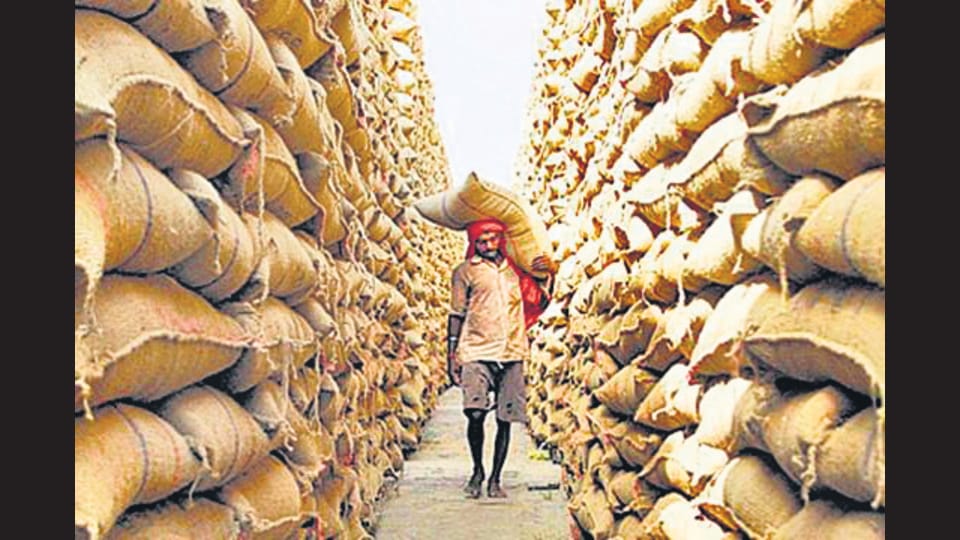
Besides, cereals worth ₹1.39 crore were stolen or pilfered between 2017 and 2021, data in the report shows.
Operational norms assume there will be some loss while undertaking large procurement operations, but data cited in the parliamentary report shows the quantity of grains lost in storage exceeded the target set by the government.
A rough calculation by HT, using tools in the website caloriecontrol.org, shows ₹406 crore worth of grains is sufficient to feed half of India’s Census-recorded 1.7 million homeless people on a bare minimum 1,200-calorie diet for a quarter.
“The (food) Ministry further stated that during storage of foodgrains scientific code of practices for safe storage is followed. Inspite (sic) of all precautions, some quantity of foodgrains may get damaged/become non-issuable due to various reasons such as storage pests’ attack, leakages in godowns, procurement of poor quality stocks, exposure to rains, floods, negligence on the part of concerned persons in taking precautionary measures etc,” the parliamentary standing committee on food’s report on procurement and storage by the Food Corporation of India (FCI) said.
Procurement refers to the government’s buying of cereals at benchmark minimum support prices from farmers.
Foodgrains procured by the government are either stored on covered platforms or covered and plinth method of storage, where sacks of food are stockpiled on raised platforms, apart from silos.
In 2019-20, the government targeted to limit losses to 0.07% of the total grains bought by it, while actual losses were higher at 0.10%. In percentage terms, the value looks small because the government procures large quantities, but in absolute terms, the quantities lost are significant.
For instance, during 2019-20, slightly over 100,000 tonnes of wheat were lost in storage, while in 2020-21, another nearly 100,000 tonnes were spoiled.
The government procured 86.9 million tonnes of paddy during 2020-21 and 43.3 million tonnes of wheat in the current year, which is the highest-ever quantity procured.
“Physical measures like installation of barbed wire fencing of the boundary walls, provision of streetlights for illumination of godowns and proper locking of the sheds are taken to secure the godowns,” the report said.
The FCI explained the loss. “The FCI has brought down the percentage of grains damaged or declared non-issuable (to consumers) considerably from about 0.047% in 2013-14. We maintain proper records of non-issuable grains. Some damage is inevitable due to natural moisture loss as a result of the long time difference between procurement and distribution,” an official overseeing procurement in the food agency said, requesting anonymity.
According to the report, there are provisions for “strict disciplinary action” against FCI staff responsible for “unjustified losses” from FCI depots.
“Where negligence is the cause, strict departmental action is taken after investigation,” the FCI official added.
Dipa Sinha, a food security expert at Ambedkar University in Delhi found it shocking that the government has lost much grain that could have fed so many people. “The government should make the public distribution system universal and secure every grain it procures,” she said.
In the 2020 Global Hunger Index, India ranked 94 among 107 countries.


