
 E-Paper



RSS and its outreach to other faiths
While the Sangh remains unfazed by the attention these meetings gathered, stating that these interactions are “routine”, the commentariat is perusing these for subliminal clues about the Sangh’s overtures towards the minorities


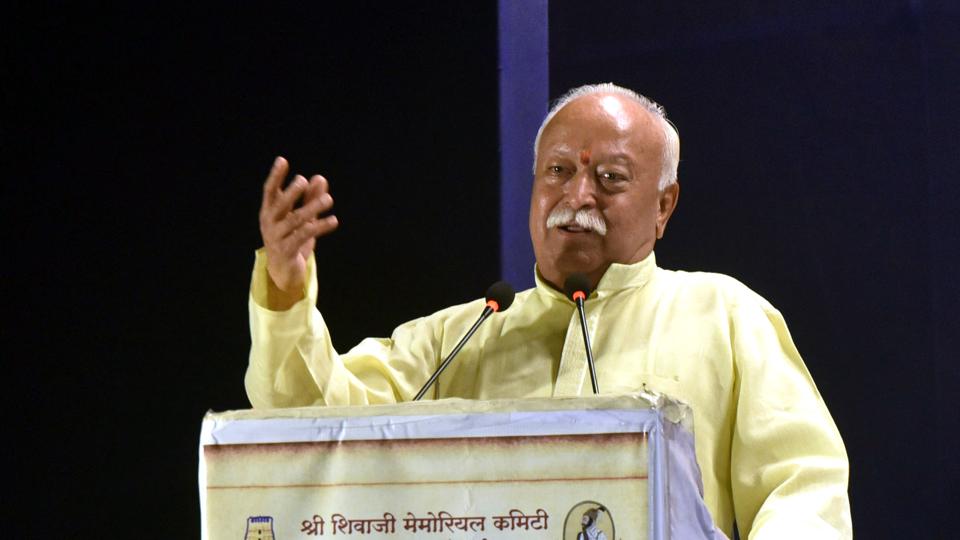
New Delhi: Rashtriya Swayamsevak Sangh (RSS) chief, Mohan Bhagwat’s visit last week to the New Delhi residence of Umer Ahmed Ilyasi, the chief Imam of the All India Imam Organisation that is in the same complex as a mosque, followed by a stopover at a Madrasa has triggered a storm of reactions.
The meeting was preceded by another closed-door interaction in August with eminent persons from the Muslim community who had sought a meeting to discuss ways of ending strife between communities.
Unfazed by the attention these meetings gathered, Sangh functionaries said these interactions are “routine” and signal a continuity of their outreach. The commentariat however, is perusing these for subliminal clues about the Sangh’s overtures towards the minorities. Those opposed to the organisation, the ideological parent of the Bharatiya Janata Party, dismiss these meetings as a smokescreen to hide the growing chasm between communities and faiths.
The head of RSS’s Prachar Vibhag or publicity division, Sunil Ambekar dismissed all speculation about the meetings and said they characterize the Sangh’s belief in continuous samvaad or dialogue. “Sudarshan ji had also met the current Imam’s father that should give you an idea of the longevity of dialogue,” Ambekar said, referring to K S Sudarshan, the predecessor of Bhagwat.
However, since the meetings come against the backdrop of a growing discomfort among Muslims over issues such as reclamation of temples, which Hindu groups assert were forcibly turned into mosques; an increasing scrutiny of Madrasas; and controversies over food and dress choices – and it is not surprising that they have attracted attention.
Christian outreach
A senior RSS functionary echoed Ambekar blamed the curiosity and the brouhaha over the visit on “short-lived memory” and “ignorance”.
“People tend to forget that this outreach is at the core of the Sangh’s purpose, to connect with people from all faiths, classes and castes. And since many are ignorant about the Sangh, they feel such meetings have a political purpose,” he said speaking on condition of anonymity.
Having spent decades in the Sangh, severing in various capacities, he recalled an incident that was narrated by the late MG Vaidya, one of the RSS’s well-known spokespersons about Sangh chiefs being open to interactions with religious heads. “The practice of RSS chiefs visiting people from other religions at a place of their choosing was started by (the fifth Sarsangachalak KS) Sudarshan ji. In 2001 a Christian member of the National Commission for Minorities, John Joseph, reached out to Vaidya with the proposal to organise a meeting with Sudarshan Ji. There were several conditions put forth including a last-minute change of venue to a Church and without any hesitation these were met and the interaction took place,” the functionary recalled.
The first meeting with the Roman Catholic Bishops in Delhi was followed by at least six other such meetings with Protestants and representatives of other sects to put on record the Sangh’s views about Christians and the Church in India. The meetings that started then continue till date with interactions held at periodic intervals.
Similarities in outreach
Apart from the intent to clear the air and cement ties, there is another similarity between Sudarshan’s meetings with the Church leaders and Sikh clergy and Bhagwat’s interactions with the Muslims.
Just as the meeting with the Muslim leaders comes against the backdrop communal polarization, Sudarshan’s outreach was preceded by an uproar among the Christians about the Sangh’s views on the Church.
In the year 2000, while addressing the annual Vijaydasahmi congregation, Sudarshan stoked a controversy by declaring that there is a need for an Indianised Church, which would not be “controlled by a foreign Church.” The provocation was a statement by the then Pope John Paul II claiming that Church's objective would be to evangelise all of Asia and a subsequent claim that Catholic faith was superior.
“What he (Sudarshan) said was in response to the Pope and there was ample evidence that the Church was proselytizing tribals in the North East and in large parts of central India, but everyone made it sound like an attack against the Christians. Just as there are attempts to create fear among the Muslims (now),” said the functionary quoted above.
The functionary said the Sangh chief had also made a similar bid to build bridges with the Sikh community that was riled by the disrespect shown to their faith, when soldiers marched into the Golden Temple during the Operation Blue Star in 1984 to flush out terrorists holed up inside the Harmandir Sahib Complex. The Rashtriya Sikh Sangat was borne out of the initiative to end the acrimony and suspicion that had set the Sikhs and the Hindus apart.
“There was never a question about the Sikhs not being a part of Bharat and yet owing to disruptive forces the Khalistan movement began here. The Sikhs who fought the invaders to protect Bharat were instigated to seek an independent state. After Blue Star happened and the (anti Sikh) riots took place (following the assassination of the then PM Indira Gandhi) the RSS worked hard to remove differences that had cropped up,” the functionary said.
There are media records of Sudarshan having visited the Damdami Taksal, the Sikh seminary once headed by Jarnail Singh Bhindranwale.
Perception building
Is the outreach towards the Muslims, then an attempt to change perceptions about the Sangh’s insular approach towards the minority community and to tackle growing resentment?
Rajya Sabha MP and political commentator Rakesh Sinha said the meetings serve to break preconceived notions about the Sangh and the perception that it isa anti-minority.
“These visits have moral significance. They not only shatter the binaries that have been increasingly institutionalised by the politics of votebank and appeasement, but also expose those who are constantly and consistently portraying the RSS as an imaginary enemy of the minorities. Therefore, being a moral force, the Sangh considers it their responsibility to contest these pseudo-secular perceptions,” he said.
The visits, Sinha underlined, are a “death blow” to forces, elements and traits, which he said “in the garb of transparent dialogue, create confusion and pursue the politics of polarization” and serve a twin purpose. “One, that the RSS’s social and cultural philosophy is inclusive and must reach the common masses, which include minorities. It does not believe or even dream to exclude anyone. And two, the objective of the meeting is to give the minorities an opportunity for self-introspection as well as to re-examine the perceptions created about them and the others. This will help them reconnect with cultural roots, which include history and legacy and can create common feelings and aspirations,” Sinha said.
His view about minorities needing self-introspecting is an echo of Sudarshan’s suggestion of an Indian version of Islam and Christianity, which is shared by the current Sangh leadership as well.
On several occasions Bhagwat has reached out to the minorities by stressing on a shared ancestry and cultural binds. At a three-day interaction in the Capital in 2018, Bhagwat clarified that the Hindu Rashtra, envisaged by the Sangh does not mean a place devoid of Muslims. “The day it is said so, it won’t be Hindutva anymore. Hindutva talks of Vasudhaiva Kutumbkam(world is a family)”, Bhagwat said and even sought to distance the Sangh from the orthodox Bunch of Thoughts, penned by the second Sarsanghchalak M S Golwalkar, a compendium known for orthodox and hardline views.
Support for reconciliation not radicalisation
A second RSS functionary said the Sangh has not altered its views but made it more pronounced that it will support “reconciliation not radicalisation.”
“Sangh’s acceptability has gone up even among Muslims. And the educated, progressive Muslims have realised that while this government (supported by the Sangh) will go after the radical elements, it will also support Muslims and uphold their fundamental rights,” the second functionary said, adding that Muslims also need to find good leaders.
Former LG of Delhi, Najeeb Jung, who was among those who met Bhagwat in August, agreed that the community needs visionary leaders. While a section of people criticised Jung and the others for reaching out to Bhagwat, he said the meeting was a step in the right direction.
“I feel we did the right thing, which is in the interest of the country. There will be sceptics and critics but we should trudge along the correct path. It will be long and dark, but all the right-thinking people will appreciate this move,” he said.
On the need for fostering a new leadership among Muslims he said, “The community needs a secular, educated and forward-looking leader who will think about the community and understand that for India to progress all communities must march together.”
Not everyone however believes that the Sangh has shed its aggressive Hindutva stance. Ajay Gudavarthy, professor at the Jawaharlal Nehru University said the RSS chief’s outreach is a red herring.
“I see it as a response to Bharat Jodo Yatra. (Congress leader) Rahul Gandhi has been spearheading the campaign against the RSS. Also, it has been the long-term strategy of the RSS to not only target the Muslims, but also emerge as their saviour,” he said.
The skepticism about its intent does not worry the Sangh. “Those who are intent on sowing seeds of discontent will always find fault. When Deoband announced a fatwa against Vande Mataram, it was the Muslim Rashtra Manch that led the opposition and participated in singing the National Song publicly and supported the call for a ban on cow slaughter. The truth is that Indian Muslims identify with Hindu nationalism… and this has been so since the time of Shivaji, whose naval chief was Darya Saran,” said the first functionary.
Bid to aid BJP’s political outreach
While the Sangh’s explanation for the outreach steers clear of any political purposes, its political protégée, the BJP hopes the interactions will have a significant impact on its political fortunes. Despite policy decisions and social welfare programmes of the BJP led government that benefit the minorities, the party has not been able to shed its image as a majoritarian outfit. While it made claims of receiving support from Muslim women, after it passed the bill to outlaw triple talaq, there is no empirical evidence to suggest that the party is no longer a pariah for the community.
The absence of Muslim representatives from the party in Parliament and the lack of representation to the community in state elections are a jarring reminder that the party has not been able to build ties with the community. The Sangh’s renewed outreach therefore, aids the BJP’s bid to elicit support from the socially and economically weaker sections within the community. At the national executive of the BJP in Hyderabad in July, prime minister Narendra Modi instructed the party to reach out to the Pasmanda Muslims, or Dalit Muslims. It was the BJP’s efforts to reach out to marginalized sections of the other backward classes and scheduled castes that helped it consolidate the Hindu vote.
 ABOUT THE AUTHORSmriti Kak Ramachandran
Smriti covers an intersection of politics and governance. Having spent over a decade in journalism, she combines old fashioned leg work with modern story telling tools.


