E-Paper



Sanskrit scholar Bhadreshdas Swami conferred with Saraswati Samman 2024
Gujarat and Maharashtra governor Acharya Devvrat described Bhadreshdas Swami’s work as a beacon of philosophical and academic excellence that unites souls and elevates India’s intellectual presence worldwide

 Prefer HTon Google


Ahmedabad: Mahamahopadhyay Bhadreshdas Swami, renowned Sanskrit scholar, philosopher of the Vedanta tradition, and an ordained sadhu of the Bochasanwasi Akshar Purushottam Swaminarayan Sanstha (BAPS), was on Sunday conferred with the prestigious Saraswati Samman 2024 by the K.K. Birla Foundation for his work Swaminarayan Siddhant Sudha.
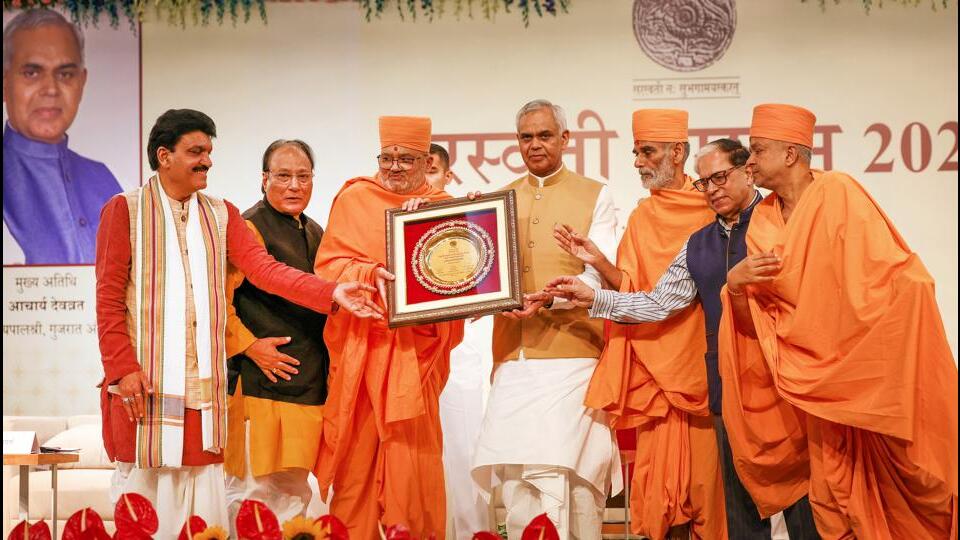
The award, announced in March, was formally presented at BAPS Swaminarayan Mandir, Shahibaug, Ahmedabad, in the presence of Gujarat and Maharashtra governor Acharya Devvrat.
In his address, the governor said Sanskrit is a profound expression of India’s civilisation and culture, deeply rooted in the welfare of humanity and nature. He urged everyone to understand the essence of Sanskrit scriptures and appreciate the beauty of the language. He lauded the monumental contribution of Swami Bhadreshdas, describing his work as a beacon of philosophical and academic excellence that unites souls and elevates India’s intellectual presence worldwide.
Dr. Suresh Rituparna, Director and Member Secretary of the K. K. Birla Foundation, presented the citation, a plaque, and a statue of Goddess Saraswati along with a cash award of 15 lakh. Swami Bhadreshdas dedicated the award money to BAPS for its charitable activities.
Other dignitaries at the event included Arjunkumar Sikri, retired judge of the Supreme Court of India and Chairman of the Award Selection Committee; Swami Anandswarupdas, Mahant of Gandhinagar Akshardham; Swami Brahmaviharidas, head of BAPS Mandir Abu Dhabi, and vice-chancellors of ten universities.
“The Saraswati Samman is the highest literary honour in the country. I am pleased that Swaminarayan Siddhanta Sudha, authored by Mahamahopadhyaya Pujya Bhadreshdas Swami, has been recognised as the 34th recipient of this prestigious award. I pray that Maa Saraswati continues to inspire him to write such profound works in the future as well,” Rituparna said in his welcome address.
The Saraswati Samman, instituted in 1991, recognises an outstanding work by an Indian citizen published in the last 10 years in any of the 22 languages listed in Schedule VIII of the Indian Constitution, encompassing creative literature as well as genres like literary history, criticism, essays, biographies, and autobiographies.
Over the years, it has been awarded to leading writers such as Harivansh Rai Bachchan for his Hindi autobiography Dashdwar se Sopan Tak, Vijay Tendulkar for his Marathi play Kanyadaan, Shamsur Rahman Faruqi for his Urdu criticism Sher-e-Shor Angez, and more recently Prabha Varma for his Malayalam verse novel Roudra Sathwikam.
Swami Bhadreshdas was born in 1966 in Nanded, Maharashtra, and was initiated as a sadhu by Pramukh Swami Maharaj in 1981. He has studied Sanskrit and Hindu philosophy for over three decades, earning postgraduate degrees in multiple schools of thought, a PhD on the Bhagavad Gita, and a D.Litt. in Vedanta. His magnum opus, the 5-volume Swaminarayan Bhashyam (over 2,000 pages), is a classical Sanskrit commentary on the Prasthanatrayi, establishing the Akshar-Purushottam Darshana—a distinct school of philosophy revealed by Bhagwan Swaminarayan.
His award-winning Swaminarayan Siddhanta Sudha is a Vadgranth (debate text) that harmonises Vedic and Vedantic principles, introducing Akshar-Purushottam Darshana in a logical, fluent Sanskrit style. It promotes social relevance by advocating equality, eliminating caste/religious conflicts, and asserting universal rights to knowledge and liberation.
Justice (retd) Sikri, Chairman of the Selection Committee, highlighted the unique charm of Sanskrit as a language—scientific, vast, and timeless. He remarked that due to scholars like Swami Bhadreshdas, Sanskrit is gaining renewed recognition and respect across the globe. “After deep and thorough deliberation, and an evaluation of works in 22 languages, this book was selected because it stood out as the most exceptional and unique among them all,” he said.