
 E-Paper



Supreme Court agrees to consider plea for National Emblem atop court dome on administrative side
The bench said that the matter fell squarely within the administrative domain of the Chief Justice and companion judges, and did not warrant a judicial order.

 Prefer HTon Google


Chief Justice of India (CJI) Surya Kant on Monday agreed to consider, on the administrative side, a plea seeking display of the National Emblem of India on the main dome of the Supreme Court, even as the court declined to entertain the issue in its judicial jurisdiction.
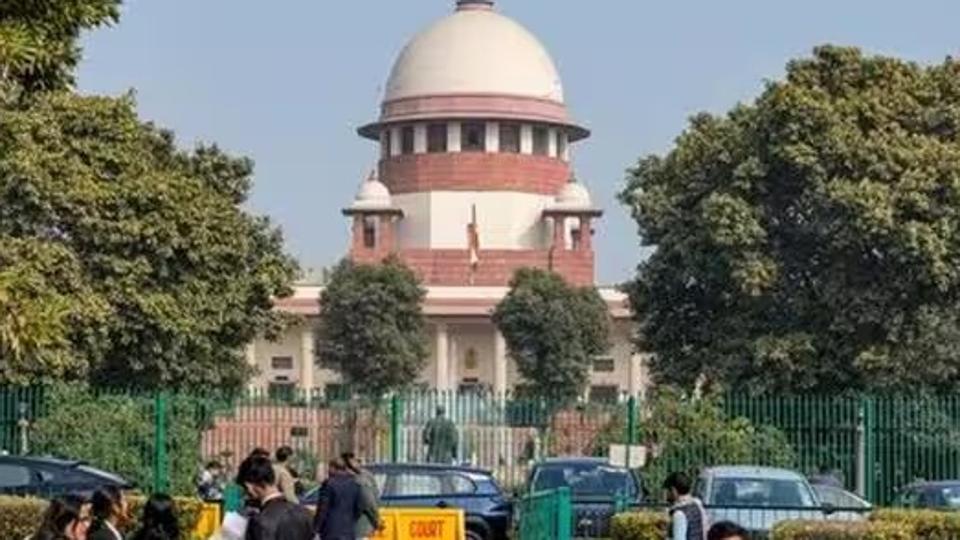
A bench comprising CJI Kant and justices Joymalya Bagchi and Vipul M Pancholi observed that the matter fell squarely within the administrative domain of the Chief Justice and companion judges, and did not warrant a judicial order.
“Do not file such petitions. Such an issue can be considered on the administrative side. You could write to the CJI on the administrative side,” the bench told the petitioner, Badaravada Venugopal, who argued the case in person.
Venugopal informed the court that he had earlier written to the CJI last year, but was informed by the registry that the Supreme Court uses its own emblem. Responding to this, CJI Kant remarked that the earlier response predated his tenure. “That was before November 24, 2025… that was also a view but we can look at this again,” he said, indicating a willingness to revisit the issue administratively.
Also Read: SC refuses to cancel bail of accused in Baba Siddique murder case
The bench then disposed of the petition, directing that it be treated as a representation. It asked the secretary general of the Supreme Court to prepare a note and place it before the competent authority -- the Chief Justice of India. “The issue needs to be dealt with on the administrative side,” the court recorded in its order.
The Supreme Court’s official emblem features the Ashoka Lion Capital placed below the Ashoka Chakra, with the Sanskrit inscription “Yato Dharmastato Jayaḥ” (where there is dharma, there is victory) inscribed below. The emblem, adopted on January 26, 1950—the same day the Supreme Court of India was inaugurated—is an adaptation of the Sarnath Lion Capital representing righteousness, justice and the authority of India’s highest court. The National Emblem, used on currency and government documents, is a slightly different representation depicting four Asiatic lions standing back-to-back (three visible), mounted on a circular abacus featuring sculptures of a lion, bull, horse and elephant, with the Ashoka Chakra at the centre and the motto “Satyameva Jayate” (truth alone triumphs) inscribed below.
In his plea, Venugopal had sought a direction to the Union government and the Supreme Court administration to ensure “statutory and constitutional compliance” in displaying the National Emblem on the principal architectural feature of the court building -- its central dome. The plea argued that if any architectural or structural provision was lacking, appropriate institutional and technical measures should be undertaken to enable such display in accordance with the Constitution and the statutory framework governing use of the State Emblem.
The petition also sought time-bound implementation, preferably within eight weeks, in line with the State Emblem of India (Prohibition of Improper Use) Act, 2005 and the State Emblem of India (Regulation of Use) Rules, 2007.



