
 E-Paper



SC denies nod to Deshmukh, Nawab Malik to vote in MLC polls
The order of the Court came with barely 15 minutes left for the voting to close. On June 17, the Bombay high court had refused permission to both Deshmukh and Nawab to cast votes. They approached the top court against this order


The Supreme Court on Monday refused permission to jailed Maharashtra minister Nawab Malik and former state Home Minister Anil Deshmukh to cast their votes in the election to the Maharashtra legislative council (MLC) going by the legal bar applicable to them under Section 62(5) of Representation of Peoples Act which bars persons in prison from voting in any Parliamentary or state elections.
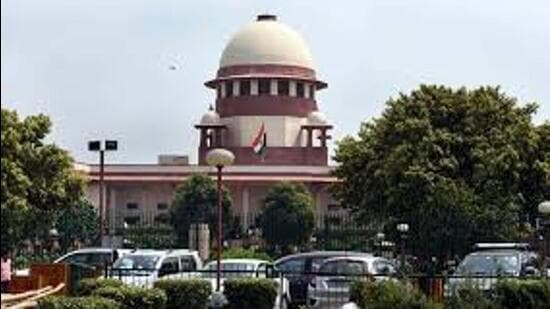
Dismissing their plea to be escorted by police from jail to the state assembly to cast votes before voting ends at 4 pm on Monday, a bench of justices CT Ravikumar and Sudhanshu Dhulia said that in view of the clear bar placed under Section 62(5) of RP Act that has been upheld by the Supreme Court in a 1997 case titled Anukul Chandra Pradhan v Union of India, no interim relief can be granted.
The order of the Court came with barely 15 minutes left for the voting to close. The bench remarked, “Even if we have to give an order releasing you, we have to order you to be taken by a chopper.” The matter was mentioned before the top court on Monday morning when the bench agreed to take it up post-lunch at 2 pm. On June 17, the Bombay high court had refused permission to both Deshmukh and Nawab to cast votes. They approached the top court against this order.
The bench observed, “It is something harsh on you, but what to do, law is harsh.” However, the bench did not dismiss the petitions as it felt that this issue can arise in future cases and agreed to issue notice on the twin petitions seeking responses of the Centre and Maharashtra government within four weeks.
The bench said, “Although the petitioners have not challenged the validity of Section 62(5) of RP Act, we cannot go into that aspect. But this provision is slightly undemocratic. A person who is in police custody can be elected, but he cannot vote.”
Senior advocate Meenakshi Arora who appeared for the two MLAs said, “I am an elected representative of my constituency and people who have sent me to the Assembly, I represent their choice, their right to governance and decision-making. This provision curtails not just my right but that of the electorate.”
Arora pointed out that under Article 171(3)(d) of the Constitution, a constitutional duty is cast on the MLA to elect one-third of the members of the legislative council by casting their vote. “I am seeking a right under Article 171 for purpose of election to legislative council. I have to exercise my vote as MLA, a function that I have to exercise under Article 171,” she submitted, seeking a last minute indulgence faced with the paucity of time.
The bench told Arora to show at least some law which makes a distinction between the right of an elector and that of an elected representative to show the distinction that the right to vote of an elected representative stood on a different footing.
Arora cited a 2007 decision where the Supreme Court allowed the then jailed member of Parliament Mohammad Shahabuddin to be taken under police escort to Parliament for casting vote in the election to the office of Vice-President. She further cited a 2003 decision by a two-judge bench in Peoples Union for Civil Liberties v Union of India which held right to vote to be a constitutional right.
Solicitor General Tushar Mehta appearing for Centre told the Court a Constitution Bench in NP Ponnuswami case (1952) has held that right to vote is a statutory right andby law, even a constitutional right can be curtailed, in this case by Section 62(5). This section does not apply to those detained in jail under preventive detention. As against the petitioners, Mehta said that both face charges under the Prevention of Money Laundering Act (PMLA).
On the SC relief granted to Shahabuddin, Mehta said that the definition election under Section 2(d) of RP Act does not apply to Presidential and Vice-Presidential election.
The bench asked Arora, “When were you arrested. That will be crucial to see if you were arrested just to deprive you of your voting right.” Malik was arrested in March 2022 while in the case of Deshmukh, his arrest took place in November 2021.
Arora said, “These are completely political matters.” Arguing for the two MLAs from the Nationalist Congress Party (NCP), she submitted, “We are 54 MLAs in the House. Each MLA has right to get two members elected to legislative council. The whole purpose is to keep us in custody.”
The bench refused to accept this submission saying, “Are you justified in contending this. You were taken into custody much before that.” The bench further asked the two petitioners if they had sought bail. Arora said that an alternate prayer of bail was taken but the only request pressed is to permit them to cast vote under police escort. Earlier this month, the two MLAs had approached the Bombay high court for casting vote in the elections to Rajya Sabha whch too was declined.
The bench said, “If you vote or not, the seat will be filled. Here there is a statutory provision that says any person in prison shall not be allowed to vote. For academic purpose, we can consider whether this provision should be interpreted differently for elected representatives. But no interim relief can be granted.”
The Bombay HC in its order passed on Friday said, “Purity of electoral process and probity of the participants therein, are also of equal significance in strengthening the democratic principles. One of the objects of prohibition under the RP Act is stated to be arresting the criminalization of politics.”
A total of eleven candidates are in the fray for the 10 seats in the MLC elections with five from the Bharatiya Janata Party (BJP) and six from the Maha Vikas Aghadi (MVA), the coalition ruling the state.


