E-Paper



SC refuses an urgent hearing of hijab pleas
The Karnataka government, represented through solicitor general (SG) Tushar Mehta, told the bench, which also comprised justices AS Bopanna and Hima Kohli, that the controversy is “completely political” and is given a “communal colour” too.

 Prefer HTon Google


Suggesting that the row over the ban on hijab in Karnataka should not be converted into a pan-India issue, the Supreme Court on Friday refused to urgently hear a clutch of petitions against the Karnataka high court order, which restrained students from wearing hijab or any other religious attire to schools and colleges that have prescribed uniforms until it finally decides the legality of the prohibition imposed by the state government.
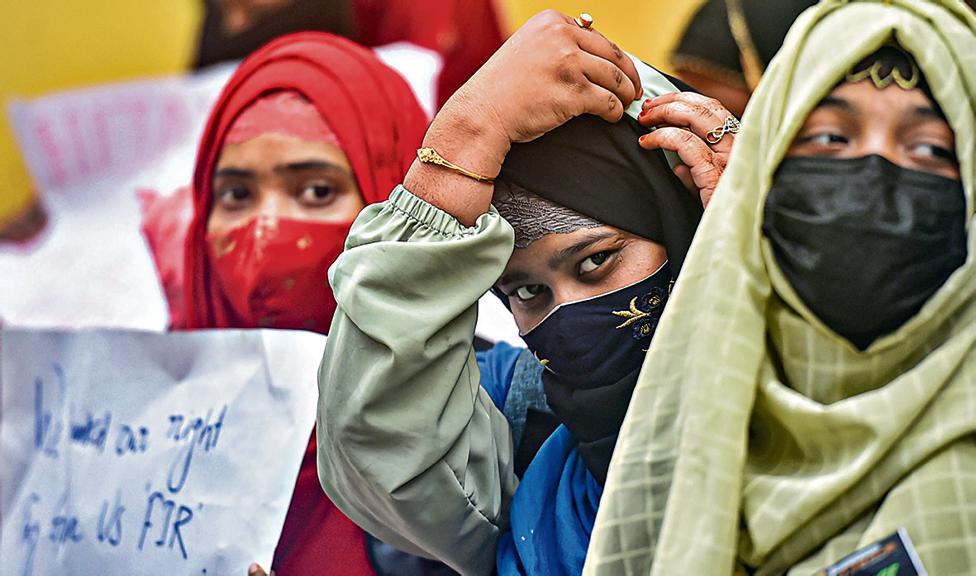
“Don’t spread these things to a larger level...We are also watching. We also know what is happening in the state. You [should] also think whether this is proper to bring such things to a national level,” remarked a bench, headed by Chief Justice of India (CJI) NV Ramana, refusing to specify a date of hearing.
The Karnataka government, represented through solicitor general (SG) Tushar Mehta, told the bench, which also comprised justices AS Bopanna and Hima Kohli, that the controversy is “completely political” and is given a “communal colour” too. The SG added that the Karnataka high court should be allowed to hear and decide the issues.
This is the second day in a row when the CJI declined to involve the apex court in the controversy at the stage on the ground that the high court was already seized of the matter. On Thursday, the CJI refused to give a date for an urgent hearing to a petition for transferring the cases from the Karnataka high court to the Supreme Court.
The court’s indisposition came after senior advocate Devadatt Kamat, representing some girl students from a government college in Udupi, sought an urgent listing of their appeal against Thursday’s interim order of the Karnataka high court.
In a seven-page order that was released on Friday morning, the high court stated: “Ours being a civilized society, no person in the name of religion, culture or the like can be permitted to do any act that disturbs public peace & tranquillity. Endless agitations and closure of educational institutions indefinitely are not happy things to happen.”
Also Read | There is no mention of Hijab in the Quran, says Muslim organisation
“Every citizen has the right to profess & practice any faith of choice, is true. However, such a right not being absolute is susceptible to reasonable restrictions as provided by the Constitution of India... Pending consideration of all these petitions, we restrain all the students regardless of their religion or faith from wearing saffron shawls (Bhagwa), scarfs, hijab, religious flags or the like within the classroom, until further orders,” directed the high court, adding its order is applicable to schools and colleges having dress codes.
The high court further said that it is “pained” by the ongoing agitations and closure of educational institutions since the past few days, especially when issues of constitutional significance and of personal law are being seriously debated before it. “It hardly needs to be mentioned that ours is a country of plural cultures, religions & languages. Being a secular State, it does not identify itself with any religion as its own,” said the high court.
Meanwhile, seeking an urgent hearing against the interim order of the high court, Kamat told the Supreme Court: “It is a strange order that none of the student will display their religious identity. This will have far-reaching repercussions, not only for Muslims but also Sikhs who wear turban. In the midst of the arguments, the court said that it would restrain everyone. My fundamental right under Article 25 (right to practice and profess religion) cannot be suspended like this.”
But the bench told Kamat that the high court is already hearing the matter, and therefore it is not proper for the Supreme Court to interfere at this stage. “We will definitely examine the legal questions and protect everyone. We have to protect the constitutional rights of everyone. That is our obligation. But we will interfere only at an appropriate time. We will take up at the right time,” the CJI told Kamat.
The bench said that the same order would apply to other petitions filed over the same controversy. “The same order will be there in other matters too. We will see at an appropriate time,” it added.
A full bench of the Karnataka high court, comprising chief justice Ritu Raj Awasthi and justices Krishna S Dixit and JM Khazi, is slated to resume hearing the case on Monday.
Following an order by Karnataka chief minister Basavaraj Bommai on Tuesday, all schools and colleges in the state are shut until Friday as a measure to contain the rapidly deteriorating situation amid the hijab controversy. The CM’s order came after week-long protests over the ban on hijab, followed by students from the majority Hindu community turning up to schools and colleges donning saffron shawls to assert their faith, forcing a clash of religious beliefs.
While hearing the case on Thursday, the high court emphasised that it would give precedence to reopening of educational institutions in the state while prohibiting all kinds of religious attire in schools and colleges for the time being.
“Let peace and tranquillity return to the state first. You are before the court. So, have faith in us. We are concerned most about the state and reopening of schools and colleges. We will restrain everyone from adopting any particular attire. This is matter of a few days,” the high court had told the lawyers appearing in the matter.
The high court’s interim order followed a submission by state’s advocate general Prabhuling Navadgi, who urged the bench to make an interim arrangement to enable schools and colleges in Karnataka reopen from Monday. “After hijab, we now have students wearing saffron shawls in colleges. We are saying that nobody should be allowed to press for any particular attire in educational institutions and follow the government’s circular as well as institutions’ dress code,” Navadagi submitted.
To this, the high court said that an interim order has to be passed since the issues involved would require long deliberation on whether hijab is an essential religious practice for Muslim women and thus, constitutionally protected.
Hours before the hearing in the high court, senior advocate Kapil Sibal sought an urgent hearing from the CJI, alleging girls are getting stoned for wearing hijab and schools and colleges are shut in Karnataka following several clashes between students and others.
But justice Ramana refrained from entertaining the request. “We cannot do anything, Mr Sibal. Why should we jump in? Let the high court decide first. Today, the matter is listed before a three-judge bench in the high court,” the judge said.
Sibal was appearing for Fathima Bushra, who is a student of Government PU College in Udupi. The plea seeks a declaration that the government’s order dated February 5 prohibiting hijab in educational institutions was unconstitutional and in breach of fundamental rights of the petitioner and others practising Islam.
Also Read | No hijab in schools till matter is resolved: HC
After the interim order of the high court on Thursday, a large number of petitions were filed before the Supreme Court on Friday morning, seeking the top court’s interference. Petitioners included some girl students and organisations that are already before the high court while a few fresh petitions were also moved before the top court. Congress Youth leader BV Srinivas has also filed a petition, seeking to recognize the right to Muslim girls and women to wear a hijab out of their own choice as a fundamental right.
With just over a year to go for the Karnataka elections, the ban on hijab is perceived by a section as the Bharatiya Janata Party government’s right-wing push. The state government, however, maintains that compliance with uniform code is a must, and that educational institutions have the autonomy to decide on their uniform codes. Karnataka state primary and high school education minister BC Nagesh recently said that the students wearing hijab in Udupi’s Kundapura were allowed to enter college premises as a “courtesy”.