
 E-Paper



SC steps in amid row over pastor’s body in morgue for 15 days
The bench headed by justice BV Nagarathna said that there should be a designated place for people of each religion to bury their dead


The Supreme Court on Wednesday said it expected an amicable settlement and a decent burial of a pastor whose body was lying in a mortuary since January 7 as it reserved its verdict on his son’s plea who was not allowed to bury his father in Chhindawada village of Chhattisgarh following opposition by the local villagers.
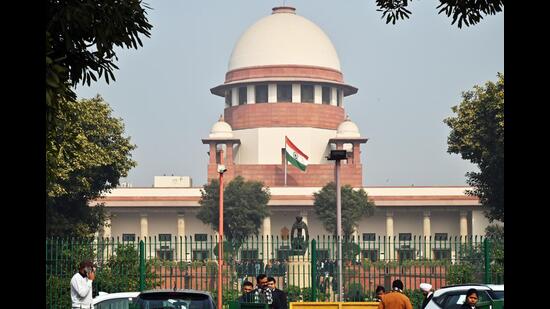
Holding that there should be a designated place for people of each religion to bury their dead, the bench headed by justice BV Nagarathna said, “What we are concerned with is that there should be a graveyard exclusively for Christians which is properly designated and marked, and where there is no interference, interruption or objection from anybody.”
“The body is in the morgue for 15 days, please find a solution. Let the man have a decent burial. There should be an amicable settlement,” the bench said.
Solicitor general Tushar Mehta appearing for the Chhattisgarh government told the bench there is no Christian cemetery in Chhindawada village and the nearest one is situated over 15km away in Karkapal village, where the petitioner Ramesh Baghel can bury his father. Mehta said that the state was willing to provide an ambulance to take the body to the Christian burial ground.
However, senior advocate Colin Gonsalves, appearing for Baghel, pointed out that the state was “discriminating” against Christian converts — a violation of Article 14 of the Constitution which guarantees equality. He pointed out that the petitioner belongs to Mahar caste and some from this community have converted to Christianity.
Gonsalves said the state’s affidavit claiming it was a tradition for Christian tribals to go outside the village for burial was a lie. He placed on record revenue maps of the village and photos of burials of others, and argued there were many cases in which the community members were buried in the village itself.
The bench expressed surprise over the sudden objection of the Hindu tribals, given for years nobody raised objections to the burials of persons from both communities together.
When the court suggested that alternatively the pastor could be buried on his own private land, Mehta objected and said burials should take place only at the designated spot which was 20-30km away.
The apex court then reserved its verdict after hearing the parties.
Mehta said that the village graveyard is used by Hindu tribals and denied any discrimination by the state claiming that it is not used to bury Christians. He further stated that Article 25 of Constitution which provides every citizen right to profess and practice any religion, but subject to public order.
However, the bench, also comprising justice SC Sharma, told both sides, “It is better to settle the issue amicably and all the more better if the body be buried in the designated place for Christians in Kakarpal village...You (state) may also put up a board saying it is designated for Christians.”
According to Baghel, Chhindawada village had a graveyard which was verbally allotted by the gram panchayat for burial and cremation of bodies.
“There is no discrimination at all,” the court said, “We should bear in mind the fact that in some villages, the (Christian) community may be less in number. In certain villages, they may be more....All we want there should be a designated place for burying the dead as per their religious rites.”
The petitioner had approached the top court challenging an order of the Chhattisgarh high court passed on January 9 refusing to grant him any relief. The bench said, “The high court has not been able to find a solution. It should not have reached there.”
The state in its affidavit told the court that in the past few years, disputes have risen between the Mahar Christian community and the tribal community with the latter denying spaces to bury Christians in their graveyard.
The Chhindawada village has a total population of 6,450 of which 6,000 belong to the tribal community while 450 are from Mahara community. Of the 450, Hindu Mahars constitute a majority with only 100 among them being Christians, the state affidavit said.


