E-Paper



SC urges President to decide Balwant Rajoana’s mercy plea in two weeks
Rajoana, sentenced to death in 2007 for his role as a backup bomber in the blast that killed Beant Singh and 16 others, has been seeking the commutation of his death sentence to life imprisonment

 Prefer HTon Google


The Supreme Court on Monday urged President Droupadi Murmu to decide the long-pending mercy petition of Balwant Singh Rajoana, a Babbar Khalsa sympathiser convicted in the 1995 assassination of former Punjab chief minister Beant Singh, within two weeks. The court added that if no decision is made before the next hearing on December 5, it would consider Rajoana’s plea to release him temporarily.
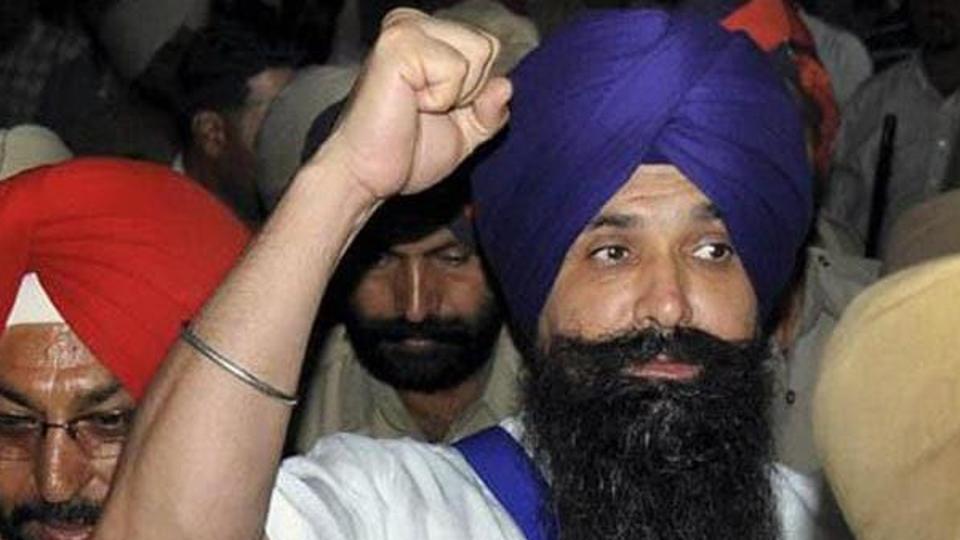
Rajoana, sentenced to death in 2007 for his role as a backup bomber in the blast that killed Beant Singh and 16 others, has been seeking the commutation of his death sentence to life imprisonment. His mercy plea, filed by the Shiromani Gurdwara Parbandhak Committee (SGPC) in 2012, remains pending, raising questions about the delay.
Expressing displeasure over the absence of any representative from the central government during the hearing, a bench of justices Bhushan R Gavai, Prashant Kumar Mishra and KV Viswanathan noted that the matter had already been adjourned previously on a request by solicitor general Tushar Mehta to allow the Union government to take instructions.
Also Read: Beant Singh assassination: SC to hear Rajoana’s plea for commutation of death sentence on Nov 4
In its written order, the bench stated: “None appears on behalf of the Union of India while the bench has assembled today specifically for this matter. On the last date, the matter was adjourned to enable the Union of India to take instructions from the office of the Honourable President of India as to how long it will take for the mercy petition to be decided. However, nobody appears for the Union today. Taking into consideration that the petitioner has been on the death row, we now direct the secretary, Honourable the President of India, to place the matter before the Honourable President with a request to consider the matter within two weeks.”
In the event no decision is taken, the order added, the bench will consider placing the matter for interim relief pressed by Rajoana. The court scheduled the next hearing for December 5, at 10:30am.
The issue of Rajoana’s release carries significant political and national security implications. He was linked to the Babbar Khalsa, a militant Sikh separatist group responsible for violent activities during the insurgency in Punjab. His release is a sensitive issue for both the families of terrorism victims and the political dynamics in Punjab, raising concerns about the resurgence of pro-Khalistan sentiment.
During the proceedings, senior advocate Mukul Rohatgi, representing Rajoana, argued for interim relief for his client, who has been on death row for over 20 years. Rohatgi highlighted the prolonged delay, stating: “Others convicted in the same case were granted relief by this court. This court converted their death sentences to life imprisonment, and now they are out. How is this delay justifiable for my client?”
The Punjab government, on its part, sought to distance itself from the issue, with its counsel contending: “We have no role to play. It is for the Union to decide as they say it is pending with the President.”
However, the bench questioned this stance, pointing out: “The offence happened in Punjab. The Union filed an affidavit previously saying it’s a matter of national security. How do you say you don’t have any role?”
At this point, the bench enquired about SG Mehta, who represents the Centre in this matter, and appeared during the previous hearing on November 4 when the law officer confirmed that the mercy plea was likely still under consideration with the President and requested additional time to verify its status. In wake of the Centre’s contention, the court had on the day observed that it would not consider Rajoana’s release without first understanding the status of his mercy plea pending with the Centre.
Rajoana, a former Punjab Police constable, was convicted for his involvement in a suicide bombing outside the Punjab Civil Secretariat in Chandigarh on August 31, 1995. The blast killed Beant Singh and 16 others, and Rajoana was identified as the backup bomber. A special court sentenced him to death in July 2007, a decision upheld by the Punjab and Haryana high court in 2010.
Rajoana was scheduled for execution on March 31, 2012, but the sentence was stayed following a mercy plea filed by SGPC. Since then, the plea has remained pending, with successive governments citing national security concerns for the delay.
In 2019, the Ministry of Home Affairs (MHA) proposed commuting Rajoana’s sentence as a gesture marking the 550th birth anniversary of Guru Nanak Dev. However, this proposal was never formalised, and Rajoana moved the Supreme Court in 2020 to challenge the delay.
During the hearing of this petition, the Union government and the Central Bureau of Investigation (CBI) opposed his release, citing concerns about national security and the potential for unrest in Punjab, a border state. The Centre has argued that any decision on the mercy plea must consider the state’s security scenario and the potential resurgence of separatist sentiments. The CBI has also pointed to pending criminal appeals in related cases, urging that these be resolved before any decision on Rajoana’s clemency.
Finally, on May 3, the Supreme Court wrapped up his plea noting that MHA’s decision to defer the decision on Rajoana’s mercy petition on the ground of national security and law and order situation “actually amounts to a decision declining to grant the same for the present”. It rather allowed the Centre to consider his mercy plea “in due course”.
A year on, Rajoana’s filed the current petition through advocate Diksha Rai, maintaining that he is “neither a member of any anti nationalist organisation and nor has he ever subscribed to their views”, and therefore, the commutation of his sentence cannot be stalled by citing grounds of national security or public order. It added that inordinate delay in execution of a death row convict’s sentence and a final decision on his mercy petition has consistently been recognised by the apex court to invoke its powers under Article 32 to commute death sentence to life imprisonment.
“Keeping him in suspense, while consideration of his mercy petition by the Hon’ble President of India remains pending for years on end is an agony, which has created adverse physical conditions and psychological stresses on the petitioner, who has now been in jail for the past 28 years and 07 months, confined to a capital punishment cell of 8” x 10” for the last 17 years,” read the petition.