
 E-Paper



Self-reliance in defence critical for India in 21st century: PM Modi
The PM’s comments came during an address at the Naval Innovation and Indigenisation Organisation (NIIO) seminar ‘Swavlamban’ that brought stakeholders together to bolster ‘aatmanirbharta’ (self-reliance) in the navy – the service aims to induct at least 75 new indigenous technologies and products.


India’s defence imports dipped 21% in the last five years and exports hit a record ₹13,000 crore last year, powering the country’s drive from being one of the world’s biggest weapons importers, to an exporter of military hardware, Prime Minister Narendra Modi said on Monday, even as he stressed that the goal of attaining self-reliance in defence was critical for the country in the 21st century and innovative indigenous solutions were important for future challenges.
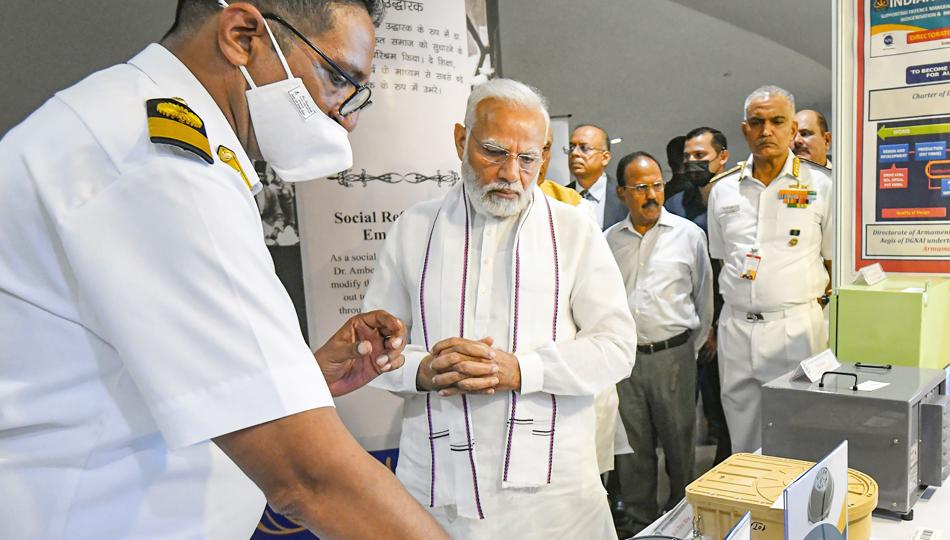
The PM’s comments came during an address at the Naval Innovation and Indigenisation Organisation (NIIO) seminar ‘Swavlamban’ that brought stakeholders together to bolster ‘aatmanirbharta’ (self-reliance) in the navy – the service aims to induct at least 75 new indigenous technologies and products.
Also Read| Defence ministry to allow private companies to develop military helicopters
He said the government had not only hiked the defence budget during the last eight years, but also taken steps to ensure the outlay was used for the growth of the local defence manufacturing ecosystem, with a significant portion of the money allocated for buying military hardware from Indian companies.
India’s military imports dropped 21% between 2012-16 and 2017-21, according to report published by Stockholm International Peace Research Institute (Sipri) in March. Also, defence exports touched the ₹13,000-crore mark in 2021-22, with the private sector’s share pegged at 70%, according to defence ministry data.
“We have to work continuously to increase the number of indigenous technologies. Your goal should be that when India celebrates 100 years of its independence, our navy should be at an unprecedented height (of indigensiation),” the PM said.
Among all types of indigenisation that India is pursuing, the most important is indigenisation in the defence sector, said Air Marshal Anil Chopra (retd), director general, Centre for Air Power Studies. “That’s because it involves the security of the nation and the reliability of supply chains has to be ensured. Also, no country wants to part with top-end defence technology that we need to develop on our own,” he added.
In his address, the PM also drew attention towards the importance of innovation and arming Indian soldiers with the best weapons. “Innovation is critical and it has to be indigenous. Imported goods can’t be a source of innovation.”
Also Read| Defence ministry sets up panel for performance, efficiency audit
He also called for a change in mindset and the need to move away from imported goods.
He said it was vital to take pride in indigenous weapons and systems for the world to acknowledge the country’s capabilities.
He said the government had infused new strength into India’s public sector defence companies by organising them in different sectors, in line with their expertise.
“We are making sure that we connect our premier institutions like IITs [Indian Institutes of Technology] with defence research and innovation. Learning from the approach of past decades, we are developing a new defence ecosystem with the strength of everyone’s efforts. Today, defence R&D has been opened for the private sector, academia, MSMEs and start-ups,” he said.
The PM said the dynamics of national security were no longer confined to land, sea and sky, and the threats had become far more complex — highlighting challenges in space, cyberspace, economic and social domains. He said it was important to anticipate future challenges and adapt, and self-reliance would help the country a great deal in staying prepared.
Modi said the wait for commissioning of the country’s first indigenous aircraft carrier (IAC) Vikrant – the largest warship to be built in India - will be over soon. The navy is set to commission Vikrant around Independence Day next month, and the carrier will significantly boost the country’s naval presence and its reach.
Speaking at the same event, defence minister Rajnath Singh said self-reliance not only meant overcoming economic constraints, but also achieving decisional autonomy for the country by overcoming diplomatic constraints. “The self-reliance efforts in the defence sector, under the guidance of the PM, have transformed India’s image and we will soon become a global manufacturing hub,” he added.


