
 E-Paper



Shah slams Nehru’s ‘blunders’ as 2 bills on J&K passed by LS
Two bills on Jammu and Kashmir were passed in the Lok Sabha on Wednesday, as Union home minister Amit Shah lashed out at India’s first Prime Minister Jawaharlal Nehru for what he termed historic blunders, said previous governments contributed to people’s sufferings, and defended his administration’s record of bringing development and ending terrorism in the region


Two bills on Jammu and Kashmir were passed in the Lok Sabha on Wednesday, as Union home minister Amit Shah lashed out at India’s first Prime Minister Jawaharlal Nehru for what he termed historic blunders, said previous governments contributed to people’s sufferings, and defended his administration’s record of bringing development and ending terrorism in the region.
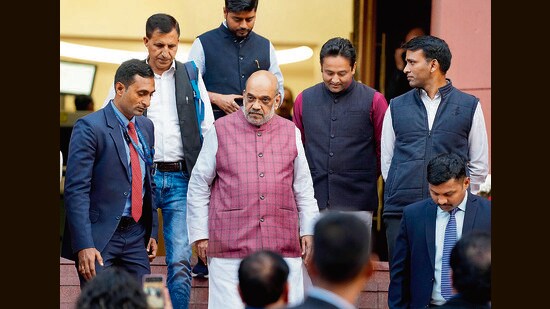
Shah said Nehru erred in announcing a ceasefire after the 1948 conflict with Pakistan and then going to the United Nations, and added that Pakistan occupied Kashmir (PoK) would have been a part of India if correct steps were taken. He also hit out at the Congress over backward classes welfare.
“Nehru himself wrote to Sheikh Abdullah admitting that when our army was winning, we should not have agreed to the ceasefire. He himself admitted they could have negotiated better (at the UN). PoK, which is ours anyway, would have been with us today if rights steps were taken. So much land of the country was lost. I say these were not mistakes. These were two historic blunders,” he said.
“I support the word that was used — Nehruvian blunder. Because of the blunder that was committed during the time of Nehru, Kashmir had to suffer. With responsibility, I want to say that the two big blunders that happened during the tenure of Jawaharlal Nehru, happened due to his decisions, because of which Kashmir had to suffer for years,” Shah said.
Shah’s comments came while replying to the debate on the two bills — the Jammu and Kashmir reservation (Amendment) Bill, 2023, and Jammu and Kashmir Reorganization (Amendment) Bill, 2023. The two pieces of legislation were introduced in Parliament on July 26 but were taken up for discussion on Tuesday.
In the speech, Shah asserted that Kashmiri Pandits had to leave their homes because of the “vote bank” politics by parties in Kashmir, but Prime Minister Narendra Modi had ensured that these people get their rights.
The home minister said that Modi was the only leader who worked towards wiping the tears of Kashmiri Pandits, who had to leave their homes and live in camps during the exodus in 1990. “We found the solution and steps have been taken to return the properties to the rightful owners,” Shah said.
The home minister’s comments led to an uproar in the House, with Congress leaders terming it as an insult to the former PM. The Congress later staged a walkout.
During his speech, Congress floor leader Adhir Ranjan Chowdhury said, “Our current Prime Minister Narendra Modi ji had announced that the distance (between J&K) and Delhi as well as the heart will be reduced. Have you been able to bring J&K closer?”
He also challenged the government to have “full discussion on Nehru and Kashmir, the truth and the shortcomings”.
The J&K reservation bill seeks to provide reservation in jobs and admission in professional institutions to scheduled castes, scheduled tribes, and other socially and educationally backward classes. The amendments seek to reword Section 2 of the Reservation Act to change the nomenclature of “weak and under privileged classes (social castes)” to “other backward classes” and make consequential amendments.
“The bill that I have brought here pertains to bringing justice to and providing rights to those against whom injustice was done, who were insulted and those who were ignored. In any society, those who are deprived should be brought forward. That is the basic sense of the Constitution of India. But they have to be brought forward in a way that doesn’t reduce their respect. There is a huge difference between giving rights and giving rights respectfully. So, instead of weak and deprived category renaming it to Other Backward Class is important,” Shah said.
The J&K reorganisation bill provides for the reorganisation of the erstwhile state of J&K into the Union Territories of Jammu and Kashmir (with an elected legislature) and Ladakh (without an elected legislature). It seeks to increase the number of seats to 90 from 83 in J&K assembly — a number fixed by the delimitation commission earlier this year. It also reserves seven seats for scheduled castes, nine for scheduled tribes, two for Kashmiri migrants and one for displaced people from PoK.
“Earlier there were 37 seats in Jammu which has now become 43, there were 46 seats in Kashmir which has now become 47, and 24 seats have been kept reserved for Pakistan-occupied Kashmir because POK is ours,” Shah said. “Earlier there were 107 seats in the Jammu and Kashmir assembly, now there are 114 seats, earlier there were two nominated members in the assembly, now there will be five,” he added.
Shah said that two bills aimed to provide rights to those who faced injustice and were ignored for decades — a reference to Kashmiri Pandits.
“They lived in their own country as refugees. Giving rights is fine but giving rights with respect is what matters more. This bill will give them back their rights to jobs, education, and contest elections through reservation,” he said.
During the debate on the two bills, several Opposition leaders questioned the need for bringing the new laws and on the impact of the effective abrogation of Article 370, which bestowed special status to the erstwhile state, four years ago.
Shiv Sena (Uddhav) MP Binayak Raut asked that while the bills provide for representation of migrants and those living in Pakistan occupied Kashmir, “when will they benefit in reality?”
Demanding elections in J&K, he said, “Many members have said that elections have not taken place and no one knows whether the polls would be held or not. If the people there are getting properly represented in the bill, then the assembly elections in Jammu and Kashmir should also be announced as soon as possible.”
But Shah brushed aside the criticism. He said Article 370 was the root of all separatism and subsequent terrorism in the Valley and added that militancy had ebbed since the special status was scrapped on August 5, 2019.
“On August 5-6, 2019, those (Kashmiri) voices which were not heard for decades were heard. Around 46,631 Kashmiri Pandit families were displaced from their own homes and land, which was grabbed. Nobody thought about them. Rather, those who should have stopped this exodus were holidaying in London,” he said.
“Article 370 was responsible for the death of 45,000 people in Jammu and Kashmir, which was abrogated by PM Modi.”
On terrorism, Shah said terror incidents in the Valley dipped by 70% compared to the period between 2004 and 2014; civilian and security personnel deaths were 72% and 59% lower, respectively, and there were zero incidents of stone pelting now.
Besides, for the first time in 30 years, a cinema hall and a multiplex have opened in the region, and a record 20 million tourists have travelled there, Shah added.
The home minister said a zero-terror plan, which was prepared for J&K and worked on for the past three years, will be completed by 2026. When Congress floor leader Chowdhary challenged him to have a full-day debate on the so-called mistakes of Nehru, Shah said he was ready to debate on the issue “anytime”.
“Through these bills, every oppressed, backward and displaced Kashmiri will remember the efforts and blessings of the Lok Sabha that the Narendra Modi government has given reservation of two seats to provide justice to the brothers and sisters of their own country who were displaced since last 70 years,” Shah said.


