E-Paper



Gujarat: 6 dead after cargo ropeway breaks down at Pavagadh Hill temple
The cargo ropeway trolley, used for carrying construction material up the hill, fell from the fourth tower after the cables snapped.

 Prefer HTon Google


Ahmedabad: Six people were killed on Saturday afternoon after a cargo ropeway trolley collapsed at the Shaktipeeth site on Pavagadh Hill in Panchmahal district of Gujarat, police said.
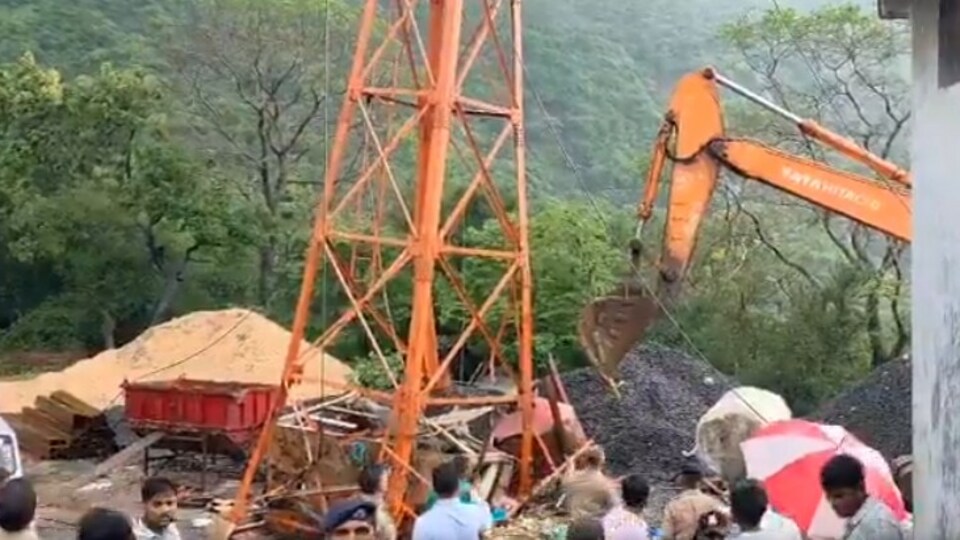
The cargo ropeway trolley, used for carrying construction material up the hill, fell from the fourth tower after the cables snapped around 3:30 pm.
“It was a ropeway to carry goods that crashed at noon today. Five persons were inside the cabin and on their way back from the top when the cables snapped near the fourth tower and it crashed with tower number one so this is where the impact came, killing all five. One person who was at the scene also died due to the impact,” Ajay Dahiya, collector of Panchmahals, told HT. Dahiya said that he has ordered the formation of a technical committee to investigate the cause of the incident. He said the operator for the goods ropeway was hired by the temple trust.
Dahiya said that all the deceased have been identified and confirmed that there were no injured persons and no additional casualties. He has ordered the formation of a technical committee to investigate the cause of the incident. “We will investigate all aspects, especially the maintenance part,” said Dahiya while adding that the operator for the goods ropeway was hired by the temple trust.
“The deceased include three local residents, two from Kashmir, and one person from Rajasthan. We are investigating the exact cause of the incident,” Inspector General of Police, Godhra-Panchmahal range, Ravindra Asari said.
According to police, the passenger ropeway, which ferries pilgrims to the Kalika Mata Temple, was shut due to bad weather, but the goods ropeway remained in use for ongoing construction activities.
Police have identified the deceased and sent the bodies for postmortem. “Annaji alias Bhairavlal Ratilal Jat from Gitawas in Rajasthan, who worked at a hotel; Mohammed Anwar Mahmad Sharifkhan and Balvantsingh Dhaniram, both residents of Rajouri in Jammu and Kashmir, were employed as ropeway operators; Dilipsinh Narvatsingh Koli was deployed as temple security; Hiteshbhai Hasmukhbhai Baria, working at the temple’s food service facility; and Sureshbhai Rayjibhai Koli, a flower trader,” an officer said.
Police, fire brigade teams, and district officials reached the spot and began rescue work.
The Pavagadh ropeway, built in 1986, is a mono-cable gondola system that carries pilgrims from the base station to near the Kalika Mata Temple, which is part of the Champaner-Pavagadh Archaeological Park — a United Nations Educational, Scientific and Cultural Organisation (UNESCO) World Heritage Site. Construction work was underway to upgrade facilities and improve pilgrim amenities.
The Panchmahal district administration has ordered an inquiry to determine the cause of the rope snapping and to review the maintenance and operational safety of the system. “Officials are examining whether the trolley was carrying material beyond its load capacity and if there were lapses in routine checks,” an official said.
The passenger ropeway is operated and maintained by Usha Breco Limited, which has been running the service since it was commissioned in 1986.
The Pavagadh ropeway has witnessed a major accident in the past. In January 2003, a hauling rope snapped, causing three cable cars to fall, killing seven persons including two women and a child, and injuring 24. The incident had led to large-scale rescue operations involving the army and air force and prompted a detailed technical review before services resumed.