
 E-Paper



SC directs day-to-day hearing from Aug 2 of pleas related to Article 370
Constitution bench of Chief Justice DY Chandrachud and justices SK Kaul, Sanjiv Khanna, BR Gavai, and Surya Kant set July 27 as last date for filing documents.


The Supreme Court on Tuesday directed day-to-day hearing, from August 2, of a clutch of petitions against nullification of the Constitution's Article 370, which gave Jammu and Kashmir (J&K) semi-autonomous status even as it allowed bureaucrat Shah Faesal and former student leader Shehla Rashid to withdraw as petitioners.
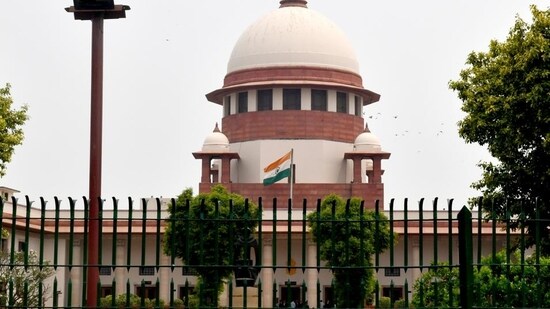
A five-judge constitution bench of Chief Justice of India (CJI) Dhananjaya Y Chandrachud, justices Sanjay Kishan Kaul, Sanjiv Khanna, BR Gavai, and Surya Kant fixed July 27 as the deadline for filing of documents and written submissions by parties while observing it is a pure question of constitutional validity. It took up the matter after over three years. Parliamentarians from the National Conference are among those who have challenged the nullification.
In August 2019, the court issued notices on the pleas and referred the matter to a five-judge constitution bench despite resistance from the Union government citing international and cross-border implications.
The government then argued that it was a sensitive matter and whatever happens in the country over it would be raked up at the UN.
What did the Union government say?
The Union government on Tuesday made a statement that it would not rely upon the contents of the affidavit it filed a day ago to bring on record the scenario in J&K after the nullification.
It told the court on Monday that the nullification has led to 'unprecedented development, progress, security and stability' in the region. It added that 'life has returned to normalcy in the region after three decades of turmoil'.
READ | Normalcy, peace returned in J&K after Article 370 abrogation: Centre
The government defended the 2019 presidential order that rescinded the special constitutional status of J&K and bifurcated the state into two Union territories. In its affidavit on Monday, it said that the nullification of Article 370 led to the dismantling of the terror network, and incidents of stone pelting and street violence have 'now become a thing of the past'.
Petitions listed in March 2020
The bunch of petitions challenging the nullification of Article 370 was last listed in March 2020 when a five-judge bench declined to refer the matter to a larger bench. The reference was sought on the grounds that the two previous judgments of the apex court were conflicting with each other.
But the bench did not agree with this contention.
At that time, it was noticed that there was also an older batch of petitions pending in the Supreme Court that challenged the validity of Articles 370 and 35A. The bench pointed out that all the matters related to Article 370 should be preferably heard together.
What do the petitions say?
Some petitioners brought up the requirement of consent from J&K’s erstwhile constituent assembly for the abrogation of Article 370, while others questioned the validity of the President’s rule that was in effect when it was made.
Some of the pleas went back to J&K's Instrument of Accession with India. Others highlighted the Supreme Court's ruling of 2018 that observed that Article 370 had gained a status of permanence.
Many petitions have also challenged the Jammu and Kashmir State Reorganization Act by which the state was bifurcated into two Union Territories with effect from October 30, 2019.
In its affidavit, the Union government emphasised that due to the non-application of the Constitution and non-applicability of several beneficial central legislations to J&K prior to the nullification of Article 370 on August 5, 2019, there were obvious constraints that resulted in the alienation of the region. It said the alienation was fuelled by the secessionist forces and terrorists with cross-border support - both financial and otherwise.


