E-Paper



Cyclone Biparjoy: Restoration process begins after cyclone leaves trail of destruction in Gujarat
Cyclone Biparjoy: In areas across coastal Gujarat like Bhuj and Dwarka, people stayed off the roads, and businesses such as hotels, restaurants and petrol stations remained shut.

 Prefer HTon Google


Thirty kilometres from the Jakhau port, where cyclone Biparjoy made landfall on Thursday evening, 48-year-old farmer Mubarak Jagan spent the last two days inside a government school, listening to the sounds of the violent wind and pouring rain outside. All that time, he wondered what the damage to his property would be, but was grateful that he was safe. Every one of the 75 families in his village of Kosha were evacuated from their homes, part of a massive exercise in the state to take over a hundred thousand people to safety as one of the most intense cyclones in the Arabian Sea bore down on the country’s west coast.
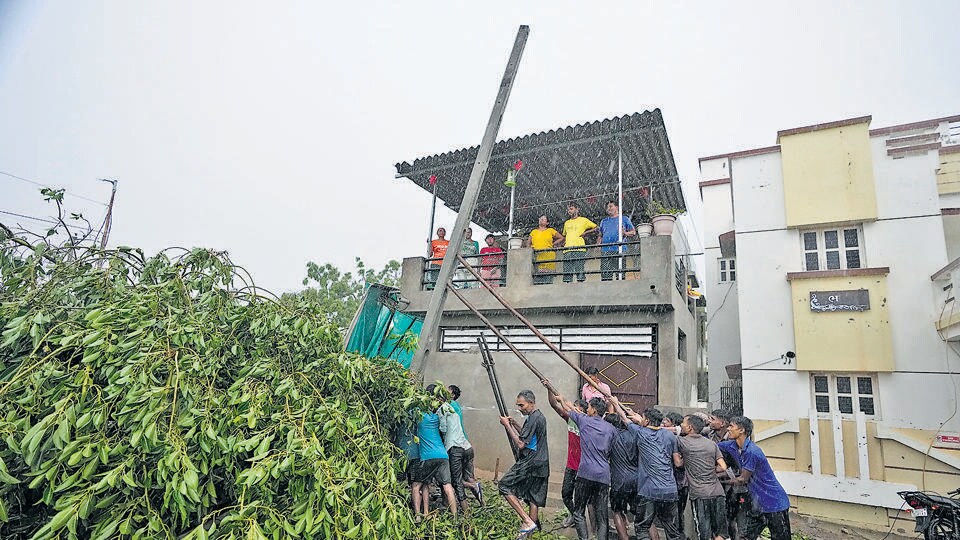
On Friday evening, the winds still howled but the worst had passed, and Jagan went back home. The roofs of the animal shelters he had built, which his family used as temporary homes during the summer, had all been swept away. “We were relocated two days ago, and there is some damage, but at least we are alive. There is no electricity and we are using our tractors to charge our phones,” Gajan said.
In areas across coastal Gujarat like Bhuj and Dwarka, people stayed off the roads, and businesses such as hotels, restaurants and petrol stations remained shut. Dwarka district collector MA Pandya said teams from the government had spent four sleepless nights, relocating 12,000 people into safe houses, arranging logistics like cooked meals from makeshift but functional in-house kitchens. “Despite facing winds reaching speeds of up to 120 k/hr for 12 hours, the district has fortunately not reported any casualties,” Pandya said.
In all, 249 villages were affected in the district. Pandya said that the district administration, like others around Gujarat, were being careful in allowing people to return home. A key consideration through Friday was electricity, with 13,000 power towers affected in Dwarka alone. Officials said efforts were underway to restore supply and clear roads blocked by fallen trees. “For the past three days, there has been no electricity. The power lines are faulty, and the restoration process is still underway,” said Bharmal Sanjot, a Kutch resident.
“Fortunately, our village has not suffered much damage. But I have heard that the cyclone has caused significant destruction to the trees and greenery in Banni, known for its grasslands, greenery, and diverse wildlife,” Sanjot said.
On Gujarat’s wind and rain swept roads, all travel came to a standstill with truckers cowering under whatever shelter they could find. Ismail Shaikh, one such driver, said he had not heard from his family since Thursday as his phone battery was dead. “I had unloaded goods from Delhi to the Kandla port and was supposed to carry more goods from Mundra to Haryana, but now have to wait because of the storm,” Shaikh said, while stranded at a roadside food stall, about 40 kms from Mundra and 30 kms from Gandhidham.
Mohammad Kasam, another truck driver from Gujarat’s Bhuj who was to ferry electricity material for post-cyclone restoration work, said he was awaiting orders. “I am waiting for instructions... but so far, there is no word. ...I cannot venture out due to heavy rainfall and strong winds,” said Kasam.