E-Paper



Odisha train accident: ‘Sparks were flying around, no memory of how I exited coach’
As the train came to a shuddering halt, sparks started flying around, says a survivor.


At 6.45pm on Friday afternoon, Manikal Tewary took out his mobile phone, and began recording. The 50-year-old garments trader from Balasore had boarded the Coromandel Express at 6.30pm, heading to the trading centre of Cuttack, 170 kilometres away; a journey he would make at least twice a week.
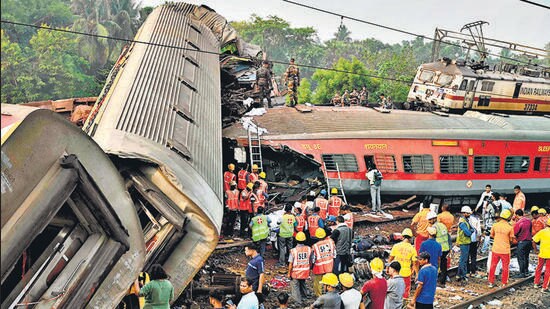
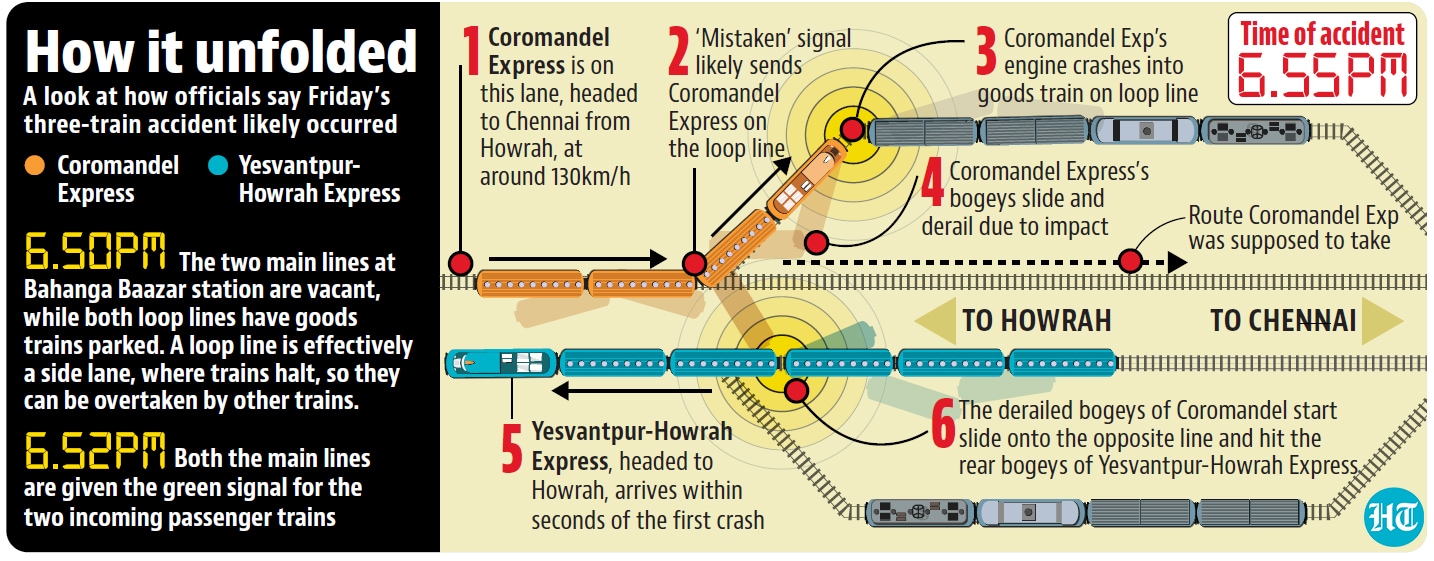
He found a seat in coach S1, towards the front of the train, next to the window, marvelled at how fast the train was going, and hit record. But in that one innocuous press of a button, Tewary seemed to foretell a tragedy. His phone still recording, he captured the devastating moment when the Coromandel Express collided into a stationery goods train, the front of the train including S1 completely mangled, its derailed compartments to the back then crashing into another passenger train running on a parallel track.
“Even before he could finish recording, his coach was tossed in the air, hurling him around. In a matter of seconds, he suffered a broken ribcage, and deep injuries on his head and arm,” said his elder brother Chandanlal Tewary.
The coach quickly became dark, smoke filling the cabin. Manikal Tewary, miraculously, with a bleeding head and hand, still had consciousness. Most around him didn’t.
“As the train came to a shuddering halt, sparks started flying around. I tried to grab my hand but I couldn’t find it. I have no memory of how I exited the coach. But I remember I stepped on severed hands and bodies. I just kept walking,” Manikal Tewary said.
Disoriented and traumatised, Manikal Tewary started walking on the tracks, and tried to call his brother from the phone in his hand, still miraculously working. “He called me, but I did not take his call,” Chandanlal Tewary said.
Manikal found a good Samaritan, who took him to the primary health centre at Khantapada.
“When the doctors heard about my brother’s survival they did not believe it; S1 coach was totally mangled, and had very few survivors. A young couple seated in front of him got badly hit. The man died, while his wife survived,” he said.
Some compartments behind where Manikal Tewary sat on the Coromandel Express, 20-year-old Subhranshu Behera stood in the coach meant for the physically handicapped, after he and his uncle found no room in the general compartment. This was not unusual, Behera said; the train routinely carried workers from the East to the South on a daily basis.
“We had planned to return to the general coach at Khurda on our way to Chennai. I remember I was talking to my mother on the phone. The next thing I remember is the coach turning turtle, and I was thrown around with other passengers. I groped for my uncle in the dark but couldn’t find him,” Behera said.
Bleeding, and surrounded by torn limbs and prone bodies, Behera began to cry, and stumbled into a paddy field, and lost consciousness. “Someone then saw me lying on the paddy field and took me to the primary health centre in Gopalpur where I called up my parents to take me home,” said Behera, who is yet to find his uncle.
Sanatan Bera, 38, also survived the crash, and with mild injuries, arranged to return to East Midnapore. “For a few moments we thought this was the end. But luckily, our coach, S2, suffered less damage than S1 and the unreserved compartments. My right elbow and right leg have been fractured. I was travelling to Chennai with my brother, Chandan, who is also injured. We and some of the other passengers wanted to return to Bengal as fast as possible, so we hired a vehicle,” Bera said.
But if Bera was back home in East Midnapore by the evening, at 2pm on Saturday afternoon, the family of 38-year-old Ramesh Jena walked fearfully across 180 bodies laid out haphazardly at the Bahanaga High School, searching for him. Jena worked as a tea-seller in Chennai and had returned home to Balasore only 20 days ago because his mother had died. Only on Friday did Jena muster the courage to return to his city of work. On Saturday morning, Umesh Jena, his brother, received a phone call, where he was briefly told, that the family had lost Jena too. “But I have not found him yet. He is not in the school. I’ll go next to the local community health centre. Until I find him, there is still hope that he is alive,” Umesh said.