
 E-Paper



Tamil Nadu, central funds and National Education Policy
School education minister Anbil Poyyamozhi that the BJP government at the Centre is “paving the way for another language war” reveals the perception and preparedness the state government

 Prefer HTon Google


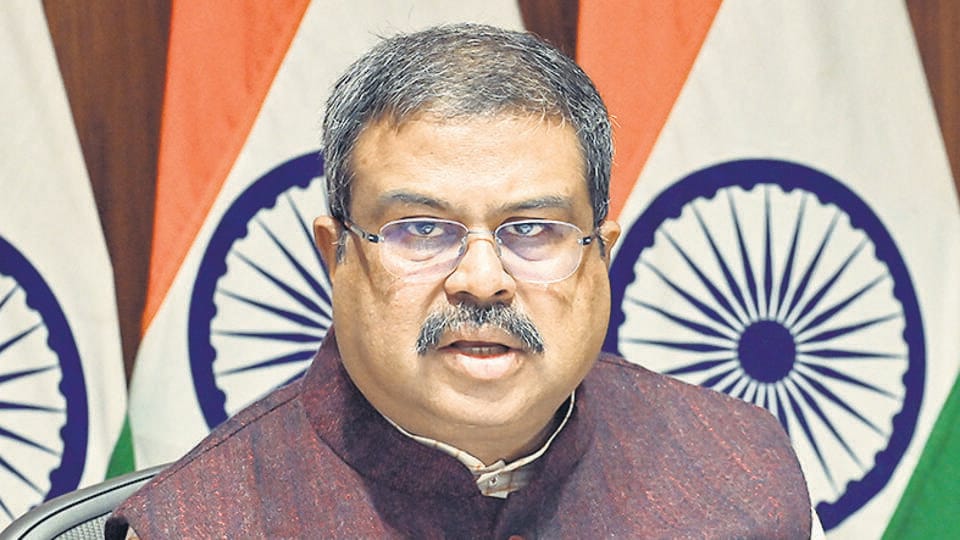
The categorical statement of education minister Dharmendra Pradhan of the Narendra Modi-led government at the Centre that unless the Tamil Nadu government accepts the National Education Policy(NEP), 2020, in its entirety, the funds under the Samagra Shiksha scheme will not be released for the state. It is equally surprising that the education minister made this unprovoked statement with riders to the historical debate in this country, linking the non-release of funds over ₹2,158 crore due to the state. The minister said: “They cannot think they are above the constitution and they must accept the NEP in letter and spirit,” and further charged “ they are divisive people.” He responded to a question if the funds would be withheld indefinitely, it is based on law. He also wanted to know that why the Tamil Nadu government would not follow the established framework of governance? All these war of words ironically were made from the platform of the Kashi Tamil Sangamam in Varanasi, Uttar Pradesh — an annual cultural-political occasion to celebrate and foster the unity of this country.
The response of Tamil Nadu school education minister Anbil Poyyamozhi that the BJP government at the Centre is “paving the way for another language war” reveals the perception and preparedness of the state government. He questioned the Centre’s insistence on the implementation of the three-language policy in Tamil Nadu when the state’s two-language policy has been followed for decades without any negative impact. He further quoted CN Annadurai (founder of DMK and former chief minister of Tamil Nadu) on his X post that “we are asking for rights, not a favour. We ask for what is lost, not a loan. We are asking for what was snatched from us, not alms”. He added that “as long as those in the north fail to understand this, it is impossible to suppress their arrogance”.
It is vital to recognise that over 4 million students and 32,000 teachers depend on the resources from the Centre, and the Tamil Nadu government is spending ₹76 crore each month and ₹920 crore per year on teacher salaries from its resources. There is an additional responsibility of ₹400 crore annually for the Right to Education (RTE) scheme which keeps increasing due to the lack of support from the Centre. Several schemes related to protected of girl children are not being implemented due to denial of funds. A key question is whether the central education minister is aware that withholding of funds directly affects education for millions of students and teachers and linking that the Tamil Nadu government must accept the NEP, 2020 is tantamount to forcing the closure of any dissent against the NEP, 2020 but also the 78 years old language policy debate in this country.
Pradhan’s statement that Tamil Nadu has to come to the terms of the Constitution of India and that the three language policy is the rule of law sounds colonial besides his unwarranted remarks that “they are divisive people” are unfortunate. The central education minister needs a good counsel next time before he speaks about the rule of law and is he aware that education is still in the concurrent list? He should at least respond to the chief minister of Tamil Nadu when he asks Pradhan to specify the constitutional provision that made mandatory the three language policy of English, the respective regional language and Hindi besides the nature and status of implementation of three language policy in northern states.
Tamil Nadu chief minister MK Stalin strongly criticised Pradhan’s statements, observing that the people of the state will not tolerate such “rash blackmail”, and warned further that Delhi might have to confront the “unique nature” of Tamils, if the state is denied funding for its comprehensive education programme. The state finance minister Thangam Thennarasu joined the debate by asking, “when Tamil Nadu contributes 9% to the center’s GDP without conditions, why should there be strings attached when it comes to receiving our rightful share?”
The observations made by Anbumani Ramadoss, president of the Pattali Makkal Katchi (PMK), draws the finer balance that needs to be acknowledged. He says that “it is the duty of the Centre to disburse the funds under the scheme”. It is therefore vital to recognise that the funds are not an incentive to implement NEP or three-language formula. There is a difference between the NEP and the funds that belong to Tamil Nadu.
The Union education minister has certainly overshot himself by forcing Hindi for the rightful share of funds and exposed the feudal and colonial mindset of the party and government that he represents, leave alone his personal knowledge of the constitution and the history of language debate in this country.
(Prof Ramu Manivannan is a fulbright scholar, political scientist, social activist in areas of education, human rights and sustainable development. He is currently the director, multiversity – Centre for Indigenous Knowledge Systems, Kurumbapalayam Village, Vellore District, Tamil Nadu.)


