
 E-Paper



Terms of Trade: When the personal is political
Those fighting for social justice are as susceptible to perpetuating retrograde social practices as its adversaries


Anybody who follows politics in Bihar will know that Tej Pratap Yadav, the elder son of Rashtriya Janata Dal’s (RJD) patriarch Lalu Prasad Yadav, is no stranger to controversies and idiosyncrasies. A lot of these were tolerated and taken note of because of who he was — the son of one of the most powerful politicians Bihar has ever seen who is, even today, an undeniable pole of the bipolar polity in the state.
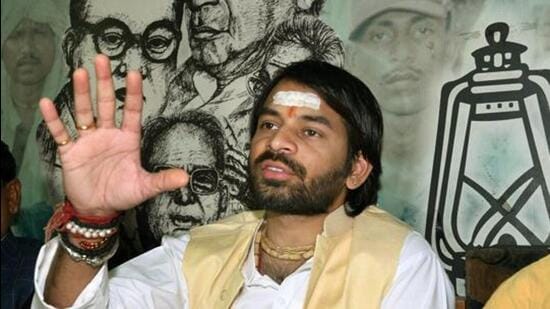
The latest controversy around Tej Pratap’s expulsion from the RJD – his father and the party’s national president announced it on a post on microblogging site X (formerly twitter) – after his revelations of having been in a relationship with a woman should ideally be a completely personal matter for Tej Pratap and his family. However, this is one of the typical cases of the personal being political in a world where politicians seek to preserve and centralise political power by keeping it within the family and clan and sometimes end up harming their cause rather than helping it while doing so. Lalu Prasad’s political life, in fact, is a case study of this theory.
Lalu Prasad’s rise in politics began with what was one of the most important, if not the most important, phases of agitational politics in post-independence India, namely, the anti-emergency struggle. Almost all of India’s current senior politicians are from this generation. He began as an office-bearer of the Patna University Students’ Union during the emergency and went on to become one of the youngest members of parliament in the 1977 Lok Sabha elections which saw the Congress lose power in the country for the first time. Between 1977 and 1990, which is when he first became the chief minister of Bihar, Lalu’s politics was about carefully negotiating the factional fights in the larger socialist camp in Indian politics to preserve his own political standing and settle scores. His elevation to the chief minister’s post itself was the result of clever factional maneuvering when he emerged as the underdog winner in three-way fight between himself, Raghunath Jha and Ram Sundar Das. Lalu’s political charisma came into full bloom once he got the chief minister’s post. He cultivated a strong social-justice and secularism constituency for himself by his aggressive politics against entrenched feudal dominance of upper castes and arresting BJP’s Lal Krishna Advani in the middle of his rath-yatra in Bihar. It was this popularity among the socially discriminated and a core voter base of Muslims and Yadavs which saw the Janata Dal under Lalu being re-elected to power in the 1995 elections with a clear majority (which it did not have in 1990) amidst a completely fragmented opposition.
Also Read: Lalu expels son Tej Pratap Yadav from RJD over lack of conformity to values
The 1995 victory, however, came in the wake of a fragmentation in the wider social-justice base of the Janata Dal. Some of Lalu’s important (but non-Yadav) comrades such as Nitish Kumar and George Fernandes walked away from the Janata Dal to form the Samata Party, which was later renamed as Janata Dal (United). This split would lay the foundation of an electoral tie-up between the BJP and the socialists in Bihar, which has proved to be an invincible coalition in the state so far.
While Yadav survived the first split in the party and emerged stronger from it in the 1995 elections, he would soon meet a legal rather than political challenge which would take him further towards on Orwellian rather than actual socialism. After being faced with a certain arrest in an ongoing anti-corruption case, he stunned everybody by nominating his wife Rabri Devi – she had no public profile earlier – as the chief minister of Bihar and forcing a split in the Janata Dal to form the Rashtriya Janata Dal (RJD). The fact that Yadav ignored several senior politicians from within his party, many of whom had been his comrades during the days of the anti-emergency struggle and were worthy of being handed the leadership of the party and govenrment, earned him the dubious distinction of a power grabber rather than a social revolutionary against feudal dominance.
This was followed by other members of the Yadav family being seen as blatant abusers of state power and responsible for a complete breakdown of law and order in the state. Yadav’s brothers-in-laws Sadhu and Subhash Yadav were two such characters. The former gained extreme notoriety in a case (the Shilpi-Gautam murder case) when bodies of a young couple were found from his official MLC residence and the case was buried as one of suicide in what was alleged to have been murder and rape. It was episodes like these which tainted the Lalu Yadav regime as one of complete lawlessness. The ghosts of this past still haunt the RJD which is best seen in its extremely poor electoral record in urban centres in the state.
It was because of this fragmentation in social base and rising discontent against misgovernance along a united opposition that the RJD would eventually lose power to the BJP-JD(U) alliance in 2005. It has not been able to come back to power ever since except when it contested the elections with the JD (U) in 2015. The RJD and JD (U) have not been able to hold on to the alliance on two occasions since 2015.
With Lalu himself getting debarred from contesting elections because of his conviction in a criminal case, the 2015 assembly elections – when the RJD was seen as the being the most favourably placed to recapture power – opened the question of next generation leadership in the RJD. The decision once again was taken unambiguously in the favour of making way for the next generation rather than the party’s existing leadership. Both of Lalu’s sons contested the assembly elections.
To be sure, even before 2015, the RJD had seen one more of Lalu’s trusted aides walking out in the 2014 Lok Sabha elections. Ram Kripal Yadav was asked to make way for Lalu’s eldest daughter Misa Bharti on the Patliputra (rural parts of Patna district) parliamentary constituency in 2014 and he left the RJD to to join the BJP. Ram Kripal had won the Patna Lok Sabha seat twice in the past for the RJD.
With both of Lalu’s sons being elected MLAs in 2015, it was the younger son Tejashwi who would be given the more important post of the deputy chief minister’s post in the new government while the elder brother Tej Pratap was made a minister. Since then, the elder brother has always been trying to make his presence felt in the party by making assertions for leadership even though it is Tejashwi who is seen as the chosen and increasingly more capable successor. On some occasions, Tej Pratap’s assertion was just optics while on others, such as RJD’s narrow loss in a its strong-hold Jehanabad parliamentary constituency in the 2019 general elections after a rebel candidate fielded by Tej Pratap polled more votes than the victory margin, it was serious nuisance value to the party. Tej Pratap’s antics however have not prevented the rise of Tejaswi Yadav in the RJD and also as the most important opposition leader in the state. However, there is no evidence so far that Tejaswhi can restore RJD’s lost electoral dominance in the state.
Ironical as it may sound, what could be Tej Pratap’s biggest damage to the RJD’s and Lalu Yadav’s family’s political fortunes seems to be the result of a decision where the family most likely prevailed on him. In 2018, Tej Pratap was married to Aishwarya Rai, the granddaughter of Bihar’s second Yadav chief minister late Daroga Prasad Rai. Rai’s father, Chandrika Rai is a politician himself and used to be close to Lalu Yadav. It was one of those classic cases of two politically important families within the same caste getting into a marital bond. The marriage, which was conducted with much fanfare, however did not last. Tej Pratap filed for a divorce within less than a year and Aishwarya made allegations of dowry and mental harassment against her husband’s family. Among the fall-outs of the marriage was Chandrika Rai walking out of the RJD to join the JD(U) in 2020 and even hinting that his daughter might contest or campaign against the RJD and the brothers Yadavs themselves.
It is in this backdrop that Tej Pratap’s revelations about him being in a relationship for the past 12 years (predating the marriage) with another woman are extremely damning for the Lalu Yadav family. This is because the revelations make it look like the marriage was an act of deceit on the Rai family with the Yadav family knowing about Tej Pratap’s relationship. Lalu Yadav’s sharp reaction terming Tej Pratap’s latest disclosure as an act of extreme moral turpitude is meant to offer plausible deniability to the RJD’s first family. The opposition is already using the event to portray the Lalu Yadav family has having deliberately brought dishonour on the Rai family, an act of grave injustice and immorality within one’s caste networks. Aishwarya herself has made public statements to the same effect. As the elections come closer, one should only expect this campaign among Yadavs, the RJD’s core support base, to grow stronger. The community, which is the bulwark of RJD’s political existence in the state will be told that its biggest leaders have brought “dishonour” to one of their own.
In an ideal world, this line of reasoning discussed above would be considered abhorrent and rightly seen as the manifestation of oppressive family structures; whether in good faith or bad, destroying the lives to two adults who should have been allowed to do what they wanted. However, power relations in Indian society are rarely in the realm of the progressive or liberal. Family and patriarchal norms are often used as controlling mechanisms to preserve or perpetuate power even at the cost of sacrificing personal agency, freedom or happiness. The larger cause cited to justify and impose these shackles is societal or clan pride and power.
The washing of dirty family linen of the Yadav family in public and its blatant politicisation, something which has only started in this author’s view, is only a manifestation of such an attempt gone wrong. The entire episode only underlines retrograde and patriarchal social structures and their deep intersectionality with the pursuit of power in India. What is ironical is that the politician in the centre of the storm is one who is rightly seen as a trailblazer in the fight against weakening feudal exploitation in an Indian state where caste exploitation was among the most violent and entrenched.
The lesson to be learnt cannot be overemphasized. A fight for political power against a regime backed by an oppressive social super structure offers no guarantee that it will also purge retrograde values along with the rulers who championed them in the past. These values, which often hold the keys to holding power can very well be equally attractive to the new regime. Herein lies the contradiction of not just Lalu Prasad Yadav but Indian democracy and the battle for social liberation in the country.
Roshan Kishore, HT’s Data and Political Economy Editor, writes a weekly column on the state of the country’s economy and its political fall out, and vice-versa
 ABOUT THE AUTHORRoshan Kishore
Roshan Kishore is the Data and Political Economy Editor at Hindustan Times. His weekly column for HT Premium Terms of Trade appears every Friday.


