
 E-Paper



‘Terror hurts all’: Modi calls for peace amid crisis in West Asia
Prime Minister Narendra Modi addressed the P20 summit on Friday, calling for unity against terrorism and emphasising the need for peace and brotherhood. He highlighted the lack of global consensus on the definition of terrorism and urged all nations and parliaments to come together to fight against this grave threat to humanity. Modi did not mention the recent conflict in West Asia, but his comments came against the backdrop of the escalating violence between Israel and Palestine. He also spoke about India's experience with cross-border terrorism and the need for a united world to address the challenges faced by the planet. The P20 summit issued a joint statement condemning terrorism in all forms and calling for increased efforts to deny terrorist groups support. Modi also celebrated India's unity in diversity and highlighted the government's efforts to promote women's participation in all sectors.

 Prefer HTon Google


The world has started to realise that terrorism in any part of the world, in any manifestation or for any reason is an act against humanity, Prime Minister Narendra Modi said on Friday, as he called for peace and brotherhood against the backdrop of a fierce conflict raging in West Asia that has killed thousands.
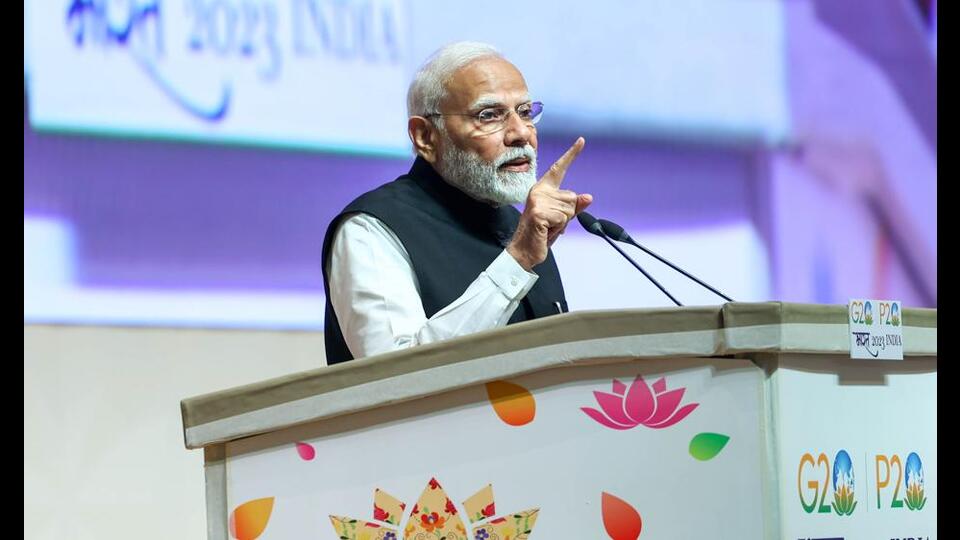
Addressing the P20 summit of parliamentary leaders of G20 states and guest countries at Yashobhoomi Convention Centre in Delhi, Modi urged all parliaments and their representatives to come together against terrorism and pointed out that the perpetrators of terror are taking advantage of the lack of global consensus on the definition of terrorism.
“Now the world has started to realise how terrorism poses a grave threat to this world. Whichever part it might be, whatever might be the manifestation of the reasons and in whichever form, terrorism is against humanity. We have to continue to fight against terrorism,” Modi said, speaking in Hindi.
“This is the time for peace, brotherhood, this is the time for moving forward together, this is the time for everyone’s development and welfare. We have to end the crisis over global trust and move forward with a human-centric approach,” he added.
Modi did not mention Israel or Palestine but his comments came amid spiralling violence following the Hamas attacks on southern Israel last weekend that killed 1,300 people, mostly civilians. Hamas fighters took about 150 people hostage in the worst terror attack in nearly half a century. In retaliation, the Israeli military targeted the Hamas-ruled Palestinian enclave of Gaza, killing at least 1,400 people ahead of an expected ground invasion.
Modi earlier denounced the Hamas assault as “terrorist attacks” and told his Israeli counterpart Benjamin Netanyahu that India stands in solidarity with Israel. On Thursday, the external affairs ministry too described the assault as a “terrorist attack”, but said India has always backed direct negotiations for establishing a sovereign state of Palestine that can exist side-by-side with Israel.
In his speech, Modi called on all nations and parliaments to come together against terrorism. “The lack of consensus on the definition of terrorism is extremely unfortunate. Even today, the UN International convention on combating terrorism is awaiting consensus. The perpetrators against humanity are taking advantage of this position,” he said.
Modi mentioned, without naming Pakistan, how India emerged stronger from a spate of terror attacks, including one on its Parliament in 2001.
“As you know, India has been facing the issue of cross-border terrorism for decades. Terrorists have killed thousands of innocents in India. Near the new Parliament building, you will find the old Parliament building. About 20 years ago, terrorists had targeted our Parliament. You will be startled to know that Parliament was in session at that time,” he said.
“Terrorists wanted to take hostage, kill MPs. India has dealt with numerous such terror incidents… Now the world is also realising how big a challenge terrorism is for the world,” Modi added.
Masked gunmen from the Lashkar-e-Taiba (LeT) and Jaish-e-Mohammed (JeM) — two Pakistan-based terrorist groups — attacked Parliament on December 13, 2001. The attack left five Delhi Police personnel, two Parliament Security Service personnel, one paramilitary constable and a gardener dead, and ratcheted up tensions between the two nuclear weapon-armed neighbours.
Modi also highlighted the global nature of conflict in the modern age, and said a divided world was detrimental to the well being of humanity.
“In various corners of the world, whatever is happening, no one is untouched from. The world is going through crises arising out of conflicts and confrontations. This crisis-laden world is not beneficial to anyone. A divided world can’t provide solutions to the major challenges faced by our planet,” he said.
He called for an end to the crisis in global confidence. “We have to see the world in the light of one earth, one family, one future,” he added, repeating the theme of India’s G20 presidency.
In a joint statement issued later in the day, the P20 — the G20 parliamentary speaker’s summit — called for increased efforts “to deny terrorist groups safe haven, freedom of operations, movement and recruitment, as well as financial, material or political support.”
The P20 leaders unequivocally condemned “terrorism in all its forms and manifestations, including those on the basis of xenophobia, racism and other forms of intolerance, or in the name of religion or belief, recognising the commitment of all religions to peace.”
“All acts of terrorism are criminal and unjustifiable, regardless of their motivation, wherever, whenever and by whomsoever committed. Effective counterterrorism measures, support for the victims of terrorism and the protection of human rights are not conflicting goals, but complementary and mutually reinforcing. A holistic approach on the basis of international law can effectively counter terrorism,” the statement said.
“Efforts to increase the effectiveness of international cooperation should be strengthened to deny terrorist groups safe haven, freedom of operations, movement and recruitment, as well as financial, material or political support. In the light of our legislative, budgetary and oversight functions, we pledge to play our role in combatting terrorism and violent extremism.” it added.
Modi also took the opportunity to highlight India’s unity in diversity and said the country has many languages and several dialects. There are more than 900 TV channels in 28 languages to provide real-time information to people and more than 33,000 different newspapers are published in about 200 languages, he said. “In this world of the 21st century, this vibrancy of India, unity in diversity, is our greatest strength. This vibrancy inspires us to fight every challenge and solve every difficulty together,” he said.
The PM also said that while a government is formed by a majority, “we run the country through consensus,” indicating a broader approach in resolving diverse interests and complexities.
Close on the heels of the passage of the historic women reservation bill in Parliament, Modi hailed women power of the country and said the government is promoting participation of women in all sectors and the country already has 50% women in local bodies.


