
 E-Paper



The BJP’s next gambit: Win over marginalised and minorities
As per party functionaries, privy to the interaction that the PM had with his colleagues, he has asked them to make a concerted effort to reach out to the deprived and marginalised in communities other than Hindus.


New Delhi: In his most recent instruction to his party colleagues to explore newer ways of expanding the party’s reach, Prime Minister (PM) Narendra Modi was relaying a message — there is no stopping till the party’s footprint is visible pan-India and till those constituencies of voters who are ambivalent towards or even unwelcoming of the BJP change their perception about it.
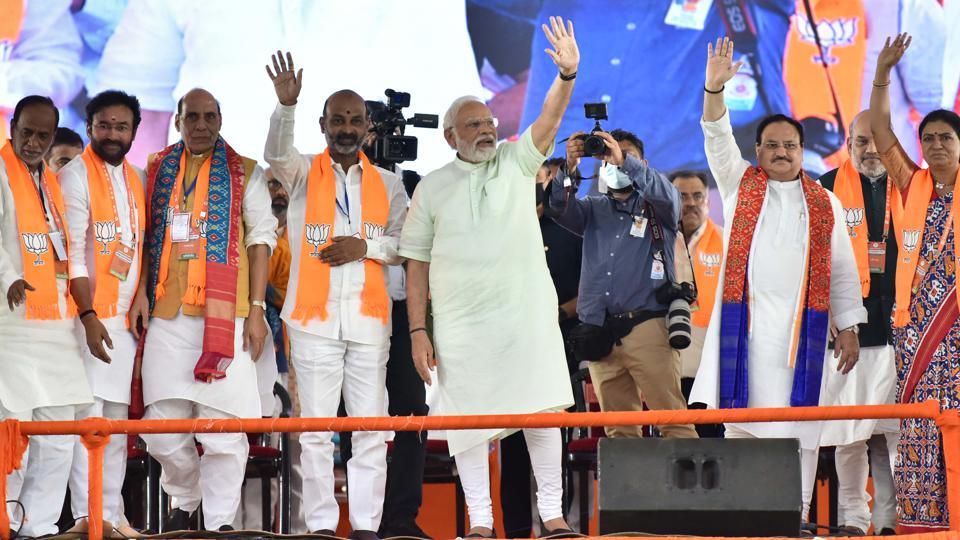
The message was delivered loud and clear, at the recently concluded meeting of the Bharatiya Janata Party (BJP)’s national executive committee (NEC) in Hyderabad. The PM spoke about the need to expand the party’s now established social engineering formula to communities outside its core voter-base and to widen its pool of beneficiaries.
As per party functionaries, privy to the interaction that the PM had with his colleagues, he asked them to make a concerted effort to reach out to the deprived and marginalised in communities other than Hindus.
“There are sections of people (who follow other religions) whose social, economic and other developmental indices are comparable to the Dalits among Hindus. Though the government’s policies are not drafted with an eye on religious or social groups, the idea now is to reach out to these sections among the non-Hindus to ensure they do not miss out on the targeted intervention such as PM Awas Yojna and Ayushman Card,” explained a functionary.
Marginalised Muslims
The PM’s reference to such sections was contextualised in the backdrop of the BJP’s surprising win in the bypolls in Uttar Pradesh’s Rampur and Azamgarh, the bastions of the Samajwadi Party, where Muslim votes are decisive in shaping electoral outcome.
The party credits its thrust on social welfarism, the free ration, subsidised cooking gas and other sops for helping it segue into votebanks that have traditionally been considered as antagonistic.
“The anti-BJP sentiment is stoked by our political opponents, they have created a fear in the minds of people about the BJP...but when people from across castes and religions benefit, get food, amenities and good governance, they can see through it… And this is what we are beginning to experience. Communities are not voting as blocs,” said the functionary quoted above.
And it is this sliver of opportunity that the BJP wants to cash in on. It wants welfarism to strike a blow at the practice of Muslims voting as a bloc to defeat the BJP and create a space for itself among the beneficiaries irrespective of their social or religious binds.
There is a perception that Muslims vote strategically to defeat the BJP.
“The BJP is trying to address two key concerns of the Muslim community that is the marginalisation of the Muslims in the electoral politics and their social-economic status,” said the functionary.
To be sure, this is not the first time that the marginalised among the Muslims, referred to as the Pasmanda, came up for discussion.
In 2017, at the NEC in Bhubaneshwar, during a discussion on the political resolution that was to be passed on granting constitutional status to the Other Backward Classes (OBC) commission, the PM had underlined that OBCs among Muslims and other religions should also benefit from the reservation policy meant for OBCs and noted that more inclusive approach was needed for backwards among the Muslim community.
The focus on the welfare of the marginalsied within the minority sections is also expected to blunt criticism about the lack of political representation to the Muslims. In Uttar Pradesh, the party appointed Danish Azad Ansari as a minister, but in the union council and among lawmakers, there are no Muslim faces.
“The outreach towards the minorities is not new. Ahead of the 2004 general elections the party had similarly reached out to the minorities organising meetings with religious heads. BJP‘s prime ministerial candidate Atal Bihari Vajpayee in a green turban, met representatives of the Muslim community and assured them that the party was not against them, but eventually the BJP remained an untouchable for the Muslim voters,” said a second functionary.
The functionary went on to say that senior leaders in the party also identified sects such as the Shias and the Bohras that would not be averse to voting for the BJP, but the outreach had a very limited response.
Taking cue from the PM, the Assam government has recognised around four million Assamese-speaking Muslims as an indigenous Assamese Muslim sub group in the state with the intent to differentiate between the Assamese Muslims and those whose origins can be traced to Bangladesh.
Christian Connect
The renewed outreach towards the marginalised among the minorities would also serve to alter perceptions that limit the BJP as a Hindu-Hindi party.
Apart from Muslims, the party and its ideological mentor, the Rashtriya Swayamsevak Sangh, have tried to establish friendly ties with the Christians, also counted as a minority in the country. The exercise has been however been dotted with challenges as the BJP-RSS have slammed Christian missionaries for using inducements and stealth to convert the poor and the marginalised among the Dalit, tribal and OBC sections.
The RSS has accused the missionaries of changing the demography of the states in the Northeastern region, where the BJP has now emerged as a major political player. An RSS affiliate, the Janajati Suraksha Manch wants the government delist members of Scheduled Tribes (STs) who have converted to other religions so that they cannot avail of quota benefits for STs.
The BJP, however, has managed to get a foothold in the region. Taking note of the party’s presence on the ground — the National Democratic Alliance (NDA)is in power in seven of the eight states aa union home minister Amit Shat, at the NEC, said the party has established its address in the Northeast and it will be difficult to dislodge the party from there.
He also said Odisha, Tamil Nadu, Telangana, West Bengal and Kerala will soon have a BJP government. With Christian population in Kerala, Tamil Nadu and Telangana adding up to a sizeable percentage of the electorate, the BJP is sharpening its outreach.
In the past, meetings between PM Modi and the Church representatives were seen as an indication of breaking the ice following a few instances of attacks on Churches. In December 2021, effigies of Santa Claus were burnt in Uttar Pradesh’s Agra by local Bajrang Dal activists who blamed missionaries for using the festival to induce the poorer sections and to convert to Christianity.
In Kerala, where Christians are 18.38% of the population as per Census 2011, the BJP and RSS have worked hard to have amenable relations with the community. In May, party president JP Nadda met Tamarassery Bishop Remigous Paul Inchananiyil. Meetings between RSS leaders were in charge of outreach with Christian religious leaders are frequent.
“The Christian community has also realised that they can benefit from the pro-people policies of the government. In Kerala in particular, the Pinarayi Vijayan government has differentiated between Muslim and Christian minorities in giving out assistance such as scholarships…”said a state leader.
He said Prime Minister himself has had several meeting with religious leaders from the church. The three cardinals of the Catholic Church, George Alencherry, Baselios Cleemis and Oswald Gracias, met PM Modi in Delhi and described the meetings as “more than cordial.”
In the state, the BJP has often found support from the Christian community on certain ideological concerns such as radicalisation that is taking root and the controversial issue of so-called “love jihad”.
The BJP is making efforts to offer political empowerment to the Christians. While the party does not field Muslims candidates, in the 2015 local elections in Kerala, the BJP fielded 500 Christian candidates for panchayats, corporations and municipalities.
In Goa, where Christians account for 25.10% of the population as per Census 2011, the party gave 30% seats to Christians in the 2022 state polls. It went to the extent of denying a ticket to former CM and BJP’s best known faces, the late Manohar Parrikar’s son Utpal from the Panaji seat and chose to backing A Monserratte.
Image makeover
The outreach also fits in with the plan to emerge as an inclusive outfit that $-: walked the talk on Sabka Saath, Sabka Vishwas. As he spearheads the party into the 2024 general election, the PM wants the party’s report card to showcase development, inclusive policies and bury the specter of communal clashes that stamped the BJP as anti-minority, said a third party functionary.
“There is always a newer milestone that he sets his sights on…Now as we head into 2024 elections and prepare for the polls in Karnataka and Telangana the PM wants the party to connect with different sections of society irrespective of their caste or religion. The concept of Sneh Yatra is based on this,” said a third party functionary.
The Sneh Yatras will see the cadre reach out to professionals and thank them for services rendered. “On Doctor’s Day we can reach out to the doctors and applaud them for their work, similar exercises will be undertaken on Teacher’s Day and Nurse’s Day… the idea is to connect with the people and show our appreciation,” said the third functionary.
Political commentator Manisha Priyam sees the outreach as an image makeover. “The BJP wants to be a rightist ideology party with a centrist welfare approach, a position that was occupied by the Congress. The BJP has been focusing on a broad welfare agenda with accent on last mile delivery. They have been doing large scale welfare spending. Whether the minorities will vote for it or not, it certainly is undergoing a major image makeover,” she said.
 ABOUT THE AUTHORSmriti Kak Ramachandran
Smriti covers an intersection of politics and governance. Having spent over a decade in journalism, she combines old fashioned leg work with modern story telling tools.


