
 E-Paper



The wild artistry of the Van Ingens of Mysuru
Inside Mysuru palace, rare weaponry and lifelike taxidermy showcase a rich history, highlighting the legacy of the Van Ingen family in wildlife preservation.

 Prefer HTon Google


If you are ever privileged enough to gain ingress into two special rooms inside the Mysuru palace, otherwise closed to visitors, expect some stunning sights. Inside the first room is a priceless collection of weaponry from the erstwhile Mysuru arsenal, including chakras (razor-edged flat metal rings coated with cobra venom before launch), wagh nakh (tiger claws made of steel), inspired by those used by Chhatrapati Shivaji, a flexible ‘belt sword’, complete with buckle, used by Kanthirava Narasaraja Wadiyar in the 17th century, and swords that once belonged to Hyder Ali and Tipu Sultan.
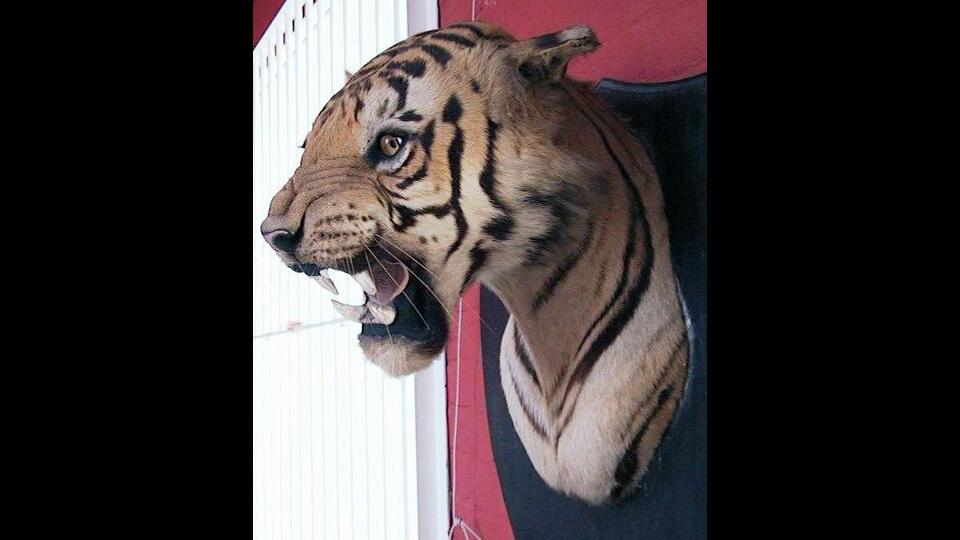
The second room makes you gasp for a different reason. When the lights come on here, you find yourself surrounded by a surreal menagerie – snarling tigers and leopards, elephants, giant gaur, even a zebra – all of which look chillingly life-like even a century after the animals were first killed for sport. The expert task of preserving them as they looked in their prime – whether as full-size specimens or as heads mounted on polished wooden boards, footstools (fashioned from elephant legs), ashtrays (a metal grille fitted over the top of a freestanding elephant trunk) or rugs – was executed by a Mysuru-based family which ran one of the world’s biggest and most sophisticated taxidermy firms of the 20th century, Van Ingen & Van Ingen.
The last of the Van Ingen line, Joubert, died in the family home in Mysuru in March 2013, aged 100.
Despite their Dutch-sounding surname, the furthest the Van Ingens could trace their lineage was to Galle, Sri Lanka, from where the first of the family arrived in Bangalore in the early 1800s. With the death of Tipu Sultan in 1799, a large swathe of the southern peninsula became available to the British to exploit as they wished, attracting entrepreneurs of every stripe. Following the Revolt of 1857, Queen Victoria assumed control of India, swelling the number of British administrators, military officers, and traders in the country. It was into this milieu that Joubert’s father, Eugene Van Ingen, was born in 1865.
Among the priceless Indian resources decimated during British rule in the 19th and 20th centuries, perhaps the least acknowledged was wildlife. By the time Eugene moved to Mysore in the 1890s to apprentice at the famous taxidermy workshop run by the Theobald brothers, shikar – killing wild animals for sport – enabled by the Indian Forest Act, 1878, which gave the colonial government full control of forests and wildlife in the British-ruled provinces, had become an integral part of the Raj. The erstwhile Mysore province, with its vast jungles thick with tropical fauna, was a veritable paradise for the keen shikari. Heartwarmingly, under Nalvadi Krishnaraja Wadiyar, it was also among the first princely states to impose conservation laws – the Mysore Game & Fish Preservation Regulation in 1901, a restriction on hunting licences and the banning of tiger shooting in demarcated areas in 1917, and stricter limits on tiger hunting in the 1930s. Yet, between 1900, when Eugene founded it, and 1998, when it finally downed shutters, Van Ingen & Van Ingen processed and mounted no less than 43,000 “trophies”, mostly for Indian nobility.
The youngest of Eugene’s children, Joubert served in WWII – he was a Burmese prisoner of war who worked on the construction of the infamous bridge over the River Kwai – before returning to Mysore to helm the family business during its busiest years. By the 1960s, however, hunting had lost its sheen; in 1972, the Wildlife (Protection) Act outlawed hunting altogether, turning Van Ingen & Van Ingen into a company that merely serviced and maintained existing trophies.
But the family’s legacy endures, in the hundreds of trophies in museums and private collections around the world today, but also in the meticulous records they kept on every animal they worked on. It was their notes, for instance, that provided critical evidence about the last days of the Asiatic cheetah in India, and were cited extensively during the debate about cheetah reintroduction in 2022.
(Roopa Pai is a writer who has carried on a longtime love affair with her hometown Bengaluru)


