
 E-Paper



Thousands displaced as rains pound north Karnataka; rivers swell, roads blocked
The overflowing Bhima river inundated stretches of National Highway 50 near Jewargi.

 Prefer HTon Google


Days of torrential rain and massive inflows from Maharashtra’s reservoirs left large parts of northern Karnataka reeling, as rivers overflowed and bridges went under water, severing connections across several districts and displacing thousands of families.
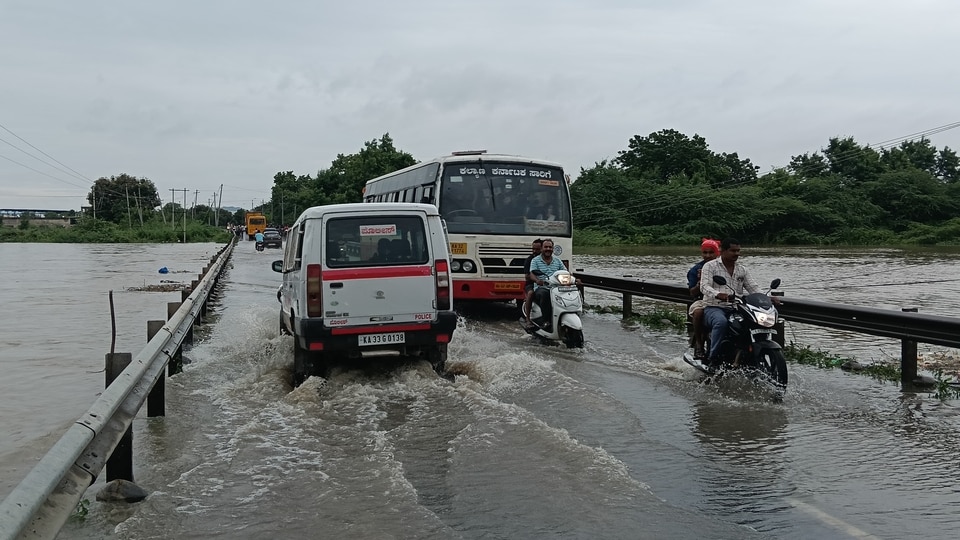
The Bhima river, swollen by releases from the Sina, Veer, and Ujani reservoirs in Maharashtra, inundated stretches of National Highway 50 near Jewargi, disrupting a crucial link between Kalyana Karnataka and the rest of the state. At Kattisangavi, river water rose level with the highway bridge before submerging it, forcing officials to halt all traffic, including ambulances and newspaper supply vehicles. By Saturday night, passengers stranded on either side of the bridge attempted to cross on foot, while trucks queued for miles.
Kalaburagi has been among the worst affected.
“Flooding of the Kagina river and Nagavi stream has cut off Mudabul village from the taluk headquarters Chittapur. The Dandoti bridge has gone under water, bringing traffic to a standstill,” deputy commissioner Fawzia Tarannum said.
She added that floodwaters from the Kagina entered more than 90 houses in Jattur village of Chincholi taluk, forcing the rescue of 200 people to safer areas.
“At Satapatanalli village in Sedam taluk, the Kagina bridge was submerged, cutting off connections between Sedam–Chincholi and Chittapur–Kalgi taluks. Flood havoc was also reported in Aland,” she added.
The Bhima river alone is receiving inflows of 3.5 lakh cusecs, according to the district administration. “From the Sonna Bhima barrage in Afzalpur taluk, all gates have been opened. Flood threat looms over 85 villages. As of Sunday evening, 6,664 flood victims had been moved to safer places across the district, with 41 relief centers opened,” Tarannum said.
In Bidar district, continuous rain combined with heavy discharge from Maharashtra’s Dhanegaon reservoir worsened flooding across Kamalnagar, Aurad, Bhalki, Hulsur, and Bidar taluks. “Heavy floods have affected Bidar district,” said deputy commissioner Shilpa Sharma, listing the specific statistics as follows: “Human casualties: three. Animal loss: 38. Water entered houses: 100 cases, damaging food grains, clothes, and utensils. Schools: 420 classrooms damaged. Power supply: 246 poles, 36 transformers, 30.68 km of lines damaged. Minor irrigation tanks/projects: 57 damaged. Health centres: 24 damaged.”
Sharma added that relief camps had been opened at Kittur Rani Chennamma Hostel in Ghataboral village, where 12 houses were flooded, and at a government school in Belakera village, where eight houses were inundated. “A total of 266 people — 126 men, 84 women, and 56 children — have been accommodated,” she said.
In Bhalki taluk, the Inchur bridge went under water, cutting off routes to Maharashtra. Traffic came to a halt on the Bhalki–Hulsur, Kamalnagar–Balur, Kamalnagar–Aurad, and Kamalnagar–Sonal roads. Three houses collapsed in Hulsur taluk.
In Basavakalyan, authorities released water from the historic Tripurant Lake to prevent a collapse of its wall after unprecedented rainfall — the heaviest in 40 years.
The diversion of water into canals submerged bridges and roads leading to Pratappur, Khanapur, Gaur, Janapur, and Betabalkunda, disrupting movement.
“To prevent damage to the lake, our staff are stationed near the sluice point, and surveillance is being maintained at other vulnerable spots,” said Jagannath Reddy, Commissioner of the Basavakalyan Development Authority.
In Yadgir, heavy rainfall compounded the crisis. “From September 22 to 28, 2025, Yadgir received 93 mm of rainfall, which is 122 percent excess compared to the normal expected rainfall of 42 mm,” Deputy Commissioner Harshal Bhoyar said. “As of Sunday evening, 1,160 flood victims had been moved to safer places across the district, with five relief centers opened. A total of 104 houses have been damaged since September 20. Twenty-two small livestock — sheep and goats — have died due to wall collapse caused by rain.”
Raichur district has also reported significant damage. In Maski, 15 houses collapsed as Bhima river waters merged with the Krishna, increasing its flow. Downstream, Andhra Pradesh authorities opened the gates of the Jurala reservoir as a precaution.
For many, the sight of submerged bridges and stranded vehicles has become emblematic of the devastation. At Jewargi in Kalaburagi district, where the Bhima river overtopped the NH-50 bridge, stranded passengers abandoned vehicles and crossed on foot.


