
 E-Paper



Thousands more back home on special flights
Since February 22, nearly 7,000 Indians have been airlifted to India from Ukraine, while another 7,400 are expected to be brought back through special flights in the next two days, government officials said on Thursday.


New Delhi: Close to 7,000 Indians who were in Ukraine have been airlifted to India since February 22 and another 7,400 are expected to be brought back through special flights in the next two days, government officials said on Thursday, before another set of officials added that India is focussing on 2,000 nationals still stuck in the besieged cities of Kharkiv and Sumy.
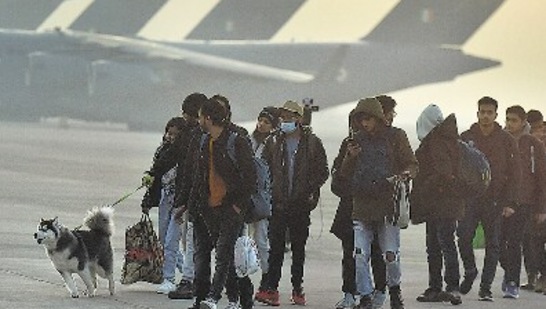
India has deployed heavy lift air force planes and mobilised special flights in partnership with commercial airlines to countries such as Poland, Hungary, Slovakia and Romania, where Indians are arriving from war-torn Ukraine, and has deployed four Union ministers.
The ministers, Hardeep Puri, who is in Hungary, Kiren Rijiju (who is in Slovakia), Jyotiraditya Scindia (who is in Romania) and VK Singh, who in Poland, coordinated some the return of these students, most of whom walked their way to Ukraine’s borders.
Early on Thursday, four C-17 Globemaster jets of the Indian Air Force arrived with 798 Indians who had reached Poland.
According to the data from the ministry of civil aviation, 17 commercial flights were scheduled to land between Thursday and Friday.
Civil aviation minister Scindia on Thursday morning tweeted: “An update on OperationGanga -- Number of flights scheduled for the day: Bucharest- 8 by @IAF_MCC @airindiain @IndiGo6E, Suceava- 2 by Indigo, Kosice- 1 by @flyspicejet ,Budapest- 5 by @IAF_MCC Indigo, @GoFirstairways& Air India, Rzeszow- 3 by Indigo”.
But the concern at present seems to be around getting 2,000 Indian nationals out of Ukraine in the first place. There were a few hundred Indians still in Kharkiv and Sumy, while around 1,000 nationals were in Pisochyn, located 11km from Kharkiv, and external affairs ministry spokesperson Arindam Bagchi said Indian authorities were exploring various options to move them to safety in western or southern Ukraine.
Also Read | ‘Instead of one body… ’: BJP MLA’s shocker on bringing Naveen’s remains from Ukraine
“Unfortunately, there has been a fresh outbreak of violence [on Thursday] in Kharkiv, which always makes our job much more difficult...It’s a dynamic situation,” Bagchi told a media briefing.
Several Indian students who made the trek from Kharkiv to Pisochyn on foot said in videos posted on social media that they could still hear the sound of shelling. They also said they were running low on food and water. Others spoke of witnessing shelling during their trip.
India on Thursday also issued a detailed advisory for on how to survive the looming conflict, which could involve attacks by Russian fighter aircraft, drones, missiles, artillery, small arms and grenades.
Also Read | ‘Molotov cocktails alert, no selfies with troops…’: India lists do’s and don’ts for nationals in Ukraine
An advisory issued by the defence ministry warned Indian citizens of several other potentially dangerous situations, including Molotov cocktail attacks by locals/militia, building collapse, internet jamming, lack of food, electricity and water, psychological trauma, lack of medical support and transportation, and coming face-to-face with armed fighters and military personnel.
The survival tips issued by the ministry are exhaustive and reflect the worsening ground situation in Kharkiv. Indian nationals have been advised to keep a kit of essential items ready at all times, including passport, ID card, medication, life-saving drugs, torch, matchbox, lighter, candles, cash, energy bars, power banks, water, first-aid kit, headgear, muffler, gloves, warm jacket, warm socks and comfortable shoes.
They have been asked to conserve and share food and water, avoid full meals, eat smaller portions to extend the rations, stay hydrated and melt snow to produce water if they find themselves in the open. The Indian nationals have been advised to keep a large garbage bag for use as ground matting/cover against exposure to rain, cold and storm, and during forced march or evacuation.


