
 E-Paper



Took back charge of vaccine drive on states’ request: Centre
The Centre’s affidavit has maintained that the option was made available to states and Union Territories to expand their vaccination drives to 18-44 age group on the states’ own requests even as the Union government kept providing free vaccines to the states for those above 45.


The Union government took back charge of sourcing and supplying vaccines to states after as many as 13 chief ministers wrote to it with a request for a reset of the policy, the Centre informed the Supreme Court on Saturday.

“The said decision to review the strategy was taken after receipt of letters from 13 Hon’ble chief ministers as well as health ministers of various states and after debating and deliberating the pros and cons of such decision,” said the affidavit filed by the Centre in the case registered suo motu (on its own) by the apex court to scrutinise the vaccination policy and supply of essential drugs and services during the Covid-19 pandemic.
The affidavit said that the letters were received from the CMs and other ministers between May 15 and June 2, asking for a review of the liberalised vaccination policy which was brought into effect from May and brought significant changes to the Covid-19 vaccination protocol. This change paved for people in the 18-44 age group to get doses, so long as these shots were acquired directly by the states or private hospitals from the manufacturers.
“The Government of India, therefore, decided to review the strategy to factor in the problems highlighted by the state governments and keeping in mind the main objective of maximising vaccination in the minimum possible time under the most extraordinary and unprecedented circumstances which is being faced by the humanity in general and by India in particular,” added the affidavit.
Following the representations from the state government and upon assessing the experience on the ground, the Centre started reviewing the policy “so that the problems faced by the state governments may not hamper the vaccination drive and citizens also do not suffer in any manner.”
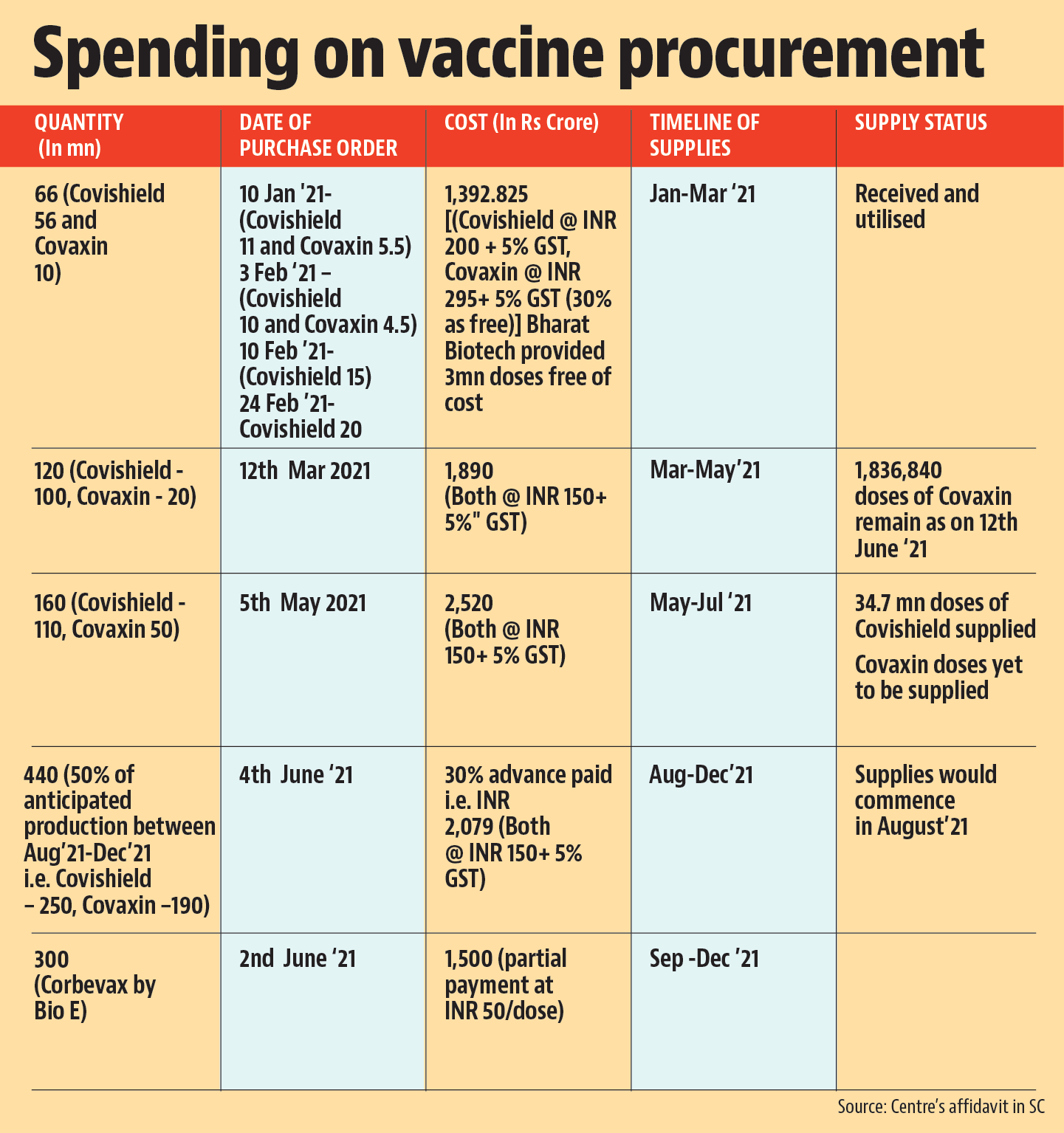
It stated that as part of a review, two meetings were conducted “at the level of highest political executive of the country” on May 15 and May 21 before Prime Minister Narendra Modi announced on June 7 that the Centre was taking over the task of vaccination from state governments and will provide Covid-19 vaccines free of cost to all adults from later this month.
The affidavit has not identified either the CMs or the states that asked for a revision of the policy while pointing out that the previous policy of May 1 was also brought in “only with a view to accommodate the requests of state governments, so that they continue to be completely focused and committed as equal stakeholders to the mission of national vaccination”.
The Union government, defending the May 1 policy, emphasised that the states’ requests for autonomy in vaccine procurement and administration of dosage were accommodated “for ensuring overall success of the National Vaccination Policy, in the face of constraints of vaccine awareness and hesitancy”.
The Supreme Court in its order on June 2 had said that the Centre’s May 1 policy, which had put the onus of giving doses to adults in the below-45 years age group entirely on states and private hospitals, was “prima facie arbitrary and irrational”. The bench, headed by justice Dhananjaya Y Chandrachud, held that this policy “conflicts with the constitutional balance of responsibilities between the Centre and states” while seeking justification also on differential pricing of vaccines between the Centre and states.
The Centre’s affidavit has maintained that the option was made available to states and Union Territories to expand their vaccination drives to 18-44 age group on the states’ own requests even as the Union government kept providing free vaccines to the states for those above 45. It has, however, not addressed the issue of differential pricing stating that the old policy now stood replaced with a new one.
About the involvement of private hospitals, which will continue procuring 25% vaccines under the new policy as well, the Centre said that their engagement in any public health programme was always “desirable” so as to give wider reach to vaccination and lessen the stress on government facilities.
It added that vaccine manufacturers were permitted to sell vaccines to private hospitals at higher rates because “unless the vaccine manufacturers have an incentive or financial ability, they may either not have the capacity to augment their potential or may not sense the viability to do so”. Additionally, this would cross-subsidise the price at which they were supplying 75% of their manufactured vaccines to the central government, said the affidavit.
“With a view to ensure that there is no exploitation by private hospitals, it has also been mandated that no private hospital could charge more than ₹150 per dose from the individuals choosing to get vaccinated in a private facility over and above the price paid by private hospitals to the manufacturers,” added the affidavit.
The Union government maintained that under the new policy, all persons above 18 years of age throughout the country are entitled to get free vaccination irrespective of their financial position.
“To put the same position differently, a person below poverty line and a multi-millionaire are equally entitled for the very same vaccine in the age group of 18 years and above free of cost,” the 380-page document said.
It further said that digital divide, if any, will not be an impediment in the vaccination since after May 23, on-site registration and digital registration on CoWIN platform had been allowed for 18 years and above, besides putting in place mechanism also for ‘Near to Home Covid Vaccination Centres’.
The Centre’s affidavit will be examined by the SC bench, which also includes justices L Nageswara Rao and S Ravindra Bhat, on Monday when the matter is heard next.


