E-Paper



Turn challenges of global trade into opportunities: President Droupadi Murmu
President Droupadi Murmu said that innovation economies are the most competitive and prosperous economies in the world

 Prefer HTon Google


President Droupadi Murmu on Monday said the challenges of global trade need to be turned into opportunities by utilising the exceptional capabilities available in the country and making India a global innovation centre.
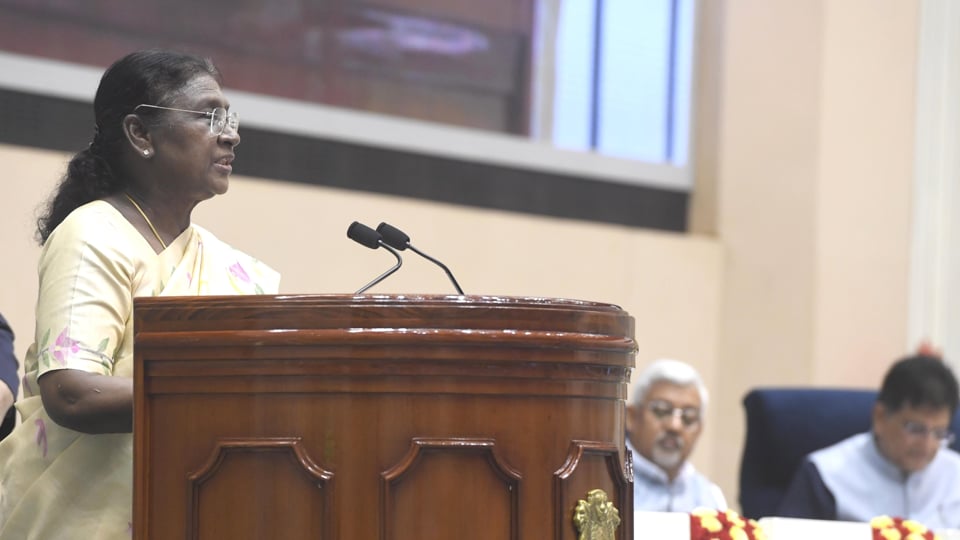
“Experts of the global economy and trade discuss innovation economies and catch-up economies. Innovation economies are the most competitive and prosperous economies in the world,” she said at the platinum jubilee celebrations of the Engineering Export Promotion Council (EEPC) in New Delhi.
She urged EEPC to continuously expand India’s role in the global value chain and emphasized its necessity because of changes taking place in the world trade order and the international economy.
EEPC is a trade and investment promotion organisation, which is sponsored by the ministry of commerce and industry.
Exports of India’s engineering goods jumped from a meagre $10 million in 1955 to $116.67 billion in FY25.
Recollecting the President of India’s speech on the Independence Day eve that focused on ‘swadeshi’ and innovation, Union commerce minister Piyush Goyal urged the Indian industry to prefer building strong domestic supply chains to meet its requirements instead of depending on imports.
“By buying products from each other, we not only help in the country’s progress, but also ensure our own protection [from global supply chain disruptions],” he said.
He was referring to recent export restrictions on key inputs imposed by certain countries that caused immense supply anxieties to Indian industries and exports. “We, therefore, must accept the call to action for ‘Atamnirbhar Bharat’… that will lead to inclusive growth.”
The country has the strength to overcome any crisis, Goyal said while addressing the 56th EEPC India National Awards on Monday. There is a need to focus more on ‘Atmanirbhar Bharat’, which is a call to action that everyone must accept, he added.
The minister highlighted that India’s strength relies on trade and the micro, small, and medium enterprise (MSME) sectors, which form the backbone of the country’s businesses. He said that India’s self-confidence is so strong that it will only grow stronger and will not bow in front of anyone.
He emphasised quality products for both domestic and export markets and expressed his confidence that India, with the motto of “Zero Defect, Zero Effect,” will grow bigger.
Under the leadership of Prime Minister Narendra Modi, India has transformed from a fragile five economies to one of the top five economies. He noted that India has been the fastest-growing economy for the last four years. In the last quarter, the country achieved 7.8% GDP growth, which he described as a world record.
Speaking about the Goods and Services Tax (GST) rate cuts and simplification, he said the move will boost domestic demand.
He said India is a nation conscious of sustainability, and as a responsible global citizen, it is mindful of Mother Nature. With its Nationally Determined Contributions (NDC) commitments under the COP21 in Paris, India has ranked in the top three for consecutive years in global sustainability efforts, he said.
EEPC chairman Pankaj Chadha spoke about challenges to exports. “Our largest export destination, the United States, has imposed a tariff of nearly 50% on most engineering products under the new trade measure. This is a major setback for exporters... Our second largest market, the European Union, presents multiple challenges. From January 1, 2026, the Carbon Border Adjustment Mechanism (CBAM) will come into effect, requiring exporters to account for carbon emissions and pay a carbon price to access the EU market,” he said.
“Protectionist policies in many countries are reshaping trade dynamics. In short, the world is changing rapidly, and we must adapt to stay competitive,” he said.
Notwithstanding headwinds, the government has set an ambitious target of $250 billion in engineering exports by 2030 and $1.25 trillion by 2047, when India celebrates 100 years of Independence, he said. He added that the Council’s 5Es framework will help in this endevour.
The 5Es are: Elevate (move up in the value chain leveraging technology), Expand (global footprint beyond traditional markets), Embrace (green and sustainable manufacturing), Empower (MSMEs with technology and easier access to markets), and Enable (must enable digital transformation), he said.