E-Paper



Under Ayushman Bharat, 6,85,000 people availed free health care in 100 days
One of the major challenges in implementing the Ayushman Bharat scheme has been the reluctance of big corporate hospitals to come on board, largely for financial reasons.

 Prefer HTon Google


A little under 7,00,000 people have so far been treated free in various empanelled hospitals across India under the Narendra Modi government’s flagship health insurance scheme, Ayushman Bharat-Pradhan Mantri Jan Aarogya Yojna (AB-PMJAY), which was launched on September 23.
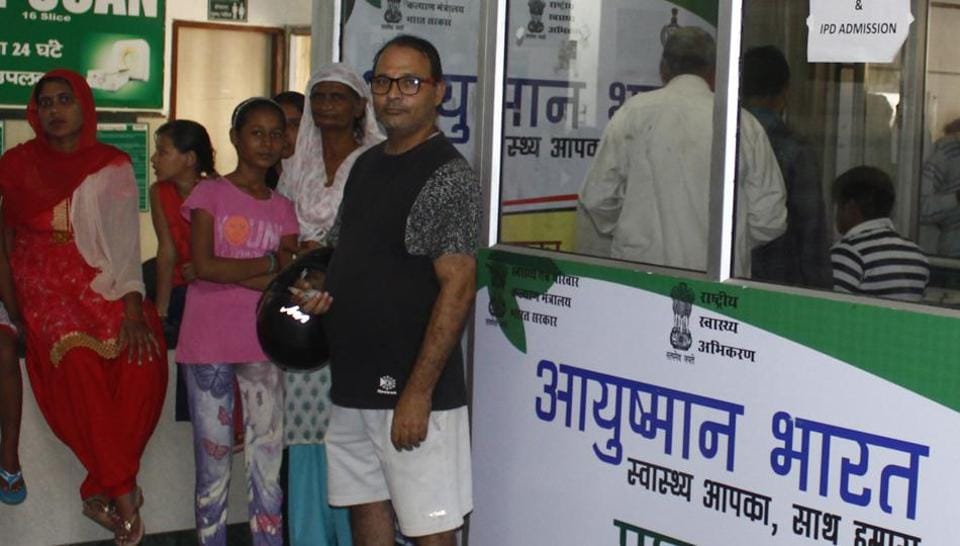
The scheme, billed as world’s biggest public health scheme, provides annual health cover of ₹5 lakh per family to 107.4 million poor and vulnerable families (around 500 million people) listed in the socio-economic caste census data for secondary and tertiary care hospitalisation through a network of empanelled hospitals. In first 100 days, 6,85,000 people have availed of the scheme.
To mark the first 100 days of the scheme, finance minister Arun Jaitley on Tuesday wrote a post on Facebook in which he described it as “a game changer in health care.”
“Many people from weaker sections avoided hospital treatment in order to avoid the burden of an unbearable payment. Today, 40% of India’s poorest are assured of a treatment in a hospital at the cost of public expenditure. This scheme also supports the hospitals as an institution by ensuring patients for them. This will lead to more hospitals (especially in Tier II and III cities), and those with better equipment. Health sector jobs are set to increase. PMJAY will help create an accountable health system because beneficiary feedback is an integral part of its implementation,” Jaitley wrote.
Those involved in implementation of Ayushman Bharat say that it has been received well, and that the number of beneficiaries is rising rapidly.
“The outcome has been better than what we expected, even in greenfield states such as Uttar Pradesh, Bihar, Madhya Pradesh, and Haryana that have had no health insurance schemes running in the past. In UP, the number of admissions increased by more than 60% during the past one month — that shows the rate of pick-up is remarkable,” says Indu Bhushan, chief executive officer, Ayushman Bharat.
While the number of hospital admissions under the scheme is rising, it’s the relatively less expensive medical fields such as obstetrics and gynaecology, general medicine, ophthalmology and oral and maxillofacial surgery (surgery for disorders affecting the facial complex and the skeleton) that have seen the most demand for treatment under the scheme, highlighting the need for more super-speciality hospitals to be empanelled for treatment.
One of the major challenges in implementing the scheme has been the reluctance of big corporate hospitals to come on board, largely for financial reasons.
“The problem here is that in insurance model you cannot have two separate rates for the same procedure. The rates in this scheme are lower than CGHS (central government health scheme) rates that cannot be acceptable. The medical industry proposed CGHS rates plus 10%; and if not that then at least CGHS rates,” says Dr KK Aggarwal, ex-national president, Indian Medical Association.
Union ministry of health provides comprehensive medical facilities to the current and retired employees of the central government and their dependents in their empaneled hospitals at subsidised rates that are fixed by the ministry.
Bhushan says, “At least 50% of the hospitals empanelled under the scheme are privately run, but the big ones seem to be reluctant as their cost structure is too high because of the kind of salaries they pay and other costs involved. We are also relooking at our rates and are in discussion with the industry.”
Another problem that the National Health Agency, the central implementing agency of the scheme, is trying to tackle is the rise of fraud websites and mobile apps that dupe beneficiaries.
“Ayushman Bharat is a totally cashless scheme and beneficiaries do not have to pay a penny out of their pocket. We have tracked some 69 apps and at least 50 fake websites that have got nothing to do with the scheme’s implementation but only meant to dupe people,” says Bhushan.
“Preventing fraud or abuse is our concern and we are trying to have more checks and balances in place. We have taken down 62 apps and many of the websites we found are registered outside India. We are getting it fixed.”
Since the scheme is information technology-enabled, safety of data has also been a concern.
“We are ensuring that the data is secure and the IT system remains stable and not easily hacked. Also, our analysis shows that our staff needs further training, especially in software and in states that have had no schemes in place earlier,” Bhushan adds.
The agency is also working with the health research department to frame a standard treatment protocol that can be issued to all empanelled hospitals.
“This is especially for tertiary care so that all patients are treated in a uniform manner even thought there could be some modifications depending on the case that the treating doctor will take a call on,” says Bhushan.
The agency also had an offline module developed as internet connectivity was a problem in remote areas like in the northeastern region.
“We don’t encourage its use much as it’s prone to frauds. But at the same time we don’t want anyone to be denied services so it will be used wherever connectivity is an issue.”
Bhushan is hopeful that in the next three months, the scheme’s reach will grow exponentially.
“Our assessment is that the weaker states such as UP, Bihar, MP should catch up in next three months,” he says.