
 E-Paper



Understanding Kerala’s unique political economy
Kerala’s political economy has undergone a radical shift in the last six-and-a-half decades, and particularly in the latter half of this period.

 Prefer HTon Google


When EMS Namboodiripad of the Communist Party of India (CPI) was elected chief minister of Kerala in 1957 , he became the first communist leader in India to govern a state. With the Communist Party of India (Marxist), or CPI (M), having lost power in West Bengal and Tripura – two states where it ruled without interruption for decades – Kerala is now the last place in India where a communist party runs an elected government.
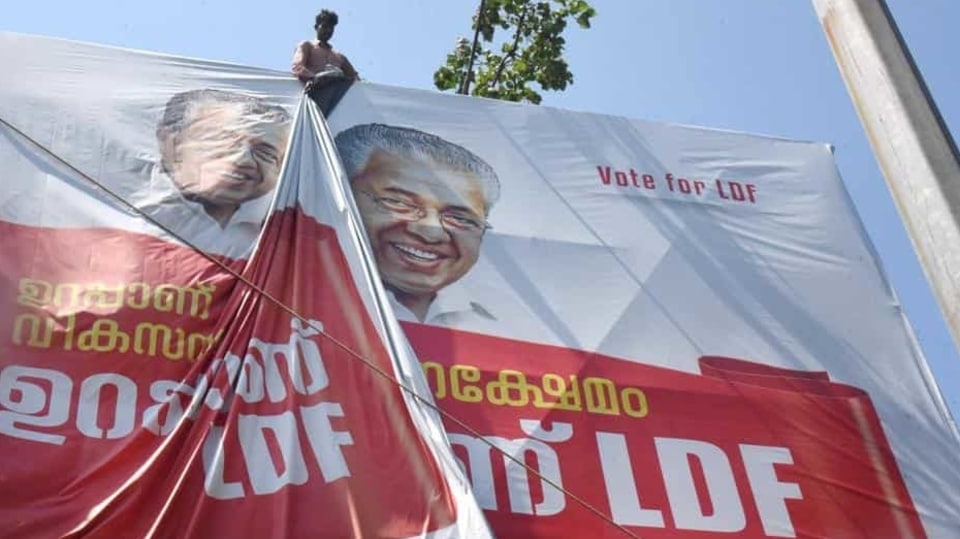
The CPI (M) and its partners in the Left Democratic Front (LDF) rightly trace their legacy to the times of EMS. But the challenges facing the current CPI (M) are very different from what EMS faced. The reason is that Kerala’s political economy has undergone a radical shift in the last six-and-a-half decades, and particularly in the latter half of this period. The communists captured power in the state by championing the politics of radical land redistribution and improvised on its economic benefits with rapid advances in the social sector, especially literacy.
Today, agriculture has a negligible role in the state’s economy. The state’s demographic profile is the most skewed in India towards people from older age groups. This also means that unskilled workers earn way more than what their peers get in any other Indian state. A lot of the state’s well-being and its growing consumerism are sustained by overseas remittances, particularly from those in oil-exporting countries in West Asia. These characteristics make Kerala a unique outlier in India’s political economy landscape.
1. Kerala has among the most equally sized farms in India, but there are hardly any farmers left now
Farm-land concentration, when seen by size of operational holdings is among the most equal in Kerala. According to the latest available data (2012-13) from the National Sample Survey Organisation’s (NSSO) report on Household Ownership and Operational Holdings in India, Gini’s coefficient for size distribution of operational holdings in Kerala was 0.342 (0 and 1 represent perfect equality and inequality) against an all-India average of 0.516. Only four states, West Bengal, Jammu and Kashmir, Odisha and Himachal Pradesh had a lower Gini’s coefficient on this count than Kerala.
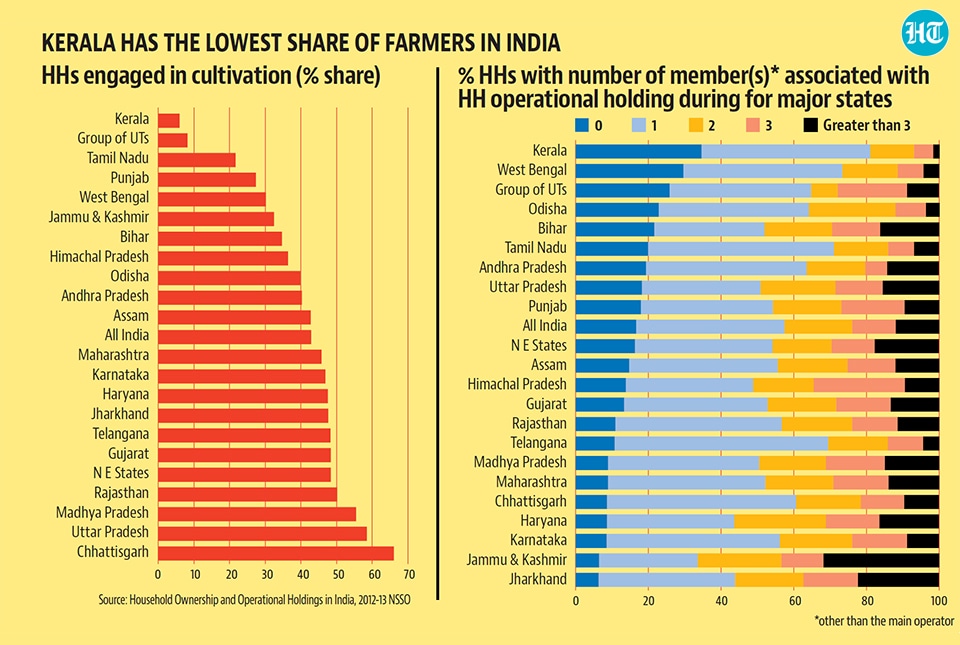
However, what separates Kerala when it comes to farming is the fact that there are hardly any farmers in the state. The NSSO report found that Kerala had the smallest share of households engaged in cultivation. Even among households engaged in cultivation, Kerala had the highest share of households where no other member apart from the head of the household was part of agricultural activity. This means that not only does Kerala have the lowest employment dependence on agriculture, it also has the lowest amount of what is often referred to as disguised unemployment in agriculture.
2. Kerala has the highest unskilled wages in the country due to its ageing population
The Left-leaning political culture in Kerala also means that the state witnesses a large number of political protests and shutdowns. Even when things are normal, unions are an influential player in Kerala’s economy. Among the most historically infamous union-related practices in Kerala is what is referred to as Nokku Kooli, a Malayalam word which literally translates to “wages for watching”. This involves unions charging a fee for “overseeing” loading and unloading activities at residential or commercial enterprises, if their demanded wages were not agreed to. While the prevalence of Nokku Kooli has come down in the recent past, and attempts to end it have had bipartisan support, Kerala still has the highest wages for unskilled workers in India. Kerala’s wage premium is only expected to increase going forward due to its aging population. The share of persons aged 50 and above was 38.7% in Kerala as on March 1, 2021 according to projections by the Report of The Technical Group on Population Projections November, 2019. This number was just 28.2% at the all-India level. This means blue-collar unions do not need to resort to strong-arm tactics anymore to preserve their material interests in the state.

3. Story of remittance tailwinds in the Kerala economy
Kerala is India’s only state with four functional international airports: Thiruvananthapuram, Cochin, Kannur and Calicut. The massive demand for international air travel needs to be seen with the widespread international emigration from Kerala, primarily to the oil-exporting countries in west Asia. A 2020 paper in the Indian Journal of Labour Economics by KP Kannan and KS Hari put the number of Kerala emigrants abroad, with an identifiable household to report in Kerala, at 2.12 million in 2020, which the authors noted, “works out to a little more than 6% of the population but 17 to 18% of its workforce”.
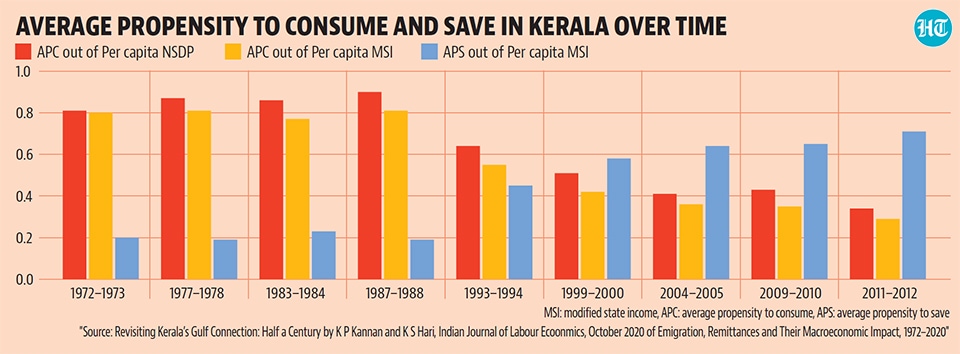
A steady rise in international emigration from Kerala has also meant a growing flow of remittance incomes. Kannan and Hari estimate that the share of remittances in the Kerala’s Net State Domestic Product (NSDP) increased from almost nothing (0.57%) in 1972-73 to almost one-fourth in the first and second decade of the century.
While this number has come down since, it was still a significant 13.3% in 2019-20, the latest period for which data is available. The paper also constructs something called modified state income (MSI) to account for the positive impact of remittance incomes on official NSDP, which the authors argue does not capture the positive impact of remittances adequately. The paper argues that additional remittance incomes have led to a reduction in propensity to consume and an increase in propensity to save.
The savings have primarily been directed to house construction, investment in gold and financial assets, the authors note. Kerala had the highest share of construction (13.7%) in its Gross Value Added among India’s states in 2018-19, the latest period for which data is available for all states in the Centre for Monitoring Indian Economy’s (CMIE) database. The all-India share was just 8% in 2018-19. It is ironical that the last surviving communist bastion is a state where labour is scarce and remittances are a key driver of the economy.


