
 E-Paper



Uniform Civil Code: What Uttarakhand CM said on second marriage, live-in relationship, property rights for daughters
Uttarakhand today became the first state to implement the Uniform Civil Code.

 Prefer HTon Google


Uttarakhand chief minister Pushkar Singh Dhami on Monday elaborated on the rules under the freshly implemented Uniform Civil Code, saying polygamy has been banned for all religions in the state and daughters have been accorded equal rights in parental properties.
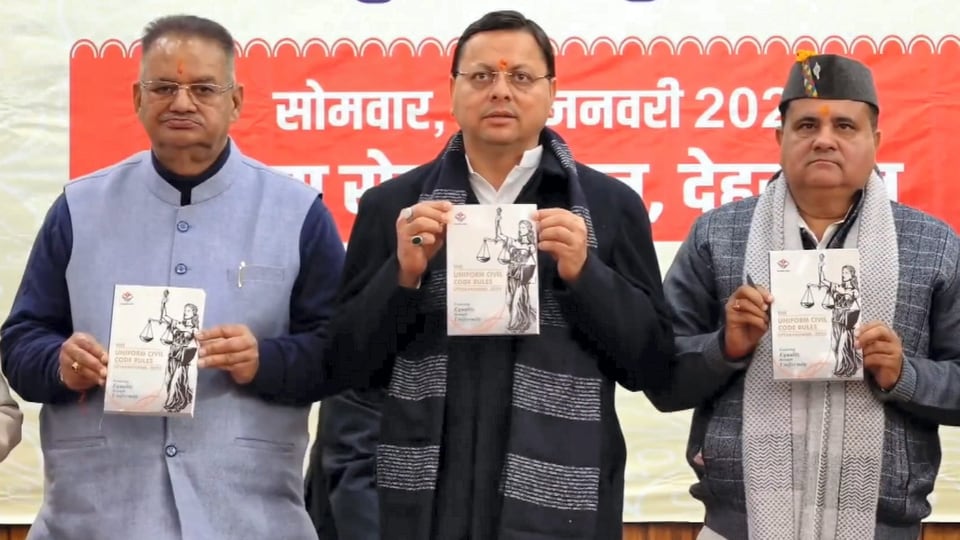
Uttarakhand today became the first state to implement the Uniform Civil Code, which envisages common rules for marriage, inheritance, maintenance, and other civil matters of all religions.
Dhami said no person of any religion will be allowed to marry for a second time until their spouse is alive. He said daughters will get equal property rights in all religions.
He said live-in relationships will have to be registered, and the registrar will inform the parents of the couple. He said children born through live-in relationships will also have equal property rights.
"Minimum age for marriage has been made compulsory in all religions - 21 years for a boy and 18 years for a girl. Second marriage is completely prohibited while the husband or wife is alive. Clear laws have also been made in the Uniform Civil Code regarding property division and child rights. Under these laws, daughters have also been given equal property rights in all religions and communities. Children born through live-in relationships will also be considered to have equal rights in property... In this law, registration for live-in relationships has been made mandatory. The registrar will give the information of the couple to their parents, this information will be kept completely confidential," he was quoted as saying by the news agency ANI.
Dhami further said that 27th January will be celebrated as the Uniform Civil Code Day in Uttarakhand.
Dhami says UCC will end discrimination
“Uniform Civil Code is a constitutional measure to end discrimination. Through this, an attempt has been made to give equal rights to all citizens. With its implementation, women's empowerment will be ensured in the true sense. Through this, evils like Halala, polygamy, child marriage, triple talaq etc can be completely stopped...We have kept our scheduled tribes mentioned under Article 342 of the Constitution out of this code so that those tribes and their rights can be protected...On this occasion today, I would like to clarify again that the Uniform Civil Code is not against any religion or sect, there is no question of targeting anyone,” Pushkar Singh Dhami added.
Dhami today launched the UCC portal, marking the implementation of the legislation.
An official order from the Uttarakhand government reads, "In exercise of the powers conferred by sub-section (2) of section 1 of The Uniform Civil Code, Uttarakhand, 2024 (Act no 3 of 2024), the Governor hereby appoints the date 27 January 2025 as the date on which the said Code shall come into force."
The UCC applies to all residents of Uttarakhand, except Scheduled Tribes and protected authority-empowered persons and communities.


