
 E-Paper



Union Cabinet clears extra fertiliser subsidy, revamped crop-insurance scheme
Prime Minister Narendra Modi said that the first Cabinet of 2025 was dedicated to enhancing prosperity for farmers


Prime Minister Narendra Modi on Wednesday said his government’s first decisions in the new year were dedicated to farmers soon after the Union Cabinet cleared a revamped, flagship crop-insurance scheme to mitigate growing climate risks and additional subsidy for fertilisers as global prices of crop nutrients edged up in recent months due to geopolitical uncertainties.
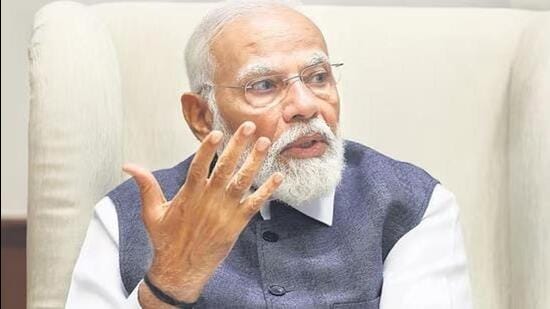
The Union Cabinet, chaired by Modi, approved a restructured Pradhan Mantri Fasal Bima Yojana and Restructured Weather Based Crop Insurance Scheme till 2025-26 with an overall outlay of ₹69,515.71 crore. Alongside, it also signed off on a proposal to top up the subsidy allocation for di-ammonium phosphate (DAP) to cushion prices for cultivators.
“The first Cabinet of 2025 is dedicated to enhancing prosperity for our farmers. I am glad that key decisions have been taken in this regard,” Modi said in a post on social-media platform X.
“We have approved an increase in the allocation for crop insurance scheme. This will provide more security to farmers’ crops and will also mitigate their concerns about any damage.”
The council of top ministers also approved a proposal of the department of fertilisers for a one-time special package on DAP over and above the so-called nutrient-based subsidy (NBS) regime, at ₹3,500 per tonne. This grant will require extra allocation of ₹3,850 crore, an official statement said.
Under the NBS policy, the government offers, on an annual basis, a fixed rate of subsidy on a per kg basis for crop nutrients containing nitrogen (N), phosphate (P), potash (K) and sulphur (S) to shield farmers from high market prices.
Since the Russian invasion of Ukraine, global fertiliser prices, especially of inorganic varieties, have remained volatile, although they have come down from their peak of 2021.
“This calls for policies to help smallholder farmers to build strong support systems to be more resilient and better able to cope with the adverse effects of rising inorganic fertiliser prices during polycrises and related shocks,” the World Bank had said in its mid-year review last year.
India relies on import of raw materials for crop nutrients as well as finished products. Fertiliser companies sell their products at a discount to cultivators through internet-enabled rural outlets. The government then pays the difference between market rates and the discount to the firms. Availability of affordable fertilisers is critical for food security of the world’s most-populous nation.
The fertiliser subsidy for FY25 has been pegged at ₹164,000 crore, down 13.18% from the revised estimate of FY24. This is now set to go up with Wednesday’s decision to increase the allocation for DAP.
In another related decision, the Cabinet also gave its clearance for a separate ₹824.77 crore fund for technology infusion in the implementation of farm-insurance programme.
“The Fund for Innovation and Technology (FIAT) has been created for the use of technology for faster assessment, faster claim settlement and lesser disputes,” information and broadcasting minister Ashwini Vaishnaw said, briefing reporters.
The overall Centre-state funding pattern for the PMFBY remains unaltered at 90:10 for northeastern & hilly states, while it is 50:50 for other states.
Farmers under the scheme pay a pre-defined premium share of 1.5%-5% of the insured value.
The technology fund will go into digital and remote-sensing technologies to bring efficiency and transparency in assessing crop damage and settling claims, the statement added.
In a statement, the agriculture ministry said the fund will be utilised towards funding technological initiatives under the scheme, such as Yield Estimation System using Technology (YES-TECH), which relies on remote-sensing tools for yield estimation with a minimum 30% weightage to technology-based yield estimates.
Wider coverage of YES-TECH is aimed at faster and accurate crop-damage assessment to calculate insurance pay-outs, farm minister Shivraj Singh Chouhan said in a separate briefing. He also said agriculture growth is expected to clock a targeted 4% during 2024-25.
“Farmers will need higher risk coverage due to increasing frequency of weather shocks to agriculture because of climate change, along with adaptation measures,” said Abhishek Agrawal, an analyst with Comtrade.


