
 E-Paper



UP court admits plea seeking removal of Mathura mosque
A petition calling for the removal of the Shahi Eidgah mosque in Mathura and handing over of the entire premises to the Katra Keshav Dev Temple is maintainable and can be admitted for hearing in lower court, a district judge in Mathura held on Thursday.


A petition calling for the removal of the Shahi Eidgah mosque in Mathura and handing over of the entire premises to the Katra Keshav Dev Temple is maintainable and can be admitted for hearing in lower court, a district judge in Mathura held on Thursday.
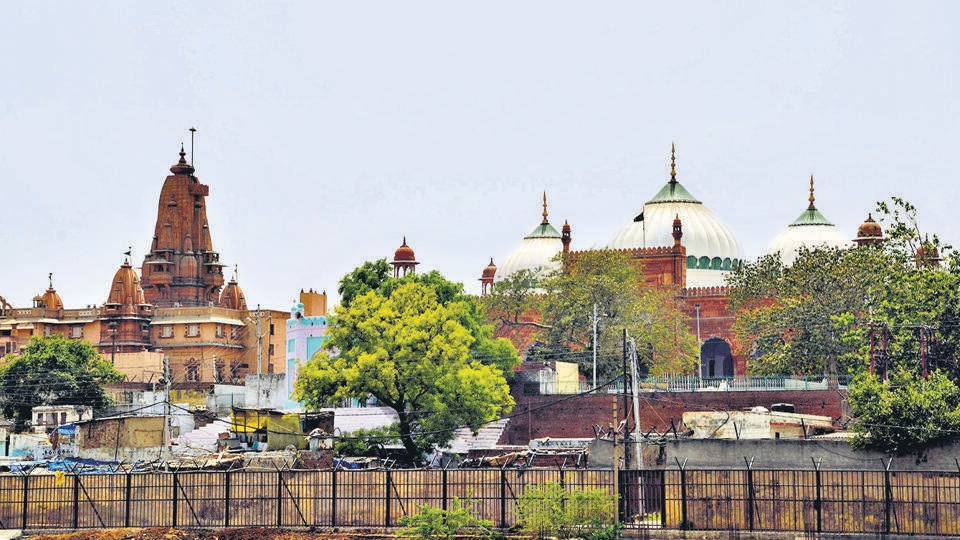
The court’s decision overturns a verdict by a Mathura civil court, which had dismissed the petition in 2020 and said it violated the provisions of the 1991 Places of Worship Act, which locked the character of places of worship as they existed on the day of India’s Independence, with the exception of the Ayodhya dispute.
The decision also reignites a decades-old religious legal fight over the Sri Krishna Janmabhoomi-Shahi Eidgah mosque complex in Mathura, at a time when a similar legal fight is roiling Varanasi in the Kashi Vishwanath Temple-Gyanvapi Masjid case. In both cases, Hindu groups argue that temples were demolished by Islamic rulers to build mosques, and therefore, the land should be returned to Hindus. Muslim groups reject the contention.
“The court has allowed revision of the lower court order and directed the lower court to register the suit as a regular suit,” government counsel (civil) Sanjai Gaur said.
The plea was originally filed in the court of Mathura civil judge (senior division) on September 25, 2020 by Lucknow-based lawyer, Ranjana Agnihotri, and six others as the “next friend” of Bhagwan Sri Krishna Virajman, the presiding deity at the Mathura temple. Next friend is a legal representative of someone incapable of maintaining a suit directly.
The suit claimed that Shahi Eidgah Masjid was constructed on a part of 13.37-acre land belonging to the Sri Krishna Janmabhoomi Trust. They demanded the mosque, which abuts the temple, be removed and the land returned to the trust.
However, the civil judge (senior division) rejected the suit on September 30, 2020 as non-admissible. The petitioners then moved the district court, seeking a revision of the order.
After hearing the arguments, district and sessions judge Rajeev Bharti allowed the revision on Thursday, meaning the original suit will have to be heard by the lower court now, an official of the court said.
“We welcome the order by the district judge, Mathura, setting aside the order by the lower court. The court of civil judge (senior division) will now hear the case on May 26, 2022,” stated Hari Shankar Jain, counsel for the petitioner in this case.
“We are yet to get the copy of the order and would be in a position to comment on observations made by the court while allowing the revision only after receipt of hte copy of order passed today,” stated Jain.
Tanveer Ahmed, secretary and counsel for the management committee of Shahi Eidgah mosque, said an application was being moved to have a certified copy of Thursday’s order, which would be studied and available options discussed.
“We would analyse the legal aspect of the order and might prefer a writ in the high court against the order if deemed fit and proper,” said Ahmed.
The religious dispute simmered in the first half of the 20th century but a 1968 agreement calmed tempers. On October 12, 1968, an agreement was signed between the Shri Krishna Janmasthan Seva Sansthan and the Shahi Masjid Idgah Trust, which divided the land between the two parties and relinquished any claims of the Hindu parties to the land of the mosque.
But Agnihotri’s petition challenged the settlement and alleged that the pact had no legal validity because the Sri Krishna Janmabhoomi Trust, which the petitioners claimed had the ownership and title of the land, was not party to the settlement.
The Hindu petitioners also claimed that Shri Krishna Janmasthan Seva Sansthan, which is the governing body of the temple complex, entered into an illegal compromise with the Shahi Idgah trust with a view to grab the property in question.
“The Shri Krishna Janmasthan Seva Sansthan is working against the interest of the deity and devotees and fraudulently entered into a compromise with the Committee of Management of Trust Masjid Idgah (Trust) in 1968 conceding a considerable portion of property belonging to the deity and the trust,” the suit alleged.
The management committee of Shahi Eidgah mosque objected to the petition, arguing that as the compromise agreement was finalised in 1968 and the final judgement and decree the case was passed in 1974, Agnihotri’s petition was time barred.
The new petition ratcheted up communal tensions. Since September 2020, eight more petitions have been filed, including one to bar Muslims from offering namaz in the mosque, another asking for a survey of the mosque premises and a third asking for security officers to be appointed to oversee the complex.
Thursday’s order came as a respite for all other petitioners because Agnihotri’s suit was the original one, and the precedent set by its dismissal made the other pleas vulnerable to falling afoul of the 1991 Places of Worship Act.
“We welcome the order by district judge, Mathura, as it will benefit all those who have filed petitions in court of Mathura seeking removal of Shahi Eidgah mosque and handing back land measuring 13.37 acres to the deity Lord Keshav Dev,” said Mahendra Pratap Singh, a lawyer in the Mathura court, who is one of the petitioners asking for a survey of the mosque premises.


