
 E-Paper



‘UP has decided to create political history this time’: Narendra Modi
Uttar Pradesh assembly election 2022: Prime Minister Narendra Modi spoke with Hindustan's Shashi Shekhar ahead of Thursday's sixth and penultimate round of polling in Uttar Pradesh.

 Prefer HTon Google


New Delhi: Caste is no longer a primary driver in elections and the Bharatiya Janata Party believes that good governance is for all, and does not discriminate on the basis of religion, caste, and creed, Prime Minister Narendra Modi said in an interview to Hindustan’s Shashi Shekhar, explaining what he sees as his party’s biggest strength in the current round of assembly elections.
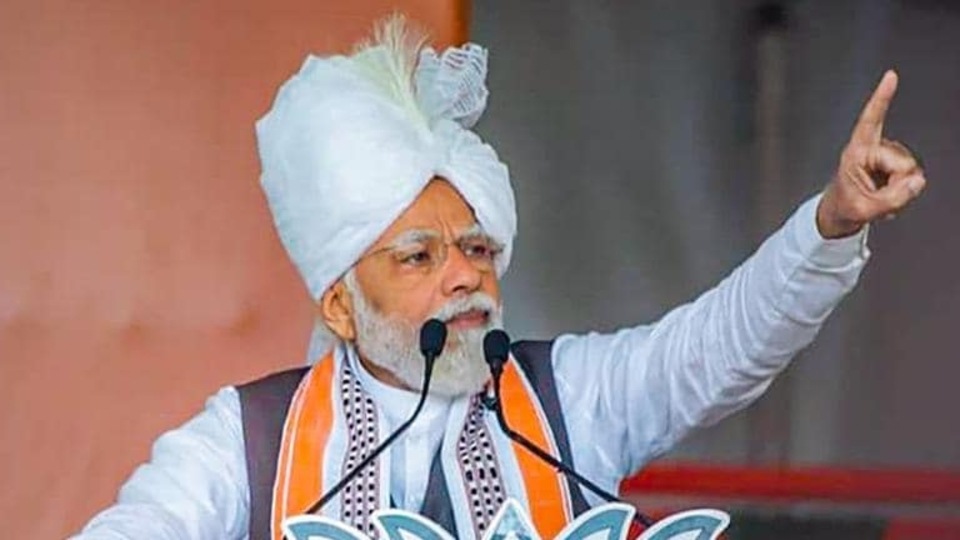
In Uttar Pradesh, where the penultimate round of voting is on Thursday, the people are determined to sustain the rapid pace of development set by the current government and hence will vote for the BJP in unprecedented numbers, he added.
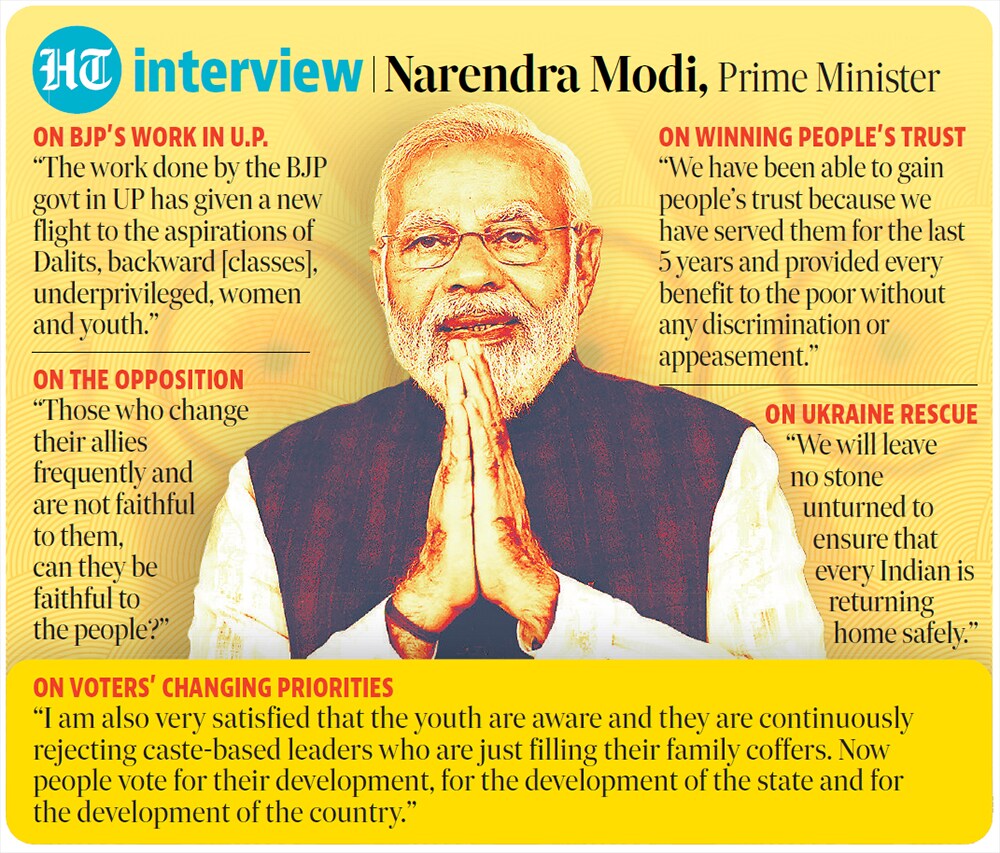
He also hit out at the Opposition, and said parties that forged fickle alliances and were embroiled in family-oriented politics could never gain the trust of the people. He said that the BJP’s agenda of development aimed to rise above caste-specific considerations.
“Uttar Pradesh has decided to create a new history this time. The people of UP are determined that the pace of development in the state for the last five years should not be allowed to stop,” Modi said.
The BJP is aiming to become the first party to retain power in India’s most populous state in two decades by fending off challenges from the Samajwadi Party (SP), Bahujan Samaj Party (BSP) and Congress. The party won the past three polls in the state – the general elections in 2014 and 2019 and the assembly election in 2017 – but faces issues of rising unemployment, price rise, farm anger in some pockets, and a possible fracture in its multi-caste rainbow Hindu coalition.
But the PM brushed aside these concerns, and said that the people of UP remembered the poor administration by previous governments, which couldn’t ensure law and order and were steeped in corruption.
“That law-and-order situation of UP is still a dark chapter. The people of UP do not want to go through those experiences again, and therefore, are themselves coming forward to ensure the return of Yogi ji’s government,” he said, referring to chief minister Yogi Adityanath.
Elections in UP, arguably India’s most politically crucial state with 80 seats in the Lok Sabha and 403 in the assembly, began on February 10 and will end on March 7 after seven phases of voting. The results will be out on March 10. The election is being seen as a virtual semi-final before the 2024 general election.
Modi attacked the BJP’s primary challenger in the state, an alliance led by the SP and comprising the Rashtriya Lok Dal, the Suheldev Bharatiya Samaj Party, and other smaller outfits.
“Don’t call it an alliance, call it opportunism and milavat (adulteration). Opportunism betrays, and milavat is never healthy. Actually, it is just an attempt by some dynastic parties to keep their existence alive,” he said.
He referred to the SP tying up with the Congress in 2017 and BSP in 2019 – both times unsuccessfully – and called it a dynastic party.
“Those who change their allies frequently and are not faithful to them, can they be faithful to the people? Their alliances have been completely exposed in front of the people of UP,” he said.
In the interview, Modi elaborated on his political philosophy and the benefits of a double-engine government, the phenomena of having the same government at the Centre and in that state – a key election plank for the BJP.
“I consider ‘pro-people and good governance’ to be the solution to every problem. This is also the solution to caste-based politics,” he added.
He said caste was a social reality and every caste should have its leaders but their priority should be national development and not narrow familial benefits.
“The youth are aware and understanding and they are continuously rejecting caste-based leaders who are just filling their family coffers. Now people vote for their development, for the development of the state and for the development of the country,” he said.
The PM said casteism got prominence because people thought only a leader from their community could get work done. “But today those people are finding that in BJP governments, the government itself is coming forward and providing all these facilities to the poorest of the poor. Therefore, their attachment to being dependent on any leader of their caste is also on the wane,” he said.
“We have been able to gain people’s trust because we have served them for the last five years and provided every benefit to the poor without any discrimination, appeasement or looking at his caste, or his religion,” he added.
Modi said voters in UP, Goa, Uttarakhand and Manipur – which have “double-engine governments” – saw all-round development. “Every section, the downtrodden, the deprived and the backward, has benefited a lot due to the almost 100% coverage of many schemes of the Centre in these states. I am sure the people will definitely give their blessings to BJP once again,” he said.
For Punjab, a state where the Congress is fighting to retain its government, he said the squabbling for power between top leaders had left a bad impression among the voters. “The people of the state are looking at the BJP with hope. They have seen the pace of development in those states which today have double-engine governments,” he said.


