
 E-Paper



Uttarakhand flash floods: At least 26 dead, 171 still missing amid rescue ops
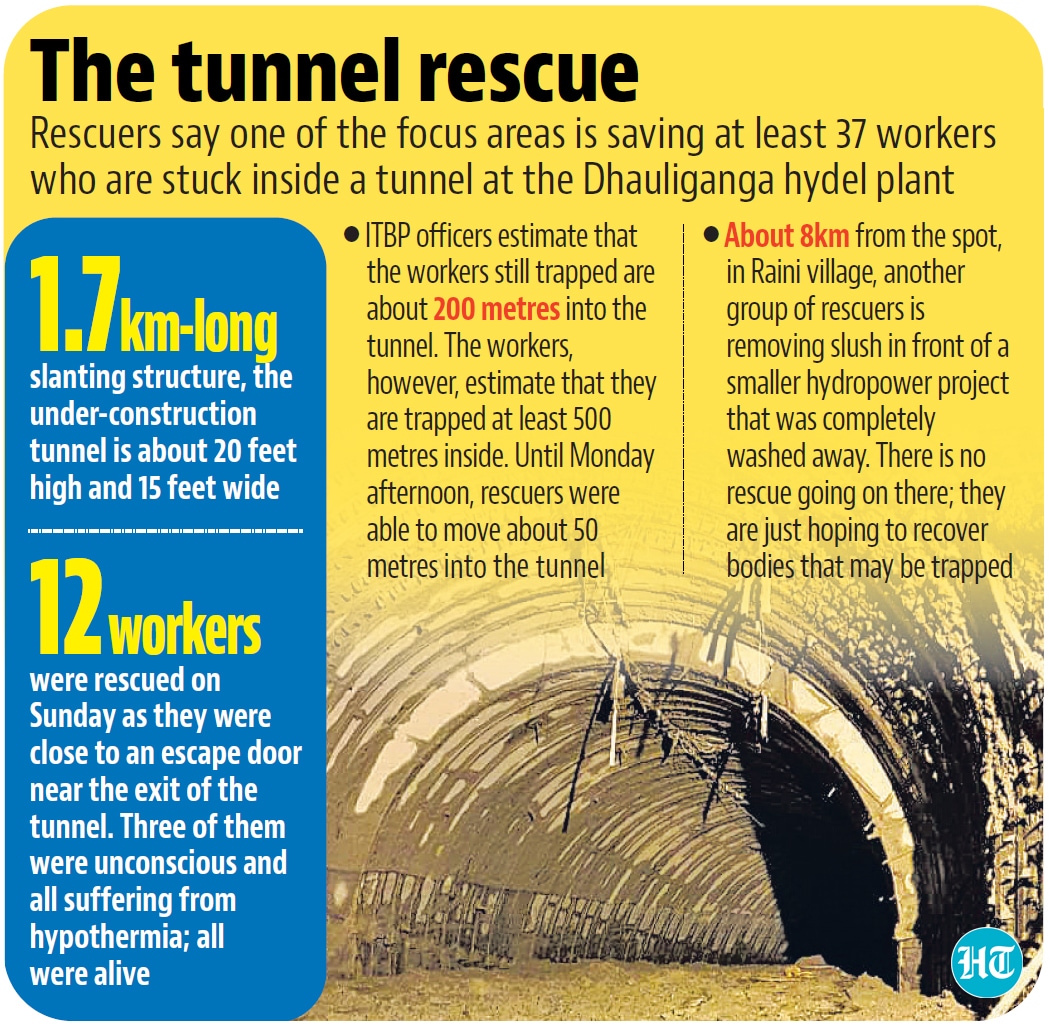
At least 1,000 disaster response, military and paramilitary personnel worked to clear a 1.7-km tunnel in the badly hit hydroelectric power project of Tapovan, where at least 35 people are still stranded in waist-deep muck.

 Prefer HTon Google


Rescue workers dug through a mountain of mud and slush on Monday to free people trapped under debris of devastating flash floods in Uttarakhand’s Chamoli as the toll of the worst disaster to hit the Himalayan region in eight years climbed to 26, with 171 still missing.
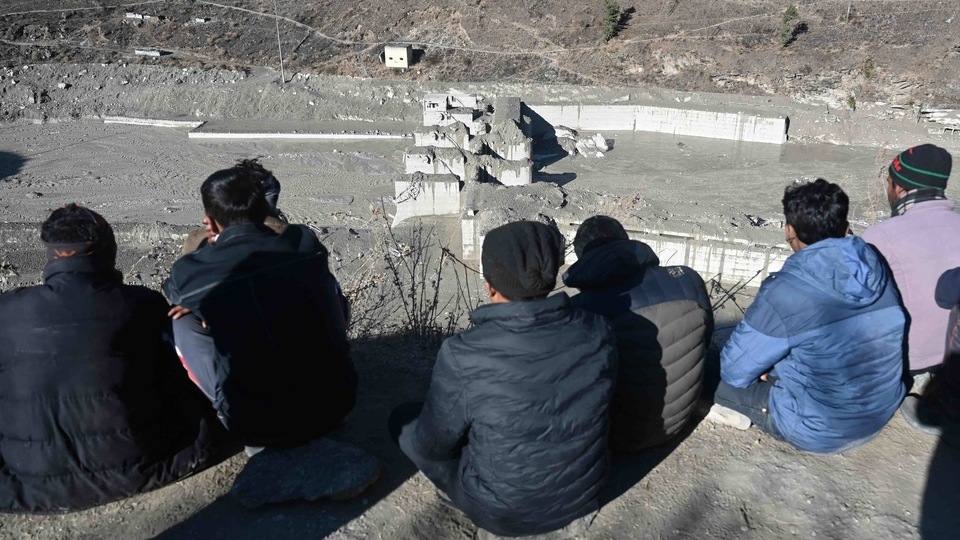
At least 1,000 disaster response, military and paramilitary personnel worked to clear a 1.7-km tunnel in the badly hit hydroelectric power project of Tapovan, where at least 35 people are still stranded in waist-deep muck.
The surging waters washed away homes, damaged two major dams, cut off 13 villages, and snapped crucial road links and bridges that connect far-flung areas in the mountainous region.
“The rescue workers have recovered total 26 bodies with about 171 still missing, which includes 11 villagers and two cops, while remaining ones are workers from the two dam sites,” said state director general of police Ashok Kumar, who is monitoring the rescue operation.
The disaster is the worst to hit the state since the 2013 Kedarnath floods killed 5,700 people and highlighted the impact of the climate crisis and degradation of the fragile ecology.
It struck at 9.30am on Sunday when a glacier breach under the Nanda Devi, the country’s second-highest peak, sent a torrent of water, rock and dust down a valley into the Rishiganga river, where workers were building a dam.
Visuals showed the muddy floodwaters smashing most of the plant and inundating bridges before roaring downstream into the Dhauliganga and partially damaging the National Thermal Power Corporation’s 530 MW Tapovan Vishnugrad project, roughly 8 km away.
Manish Kumar, a worker in Tapovan, was standing outside the tunnel that would later trap most of his colleagues, but sprinted up a hill when he noticed a dense plume of smoke and rumbling waters. “Those who turned around to see were washed away,” he said on Monday.
The tragedy left columns of slush and debris in its wake, strewn across at least 30km downstream, where authorities had to airdrop ration packets to stranded villagers.
“There was a very loud and scary noise. I turned around to see water and debris gushing towards us. It was as if the mountains were crumbling,” said Godambari Devi, a resident of Raini village who was tending to her apple trees when the tragedy struck.
Uttarakhand chief minister Trivendra Singh Rawat, Union power minister RK Sinha, Union education minister Ramesh Pokhriyal ‘Nishank’, and other senior politicians visited the site.
“The rescue work is going on at all possible speed. We will leave no stone unturned to help the needy ones with the Centre also assuring all the help needed,” said Rawat.
In Delhi, Prime Minister Narendra Modi met a delegation of state MPs and assured them that the Centre was working to strengthen infrastructure there to deal with any natural disaster in the future.
According to Bharatiya Janata Party (BJP) MP Anil Baluni, a Rajya Sabha member from the state, Modi said the central government stood with Uttarkhand’s people and was monitoring ongoing rescue operations. Union home minister Amit Shah and BJP president JP Nadda were present at the meeting.
At Dehradun, Sinha said Tapovan suffered a loss of about ₹1,500 crore but ruled out the possibility of scrapping the project.
“It (NTPC Tapovan project) was supposed to be commissioned by 2023 but now it is obvious that the target year would be pushed ahead. However, we have no intention to scrap the project with the main focus right now on the rescue operation,” said Sinha.
The rescue operation was helmed by 300 personnel of the state and national disaster response force, and 700 personnel from the Indo-Tibetan Border Police (ITBP), and army. On Sunday, they had rescued 12 people stuck in a small tunnel at the NTPC dam site.
“Of about 120 workers missing from NTPC dam, the labour contractor is unable to inform us about the identities of 100 labourers. Right now, we are focusing on clearing muck from the tunnel where about 35 workers are feared to be trapped inside,” said Kumar. On Sunday, 12 workers were rescued from one end of the tunnel with authorities saying far fewer workers were on duty because it was a Sunday.
He said rescue workers were scanning the Alaknanda river to find bodies and visiting the affected villages to provide them relief. “The SDRF teams are scanning the river on motorboat and walking on the riverside to find bodies,” Kumar added.
At the 13.2 MW Rishiganga dam site, rescuers were more sombre as they cut slowly through the slush. “There is no rescue going on here. We are just hoping to recover bodies that may be trapped in the gates of the power plant,” said Sumit Kalkhudiya, an army officer.
Experts differed on what triggered the disastrous flash floods. US-based scientists who looked at satellite images suggested it was caused by a landslide onto a glacier which led to debris flooding the river.
But a group of Indian scientists said there was no landslide or avalanche but pointed at the possibility of a glacial lake that led to the breach. They said release of water from an underground glacial lake led to flash floods and inundation in the valley.
The landslide theory was backed by Rawat, who told reporters that scientists of Indian Space Research Organisation (Isro) revealed to him that the tragedy was caused by a mix of snow and rock avalanche and that satellite images have shown no glacier breakage.
“It was due to lakhs of metric tonnes of snow sliding down abruptly from a trigger point on top of a naked hill,” he said.
Still, many flood victims in the upper reaches of Uttarakhand blamed unchecked construction and environmental damage for the tragedy. “When you dig all around and use gunpowder to shake the mountains, this is what happens. No one in these villages was infected by coronavirus, but a man-made tragedy has left six villagers dead,” said Rajni Bhandari, the Chamoli Zilla Parishad president.


