
 E-Paper



VS: A Communist doyen who transcended partisan divide, became mass leader
What distinguished VS from most of his political peers is that his popularity was not restricted to the cadre base of his party

 Prefer HTon Google


The late Sitaram Yechury once compared Velikkakathu Sankaran Achuthanandan – VS for his millions of admirers – to the Cuban leader Fidel Castro. VS, who passed away aged 101 Monday evening in Thiruvananthapuram, was more of a state chieftain than a national leader. But in his battleground, the state of Kerala, he commanded widespread respect and loyalty similar to that the “Comandante” evoked in the communist citadel in the Caribbean.
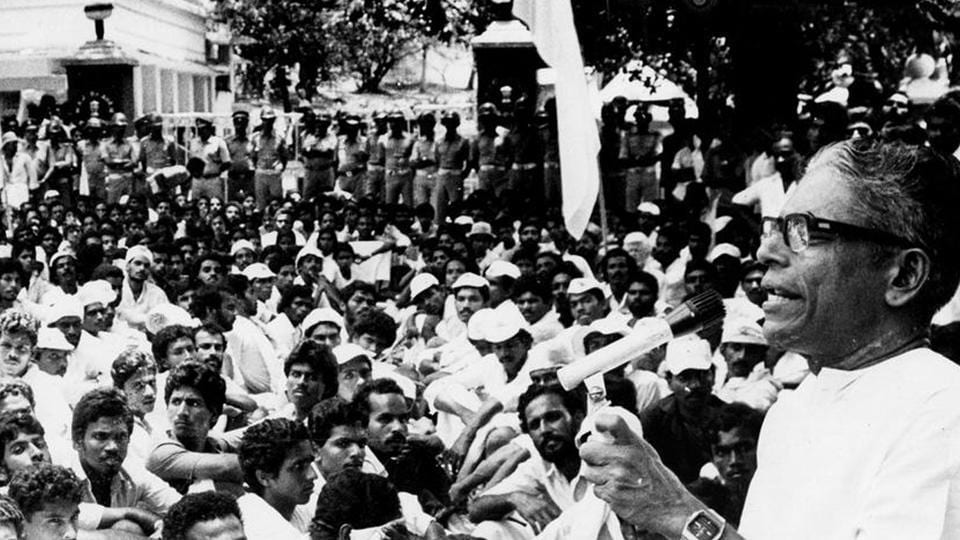
What distinguished VS from most of his political peers is that his popularity was not restricted to the cadre base of his party, the Communist Party of India-Marxist. In the last few decades of his life, he transcended the image of a hardline commissar and transformed into a mass leader, whose popularity the CPI-M both desired and feared, which had consequences for his political career. The last of the titans who built the Communist movement in the country – VS joined the undivided Communist Party of India (CPI) in 1940 at the age of 17 – he was representative of a generation of pre-Independence politicians, incorruptible, disciplined, frugal in needs, and fiercely committed to the values and dreams that inspired him to join politics. In practical terms, his politics and worldview were provincial, but it was underwritten by a solidarity with the poor and the underprivileged. The big ideological debates, including the collapse of the Soviet Union, hardly challenged his convictions.
VS lost both his parents by the time he turned 12 and dropped out of school early. Born in an Ezhava (an OBC community) family, he joined the lower rungs of the labour force in Alappuzha, then an industrial town in the Travancore state in the late 1930s, and simultaneously, the CPI, which was organising workers in coir factories, port and the large paddy fields in Kuttanad, the hinterland of Alappuzha. He came under the tutelage of P Krishna Pillai, the “comrade” who built the base for a powerful Communist movement across the different regions that later came to constitute Kerala in the 1930s and 40s. VS was arrested and tortured in the aftermath of the 1946 Punnapra-Vayalar uprising of peasants and workers, which was ruthlessly crushed by the Travancore state.
In the 1950s and 60s, VS distinguished himself as an organiser. He was the district secretary of Alappuzha during the first assembly elections (1957) after the formation of Kerala state, which saw the CPI assuming office. He was one of the 32 senior leaders who walked out of the CPI National Council to form the CPI-M in 1964.
In 1980, he became the state secretary of the CPI-M and headed the organisation for 12 years, which saw a remarkable expansion of the party’s influence in the state, especially among the students and youth through the Students Federation of India and the Democratic Youth Federation of India. This was also a period of intense inner-party struggle, with EMS Namboodiripad articulating a new line on secularism that shunned alliance with the Muslim League with the full backing of VS. Ironically, this tactical line helped the CPI-M and the LDF consolidate the Hindu vote and win the 1987 assembly polls. The quintessential party head, VS brooked no deviation from the party line, and stalwarts like MV Raghavan were forced to leave the party.
VS entered electoral politics in 1965, winning his first election in 1967 from Ambalappuzha assembly constituency. He was elected to the Kerala assembly seven times and lost elections thrice, once in 1996, when he led the Left Democratic Front (LDF) to power and was tipped to become the chief minister (CM) of Kerala. This poll defeat was attributed to inner-party sabotage. Five years later, the LDF lost power, but VS emerged victorious and entered a remarkable phase of his political career as the opposition leader.
The years 2001 to 2006 saw a major makeover in VS’s political personality as he consciously broke with the party apparatus and established himself as a crusader against corruption, violence against women, and for environmental causes. The sight of a man in his 80s climbing the steep slopes of the rain-soaked Mathikattan shola forests, leading street campaigns against sex crimes, championing the needs of the poor, energised the civil society, which backed him to the hilt. One of those days, VS told this reporter that every morning he would scan newspaper headlines, pick up public concerns, and reach out to the affected, irrespective of their party loyalties. This, of course, put him on a collision course with the party, which denied him the ticket to contest in the 2006 assembly elections. An unprecedented rebellion broke out with workers, disregarding the party diktat, hitting the streets, raising the demand that VS was the people’s choice for the CM’s office. VS was early to spot the new Kerala, where a Left-minded middle class, steeped in egalitarian mores, had aligned with the underclass to speak a new politics that transcended red lines drawn by caste, faith and party. The CPI-M, which has expelled senior leaders for much milder reasons, quickly restored his candidature, fearful that VS could split the party.
A beaming VS campaigned hard to win the state for LDF and became the CM. He nearly led the party to an unprecedented second term but lost office by the margin of a mere two seats, more because of infighting within the party. His charisma and energetic campaign were instrumental in LDF winning the 2016 polls. At 93, he did 200 kms daily on the road, covering 62 constituencies across the state’s 14 districts, addressing delirious crowds that would wait long hours and greet him with the roar, kanne karale VSse (Our eyes, our heart, our VS). Post results, however, he had to make way for Pinarayi Vijayan, once a protege and later, his bete noire in the party, as CM.
VS was a quintessential fighter, groomed in the agitationist mode of working-class politics. He had no family, legacy or caste capital. This served him well in the organisation and in the Opposition ranks. But the doctrinaire demagogue in him was a limiting influence in office. He could gauge public mood and knew how to play to the gallery, but that populism, rooted in the mores of working-class politics, did not help him negotiate the labyrinths of administration.
VS was game for faction wars, and had smart lieutenants to cover his back and even build his brand. At some point, Brand VS became more popular than the CPI-M. An aghast party took disciplinary action against him and dropped him from the politburo, a disciplinary action that VS could not reconcile with. He argued with the party, contested its calls, but despite all the dissidence, he was the quintessential party man. His loyalty was forever to the CPI-M, except that he wanted the party to toe his line, which alone he felt would serve the poor and the oppressed.


