
 E-Paper



Warship Kolkata heads for Quad Malabar exercises, Navy focuses on PLA threat in Indian Ocean
Navy Chief Admiral R Hari Kumar is going to Vietnam to gift corvette INS Kirpan to Vietnamese People’s Navy as the first active warship gifted by India

 Prefer HTon Google


New Delhi: With the Chinese Army showing no signs of any de-escalation of troops from the Line of Actual Control (LAC) including those inducted in western theatre post October 2022, the Indian military planners are now focusing on meeting the PLA challenge in the Indo-Pacific. The Indian Navy expects Chinese carrier based strike force to be patrolling on high seas in the Indo-Pacific by 2025 if not earlier.
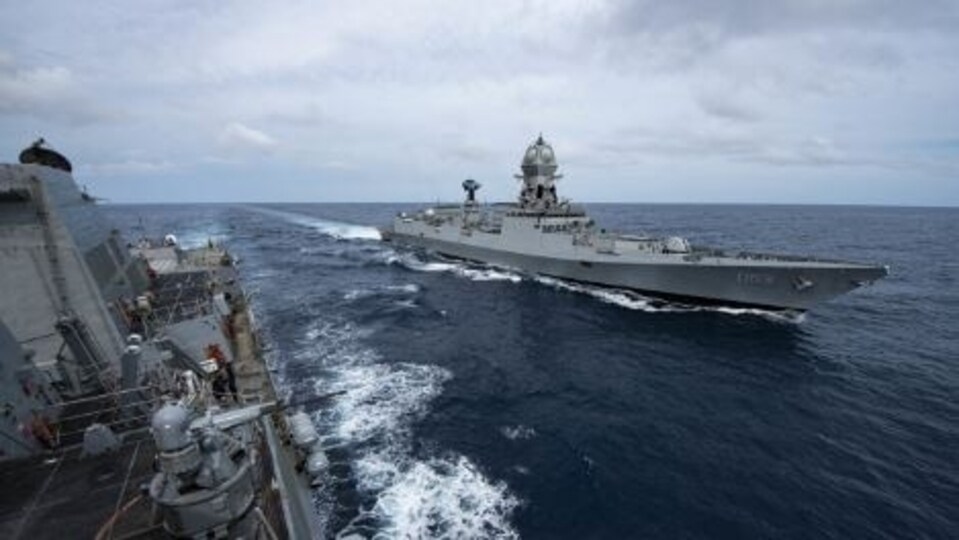
Keeping the evolving maritime security scenario in mind, Navy Chief Admiral R Hari Kumar is going to Vietnam to gift corvette INS Kirpan to Vietnamese People’s Navy as the first active warship gifted by India. Simultaneously, Indian stealth guided missile destroyer INS Kolkata and stealth guided missile frigate of INS Shivalik class along with a P8I anti-submarine warfare aircraft are on way to Sydney to participate in advanced exercises with Quad navies under the Malabar rubric. The Malabar exercises, as reported by HT, will be taking place off the coast of Sydney from August 11 to 22 and sending a signal to the island nation states in the far Pacific, who have been cavorting with the Xi Jinping regime ostensibly for getting funds under the Belt Road Initiative.
The Chinese military posture in East Ladakh under Western theatre command has not changed since the May 2020 PLA belligerence in Galwan and Pangong Tso. The PLA threat, however, has increased in the Eastern Sector with reserves being brought in from Central and Eastern Theatre command in the run-up to the 2022 National Party Congress. These reserve troops, part of the light to medium combined armed brigades, have not been pulled back since then with pressure on Siliguri corridor, Tawang and Kibuthoo sector in Arunachal Pradesh.
Fact is that a stale-mate exists all along the LAC as PLA has not deescalated its forces from either occupied Aksai Chin area or across Arunachal Pradesh with border villages being strengthened to tackle the worst case scenario. The Chinese activity incidentally has grown in India’s north-east with the Myanmar government looking the other way. Despite the presence of Chinese nationals and infrastructure upgrade in Coco Islands in Bay of Bengal, the Myanmar government denies any Chinese involvement.
Given the state of play, the Indian Navy is preparing plans beyond 2028 to counter the Chinese challenge in the Indian Ocean and larger Indo-Pacific as all the PLA surveillance ships and ballistic missile tracking ships traversing the Indian Ocean are designed to survey the Indian Ocean bed for future PLA submarine operations beyond the current conventional platform reach of Indian Navy. Over the years, the PLA Navy is preparing to chart out a route for its nuclear submarines entering Indian Ocean via Ombi-Wetar straits in Indonesia and then head down to south Indian Ocean via 90 degrees ridge to reach the eastern seaboard of Africa. That the Chinese have ambitious plans is evident from construction of a jetty in its naval base in Djibouti to dock an aircraft carrier. The only answer to this rising threat is that the Indian Navy acquires long legs and creates maritime domain awareness with the help of friendly Quad and the French Navy, which has assets in the Indian Ocean region and Far Pacific. The world is focused on the Chinese threat to Taiwan but that perhaps is a ruse to hide the PLA ambitions to rule the high seas in the Indo-Pacific.


