E-Paper



Watch out for the ‘statistical boost’ in the GDP numbers
A look at why GDP number may need to be taken with a pinch of salt.

 Prefer HTon Google


The National Statistical Office (NSO) will release GDP numbers for the quarter ending June 2023 on Thursday, August 31. Analysts believe that they are likely to paint a bright picture of the economy. A Bloomberg poll of economists has forecast forecast 7.8% GDP growth, which is a significant increase from the print of 6.1% in the quarter ending March 2023. RBI’s Monetary Policy Committee (MPC) resolution published earlier this month projected an 8% GDP growth for this period.

While there can be no argument that the Indian economy is doing reasonably well, there is merit in arguments made by some economists that the latest GDP numbers will overstate the economic momentum due to some methdological issues. For example, a research note issued on August 3 by HSBC economists Pranjul Bhandari and Aayushi Chaudhary, while projecting a GDP growth of 8% in the June quarter advises against taking the GDP numbers at face value. “But we caution that growth on the ground, though impressive, is not as high, and the GDP number may have to be taken with a pinch of salt”, the note says. Here are three charts which explains what’s happening.
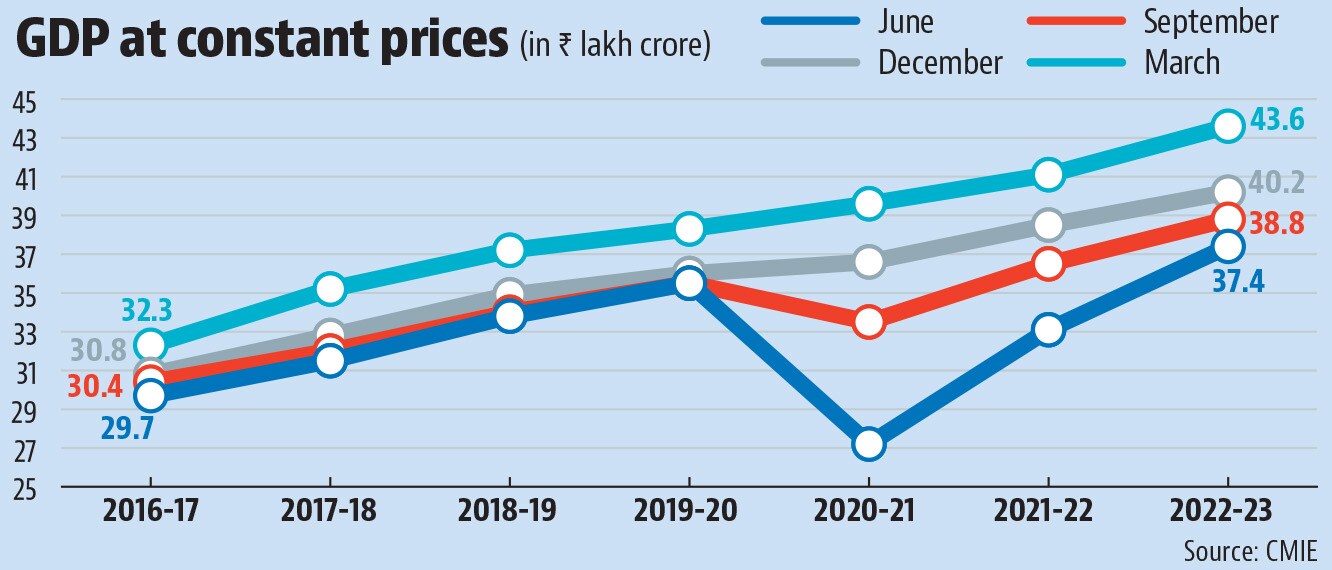
 The pandemic’s base effect is still a factor in the June quarter“Ever since the pandemic, the 1Q and 2Q data have not normalized. Base effects from a still-weak 1Q last year, could push GDP growth higher, statistically,” the HSBC note says. A comparison of quarterly GDP numbers shows this clearly. The biggest quarterly contraction in the fiscal year 2020-21 – annual GDP contracted by 5.8% in this year – was in the June quarter, which saw the 68-day long nationwide lockdown which began on March 24, 2020. While the contraction reduced significantly in the September 2021 quarter, the economy actually saw a small growth in the second half of the fiscal year. It is this fact which has played a role in the June quarter GDP growth numbers being significantly higher (21.6% in June 2021 and 13.1% in June 2022) than September (9.1% and 6.2% in 2021 and 2022), December (5.2% and 4.5% in 2021 and 2022) and March (4% and 6.1% in 2022 and 2023) quarters in the post pandemic period.
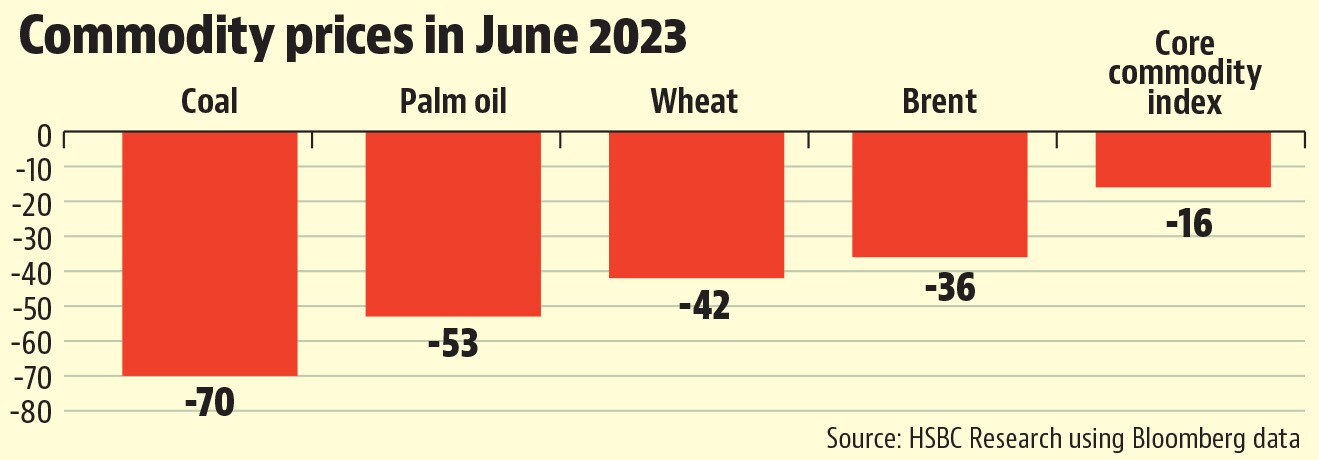
- A ‘statistical boost’ to manufacturing GVAAnother factor that could give a boost to June quarter GDP is a potential overestimation of manufacturing growth due to a contraction in input prices. This is the result of a methodological inconsistency in the way the NSO estimates GVA for the sector. At the heart of the issue is the practice of using single deflation – using the same index to deflate input and output prices to smoothen out the impact of inflation – instead of double deflation (using different indices to deflate the two ) in some components of GVA, especially manufacturing. The HSBC note explains this in detail. “The Statistics Office’s practice of doing single deflation instead of double deflation in calculating GVA data, leads to an overestimation of growth in periods when commodity prices are falling. But how much will it exaggerate growth this time? In the FY16 period we had estimated that a $40 per barrel fall in oil prices led to manufacturing growth being exaggerated by 4.5ppt (percentage points). This time around, oil prices have fallen by $20/b, which could lead to a 2.5ppt exaggeration in manufacturing growth, and a 0.33ppt exaggeration in headline GDP growth,” the note says. A January 2017 IMF Staff Discussion Note supports this argument. The note simulated single deflation method on GDP numbers of eight countries (Belgium, Brazil, Canada, France, Japan, Korea, the Netherlands, and the United States) using state-of-the-art deflation techniques which used the double deflation method and found that “single deflation can introduce a significant error in the gross value added growth”, which could range up to 3-4 percentage points in certain years. “The single-deflation estimates lead to a systematic underestimation of GDP growth in commodity importers during the global commodity price boom,” the IMF note added.
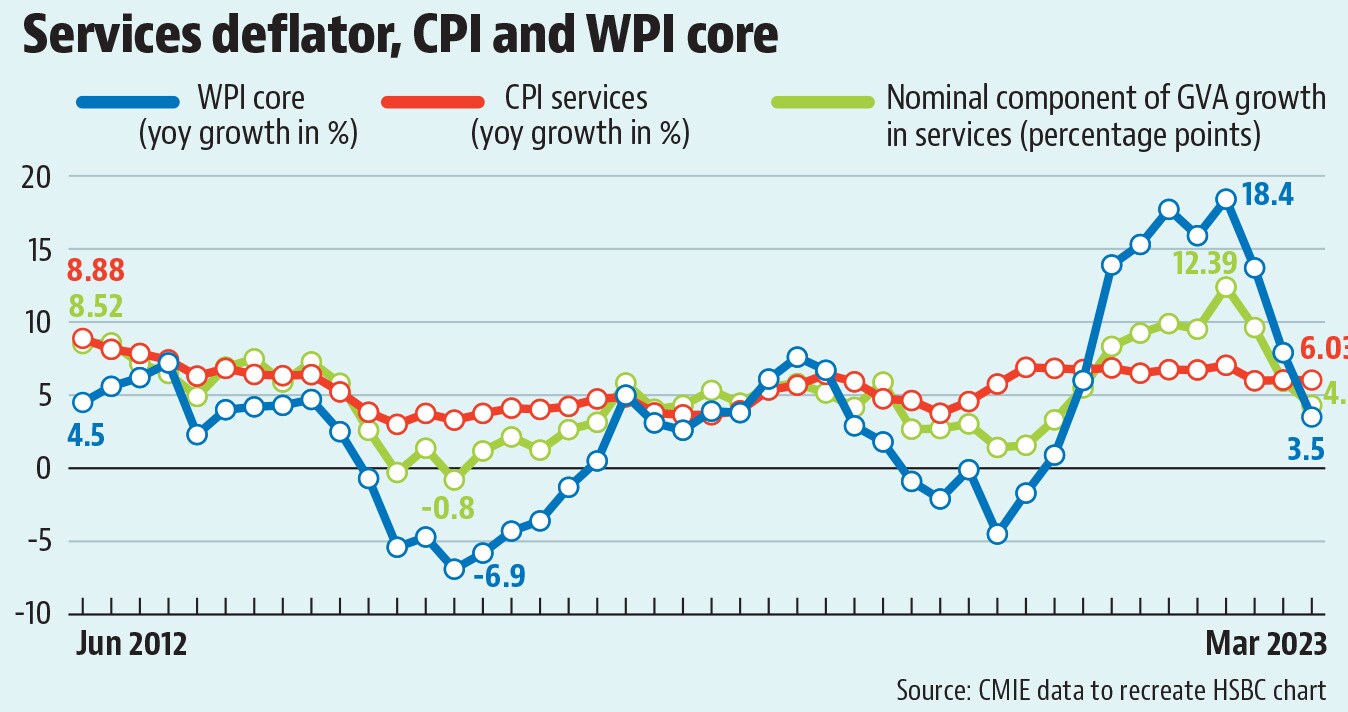
- The problem with service sector deflator in GVA numbersA large component of India’s services GVA is deflated using Wholesale Price Index (WPI) which does not have any services component in it. This means that a period of reduction in WPI – the WPI has contracted by 2.5% in the quarter ending June 2023 – will give an artificial boost to the service sector GVA number. The HSBC research note estimates that this will likely give a 1.2 percentage point of statistical boost to services GVA leading to a 0.67 percentage point boost to headline GDP. This means that issues with deflation of manufacturing and services sector GVA alone could give a boost of 1 percentage point to the June 2023 GDP number. To be sure, even 7% is a very good GDP growth number.