E-Paper



Wayanad copes with grief, looks to mitigate disasters
Multiple landslides, following torrential rainfall exceeding 570mm in 48 hours, started in a remote forest in Wayanadon July 30, 2024

 Prefer HTon Google


One recent rain-soaked morning, P Usman, clutching an umbrella, is making his way slowly past verdant tea plantations towards a large graveyard, fenced neatly with stone slabs. Opening the gate and taking a few steps in, Usman, in his late 50s, is quickly overwhelmed with emotion. His eyes well up. Inside the compound are scores of graves, most identified with names and photographs, and others marked only by small cement blocks. “That’s my cousin sister Muhsina,” he says, pointing to a grave marked by a black granite stone with her name etched on it. “And over there, her three children,” he says, choking on his words.
The rain is now heavier, and he moves closer to his sister’s grave, and begins reciting prayers in Arabic. The day is significant for Usman and others whose relatives are buried here: it marks the first anniversary as per the Islamic calendar of the July 30, 2024 landslides in Mundakkai-Chooralmala in Kerala’s Wayanad, a tragedy that claimed 298 lives and displaced over 700 families.
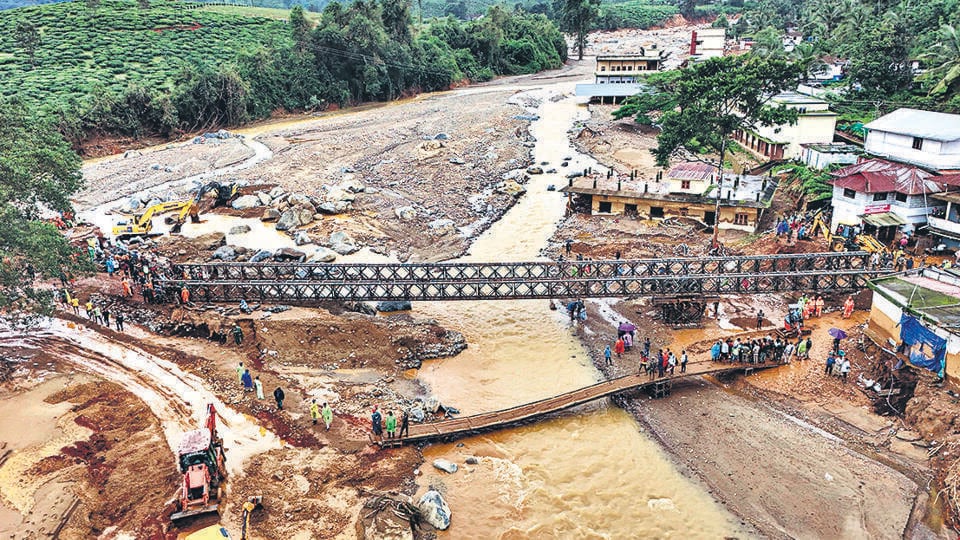
Multiple landslides, following torrential rainfall exceeding 570mm in 48 hours, started in a remote forest in the upper reaches of the hill-range in the early hours of July 30, causing large amounts of soil, rocks and vegetation to cascade down nearly 8km and flatten the settlements of Punchirimattam, Mundakkai and Chooralmala. An expert geological team likened the impact to a dam burst. The inclement weather, the time of the accident and the collapse of a key bridge over the swollen Punnapuzha river contributed to high fatalities. Search and rescue operations went on for almost two months, with body parts of the dead being found 50km away.
Dozens of the dead (from all faiths), were laid to rest at the specially-erected burial ground in Puthumala, coincidentally located just a few hundred metres away from a similarly devastating 2019 landslide-affected site. One grave contains the remains of three children, brothers aged nine, six, and three. Pens and toys have been left on the grave, likely things they loved.
Usman’s loss is both personal — his cousin, her children, and at least seven from her husband’s family — and communal.
“For around eight years, I was the driver of a state transport bus that operated daily services to Mundakkai. So I knew these people, many by name and others by face. I have shared tea and meals with them. Their children used to board my bus to go to school. Most of them are now gone,” he recalls, adding that he got a transfer just three months before the disaster struck.
Questions about rehabilitation
Around 25km away, 40-year-old Regina Johny has been trying to find closure from the deadly landslide that claimed the lives of her husband Johny and their two teenage children, Abhinav and Anugrah. She herself was trapped in the mud, with only her hand above the ground. It was noticed by alert rescue workers; at the time, her survival was deemed a miracle by rescue personnel and local media.
Over the past year, Regina has been flitting between the homes of her siblings in Wayanad and keeping herself occupied by working as a sweeper at the district government complex, a job she found through employment exchange and for which, as a civil engineering diploma holder, she is far too qualified. “It’s not what I want to do, but at the end of the day, it’s a government job. At my age, I don’t know if I will get another job,” rues Regina.
A year after the landslide, there are mixed feelings among survivors and kin of the dead about how the state government handled the disaster and the ambitious plan it has set forth for their rehabilitation. A mega residential township for the landslide-affected is slowly taking shape near Kalpetta, and plans are in the offing to fine-tune monsoon rainfall predictions and set up shelters as part of long-term measures.
Just 2km away from the centre of Kalpetta, the headquarters of Wayanad district, is the 64-hectare plot of the erstwhile Elstone tea estate where the government is building the township. Each family has been offered a 1,000 sqft home in a roughly 3,300 sqft plot within the township. Apart from homes, the township will also feature community centres, a market area, a primary health centre, an anganwadi and playgrounds for children, the government claims.
On a recent morning, workers of the Uralungal Labour Contract Co-operative Society (ULCCS), which is in charge of the project, are putting finishing touches to the first model house. The foundations for around half a dozen houses are also ready; the work was inaugurated by chief minister Pinarayi Vijayan in April. With over 300 houses to be built, there are serious doubts over whether the December 31 deadline set by the government will be met.
But Wayanad district collector DR Meghasree, who took charge just days before the landslide hit last year, appears confident. “The construction has begun, and the first model house is nearing completion. Work is progressing as per schedule. We will meet the December 31 deadline,” she says.
The township project is seen as a top priority for the Vijayan government, especially since the state heads for Assembly polls next year. As part of short-term rehabilitation, survivors are also entitled to allowances for monthly rent and livelihood.
The administration pays ₹6,000 as monthly rent for those who lost their homes in the disaster until their new homes are ready in the township. And as part of livelihood allowance, two members of each family are entitled to a daily sum of ₹300 for a year. Bedridden patients get an extra allowance.
While these allowances are being disbursed, there have been complaints of delay and eligible beneficiaries being pushed off the list citing arbitrary reasons. On June 26, a group of survivors protested in Chooralmala against alleged delay in payment of allowances and were booked for allegedly manhandling the local village officer.
Sulaiman CH, whose home was marked as unsafe in the landslide-affected zone, complains that the government assistance has run into arrears for the past couple of months. “The first few months, the payments were on time. But now, they have run into arrears. At a time when we have lost everything and have to start from zero, it’s difficult to survive without the government’s help.”
Samshad Marakkar, president of the Wayanad district panchayat who represents the Congress, accuses the administration of reducing the number of beneficiaries without valid reasons.
“Earlier, the livelihood allowance of ₹9,000 per month was being distributed to around 1,000-odd families. Now, it has come down to 650-odd. They are essentially filtrating the beneficiaries and categorising them. Some are getting the allowance while others aren’t. It’s causing fissures.”
Meghasree says the government has tried its best to include all eligible people, and published several lists with names of beneficiaries. “We have conducted home visits of all 402 displaced families, and 98% of them are happy as per our survey; (but) we cannot give away allowances to those who are ineligible.”
Short and long-term solutions
With Wayanad, an ecologically fragile region in the Western Ghats, reporting two major landslides and numerous minor landslips in the space of five years, the administration has come under fire for ignoring the larger environmental challenge. Over 31% of land in Wayanad has been classified as “highly susceptible to landslides” by the Hydrosense lab at IIT, Delhi. This correlates with a 2022 study finding that 62% of forests in the district vanished between 1958 and 2018 while the plantation cover rose by 1,800%.
Meghasree, who is also the chairperson of the district disaster management authority (DDMA), says the government is aware of the issue. “There are already strict demarcations in high landslide-prone zones or red zones for allowing construction work. We have tightened the restrictions there. Administrative sanction has been received to construct shelters in eight panchayats of Wayanad where people can be relocated during heavy rain. In the non-monsoon season, they can be used as community halls by local panchayats.”
N Badusha, chief of the local advocacy group Wayanad Prakruthi Samrakshana Samithi, says around 4,500 families have been identified by state and union governments through surveys as living in areas prone to disasters like landslides. Mundakkai is one of those areas.
“These families are mostly poor farmers and tribespeople. They must be relocated from the unsafe slopes gradually. The government owns around 1.61 lakh acres in Wayanad as per documents submitted in the high court. So paucity of land is not a problem,” he says.
The government is also working on accurately recording rainfall data and monitoring the movement of cumulonimbus clouds that are responsible for extreme weather globally, Meghasree adds.
“There are 240 existing rain gauges across the district, which have been repaired and cleaned. Responsibilities have been given to young people and students for each gauge and recording rainfall data. Additionally, we have received approval from Kerala State Disaster Management Authority (KSDMA) for 400 additional superior-grade rain gauges.” The state has signed an MoU with the India Meteorological Department (IMD) to install an X-band radar at a college in Pulpally. The radar, expected to be operational by next year’s monsoon, will enhance weather forecasting accuracy and give timely alerts on extreme weather in the Western Ghats, she says.
The ULCCS has been given the contract to clear debris from the Punnapuzha river bed. And ₹195 crore, the bulk of which shall be used for applying river training modules and setting up alarm system, has been earmarked under the Union government’s Special Assistance to States for Capital Investment scheme.
Some lessons are yet to be learnt
CK Vishnudas, director of the Hume Centre for Ecology and Wildlife Biology based in Wayanad, has been playing a key role in the collection of daily rainfall data using gauges and relaying alerts to the district disaster management authority (DDMA) in case of extreme weather.
He points out that 18 of the 27 gram panchayats in Wayanad are prone to landslides and mudslips. “The western slopes of Wayanad are at high-risk because since 2018, we have been getting normal monsoon rainfall plus extra localised downpours. During this period, there must have been gradual changes to soil composition in the slopes. We have to be careful and we need more investments in setting up early warning systems.” But some lessons do not seem to have been learnt.
Projects like the Anakkampoyil-Meppadi tunnel road, connecting the Kozhikode and Wayanad districts, which involves drilling through highly vulnerable terrain in the Western Ghats, should be avoided, Vishnudas says, referring to an ambitious infrastructure project approved in 2025.
And tourism needs to be checked, Badusha adds.
Tourist activities, including adventure tourism, are being allowed without proper checks in sensitive areas of Wayanad by the government, he says. “From off-road tours to building glass bridges, such activities in vulnerable hill slopes can trigger landslides. The government must put a stop to it.”
At the landslide site, two police constables are standing guard on the road leading to Chooralmala, barring access to everyone except journalists and residents. “With heavy rains in the region, it’s not safe to go there,” one of them says.
Earthmovers employed by ULCCS are at work, trying to construct a bund to control the flow of the Punnapuzha river.
The government high school at Vellarmala, on the banks of the river, remains in the same dilapidated state; its students have been moved to another school. Many homes, untouched by the landslide but deemed unsafe to live in, and cars abandoned by their owners are overrun with weeds. A once-prosperous and densely populated settlement is now a ghost village.