E-Paper



What is wrong with saffronisation of education system, says V-P Naidu
Foreign dignitaries coming to India speak in their mother tongue instead of English despite knowing it because they take pride in their own language, Naidu added.


Vice President Venkaiah Naidu on Saturday countered allegations that the Bharatiya Janata Party (BJP) government was saffronising the country’s education system and asked “what is wrong with saffron?”, as he called on Indians to give up their “colonial mindset”.
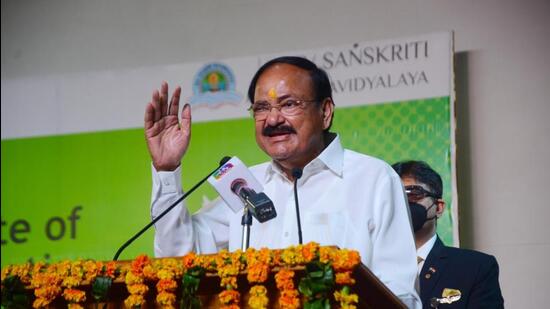
Asserting that “bhartiyakaran” (Indianisation) of the education system has been the aim of the new National Education Policy, Naidu said: “But the moment you say it, some English loving and living people say we want to go back…yes we want to go back to our roots…to know greatness of our culture and heritage…to understand the great amount of treasury in our Vedas, our books, our scriptures…they don’t want us to know our greatness; they want us to suffer with inferiority complex…they say we are saffronising…what is wrong with saffron…I don’t understand it...”
He made the statement after inaugurating the South Asian Institute of Peace and Reconciliation at the Dev Sanskriti Vishwa Vidyalaya in Uttarakhand’s Haridwar.
“Prolonged colonial rule deprived large sections, including women of education and only a small elite class had access to formal education. It is necessary to provide quality education to all, only then can our education be inclusive and democratic,” he added.
He further encouraged youngsters to propagate their mother tongue. “I would like to see a day in my lifetime when Indians talk to their fellow countrymen in their mother tongue, administration is run in mother tongue and all government orders are issued in people’s language,” he said.
Foreign dignitaries coming to India speak in their mother tongue instead of English despite knowing it because they take pride in their own language, he added.
Suryakant Dhasmana, state Congress vice president said that vice president should not have made a statement like “what is wrong with saffron” as he is on a constitutional post. “As vice president, he should not talk like a BJP leader. Such statements are not expected in the speech of the country’s vice president
Talking about rising tensions in the strife-torn world, Naidu said that peace is a prerequisite for humanity’s progress. “Peace has a cascading effect—it engenders social harmony and paves the path for progress and prosperity. The ‘dividend of peace’ benefits every stakeholder and brings wealth and happiness to the society”, he said.
Naidu said that India’s commitment to peace and welfare of humanity transcends geographical boundaries. “India is known as a land of peace. We have always accorded highest priority to maintaining peace and ensuring harmonious living of all sections of the society,” he added.
Noting that South Asian countries share common history and civilization, he also called for respecting the linguistic, ethnic and cultural diversities in the region, which showcase the core values of tolerance and peaceful coexistence. “As the ‘spiritual capital’ of the world, India will continue to play its part in maintaining peace and ensuring harmony,” he added.
After inaugurating SAIPR, Naidu also visited Pragyesh Mahakal Temple and planted a Rudraksha sapling at the university premises. The Vice President also paid tribute to the martyrs at the ‘Wall of Heros’ on the campus and launched various publications of the university, including its new website.