
 E-Paper


Whom will Cong pick as next Kerala CM? Poster war among 3 contenders, a Tharoor-Kharge meet, Delhi decision anytime now
Three senior leaders are in the race: V D Satheesan, Ramesh Chennithala, and KC Venugopal. All three are in Delhi as of Saturday.

 Prefer HTon Google


The Congress-led United Democratic Front's (UDF) emphatic sweep of the Kerala assembly elections — 102 seats in a 140-member House — has ended a decade of Left Democratic Front (LDF) rule, but the euphoria of victory has quickly given way to a fierce, messy, and very public battle over who becomes the state's next chief minister.
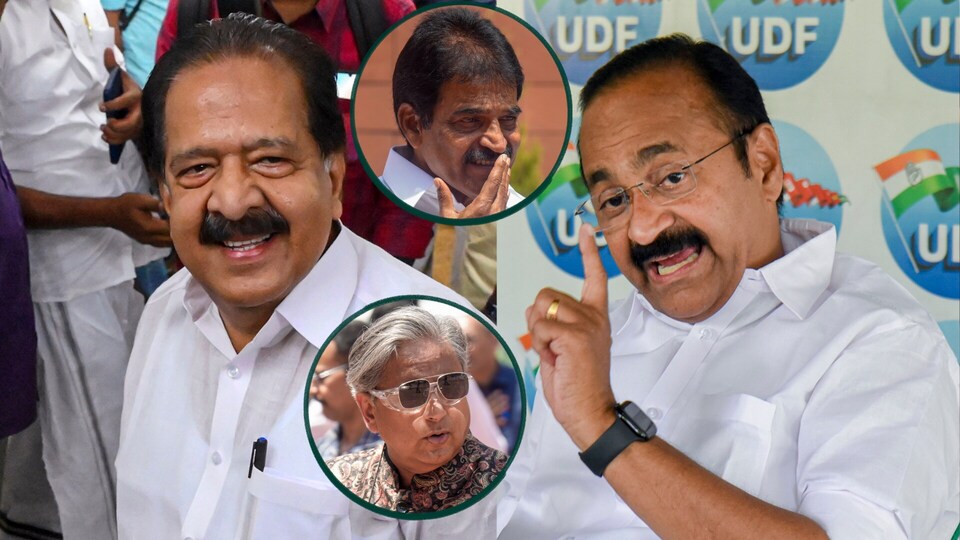
Three senior leaders are in the race: VD Satheesan, Ramesh Chennithala, and KC Venugopal. All three are in Delhi as of Saturday; the Congress high command has been meeting through the week; and a final decision was now expected within 24 hours.
The last time Congress held power in Kerala was under Oommen Chandy, whose government ended in 2016. Chandy, who passed away in July 2024, remains perhaps the most revered figure in recent Kerala Congress history — which made it all the more jarring this week when a flex board bearing his image, alongside KC Venugopal's, was torn down and doused in black oil by rival supporters.
The contest has spilled onto Kerala's streets. Satheesan’s supporters held marches from Thiruvananthapuram's Palayam Martyrs' Memorial. Venugopal's posters appeared along Trivandrum Road. Chennithala's backers put up hoardings in Idukki.

The destruction of the Venugopal flex board triggered a furious response from senior leaders across the party.
"People who destroyed the flexboard of Venugopal, which contained images of other leaders including Chandy, cannot be seen as part of Congress," said Congress MP Rajmohan Unnithan. PJ Kurien was equally blunt: "A chief minister cannot be decided through pressure tactics." MLA T Siddique called the public attacks on senior leaders a source of "deep pain and disappointment”, adding that leaders who dedicated their lives to public service “should not be humiliated in public”.
A fourth name — Shashi Tharoor — has also circulated mostly in Delhi circles, though he is widely seen as a figure of central politics rather than state administration so far.
What’s the Congress process?
Formally, the decision now rests entirely with the All India Congress Committee (AICC) leadership. At the state Congress Legislative Party meeting in Thiruvananthapuram earlier this week, all newly elected party MLAs passed a resolution authorising the high command to select the leader. AICC observer Mukul Wasnik, who attended the meeting alongside Ajay Maken, confirmed this.
Satheesan, Chennithala and Kerala Pradesh Congress Committee (KPCC) president Sunny Joseph flew to Delhi on Friday night. Venugopal, based in the capital, was already there. Congress observers submitted their report to party president Mallikarjun Kharge.
A meeting involving the senior Kerala leaders was held at Kharge's residence on Saturday afternoon.
Senior leader K Muraleedharan, speaking to reporters in Thiruvananthapuram, said a final decision was likely within 24 hours, while cautioning that "seniority is not the sole criterion" and that the views of coalition partners would also matter. "This is a coalition government," he said.

Know the contenders
VD Satheesan, 61, is widely considered the frontrunner. A five-time MLA from Peravur in Ernakulam district, he spent the last five years as Leader of Opposition and built a reputation as the most visible face of the anti-LDF charge in the assembly. Syed Sadikali Shihab Thangal, chief of UDF ally IUML in Kerala, has openly backed him too.
Congress leader KP Noushad made the case for him too, "VD Satheesan's contribution has been significant as Leader of the Opposition and UDF chairman, making him naturally the frontrunner."

Ramesh Chennithala, 69, who won from Haripad in Alappuzha, is a former Leader of Opposition and national president of the Congress student wing NSUI. Thus, he has strong organisational roots both within Kerala and across the party nationally.
He met Sonia Gandhi in Delhi earlier this week as consultations gathered pace. But the 2021 defeat occurred under his leadership, a fact his rivals' camps have not let the high command forget.
KC Venugopal, 63, brings a different kind of weight — he is Congress's national general secretary (organisation) and enjoys the trust of both Kharge and Rahul Gandhi. His crowning as CM, however, would create a significant vacuum at the national level. He also did not contest the assembly elections, which may count against him if the high command decides the CM must come from the elected MLAs. He can, legally, win and enter the assembly within six months if he is made CM.
Tharoor’s meeting amid this
Tharoor's meeting with Kharge on Friday, where the Thiruvananthapuram MP said he went to "share impressions of the situation in Kerala", added a layer of intrigue.
His name has been in circulation as a dark horse, particularly in Delhi circles, though analysts and party insiders consistently note that he has long been seen as a figure for central politics rather than state administration.
He has not publicly backed any of the three main contenders, positioning himself as a statesman above the factional fray.
What happens next?
The Congress leadership holds all the cards now; Kharge and Rahul Gandhi will decide.
Muraleedharan expressed confidence that unity would follow whoever is named. “There will not be any revolt in the party,” he asserted.


