
 E-Paper



Why is Ladakh seeing youth-led protests? Four demands form core of violent unrest in Leh
Demand is not merely for statehood; extends to a wider set focused on preserving the unique character of the mostly tribal region with cold desert climate

 Prefer HTon Google


Protests led by mostly young men turned violent in Leh, the capital of the union territory of Ladakh, on Wednesday, two days after leaders of the Leh Apex Body, an independent organisation that's been leading the protests, warned that public patience was wearing thin.
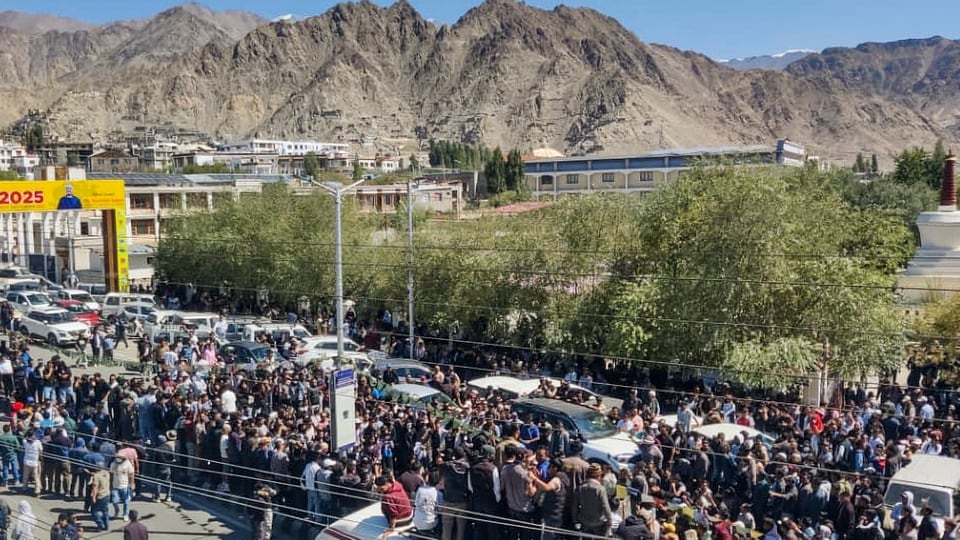
The demand is not merely about statehood, but extends to a wider set focused on preserving the unique character of the mostly tribal region. Buddhist and Muslim bodies, representing the two major communities in Ladakh UT, have been together in this movement.
The LAB had announced on Monday that its leaders won't end their hunger strike until their demands are met. A 35-day hunger strike was started by the leadership of the LAB on September 10.
Famous activist Sonam Wangchuk's ongoing strike was under its umbrella, though he has condemned the violence as nonsensical and ended his strike in disgust.
The LAB, along with the Kargil Democratic Alliance (KDA), has been in dialogue with the Ministry of Home Affairs over its demands, for which they have been agitating for the last four years.
Ladakh is a strategically important region for India as it borders China and has seen border tensions over the years.
Follow live updates: Leh sees massive youth protest, arson
What are immediate demands behind Leh protest?
- What LAB sought: The LAB, whose youth wing had given a call for a major protest on Wednesday, had demanded an immediate next meeting with the central government as its members' hunger strike was on since September 10.
- What MHA set: The Union Ministry of Home Affairs (MHA), which oversees Ladakh since it's a UT, then announced that talks would next be held on October 6. The last meeting was held in May; the most recent talks have been ongoing since 2024.
- ‘Dictation’ not accepted: But LAB members saw the October date-setting without discussing with them as “just dictation” when “people are on hunger strike”. Their call for a shutdown and protest turned violent on Wednesday.
In an online press conference earlier, LAB co-chairman Chering Dorjey had said they'd told the government they could not end their hunger strike until an agreement was reached. "Our protest is peaceful, but people are getting impatient. The situation may get out of our hands," Dorjey said, as per a report by news agency PTI.
‘People say got nothing via peaceful protest’
Sonam Wangchuk had said on Monday that the BJP-led central government should keep had made a promise to include Ladakh under the Sixth Schedule of the Constitution. He stressed the promise should be fulfilled before the upcoming Hill Council polls. "If they fulfil their promise, Ladakh will vote for them. They will benefit the most, and vice versa," Wangchuk had said.
Also read | Sonam Wangchuk's appeal as Leh erupts in youth protests: ‘Damages our cause’
He had also said people were growing impatient. "They (people) tell us we are getting nothing through peaceful protest. We do not want anything to happen that may be embarrassing for India," Wangchuk said.
What are major demands behind Leh-Ladakh protest?
Though the demands have been there ever since Ladakh was made a UT — one of two UTs upon Jammu and Kashmir state's division in 2019 — the year 2024 saw it transform it into a significant agitation.
The UT of J&K got an assembly and has since got its first elected government too. Ladakh remains more centrally governed.
Ladakh also lost some of its protections when rules governing land ownership by non-locals went away, along with abrogation of Article 370 and the related special status of the undivided J&K state.
Since that move by Prime Minister Narendra Modi's BJP-led NDA government, people in Ladakh have rallied around a four-point agenda since:
- Statehood for Ladakh, as UT status has not fulfilled their demands of self-governance and protections
- Inclusion of Ladakh under the Sixth Schedule of the Indian Constitution, to safeguard its tribal status
- Setting up a separate public service commission for Ladakh, to address joblessness
- Two parliamentary seats for Ladakh, as against the one it has for now, for more say at the Centre
What is the Sixth Schedule issue?
The MHA reportedly agreed to discuss only the last two demands: separate service commission, and two Lok Sabha seats instead of one. The counter-argument to the statehood demand has been that Ladakh has now already got UT status that it was demanding even when it was part of J&K state.
But the Sixth Schedule demand has its own ramifications.
The Sixth Schedule grants greater autonomy to tribal areas, such as those in Assam, Meghalaya, Mizoram, and Tripura.
Autonomous District Councils (ADCs) manage land use, inheritance laws, and social customs. ADCs hold legislative, executive, and financial powers, with the ability to collect taxes and manage local resources. ADCs can make laws that supersede those of the state, albeit with approval by the governor.
At present, the Ladakh Autonomous Hill Development Councils (LAHDCs) have executive powers for district-level planning and development.
Unemployment major issue
Unemployment, and the slow pace of government recruitment, has angered the youth too. That's where the demand for a separate service commission comes from.
A recent government survey said 26.5% of graduates in Ladakh are unemployed.
The same rate for the whole country stood at 13.4%.
Data showed the highest unemployment in Andaman & Nicobar at 33%, with Ladakh the second worst at 26.5%, among all states and UTs.
When talks with MHA began in December 2024, there was reportedly as a proposal from the government for 95% reservations for Ladakhis in jobs.
Reacting to Wednesday’s violence, KDA leader Sajad Kargili wrote on X: “Whatever is happening in Leh is unfortunate. Ladakh, once peaceful, is now gripped by frustration & insecurity due to Govt’s failed UT experiment. The onus lies on the Govt—resume dialogue, act sensibly & fulfill Ladakh’s demand for Statehood & Sixth Schedule without delay. Also I appeal people to remain peaceful and steadfast.”
The government sees a conspiracy in the protest, with officials saying the youth were “used as cannon fodder”. They also pointed towards references to the recent “Gen Z” protests in Nepal as evidence of a “sinister plot”.


