
 E-Paper



Number Theory: Will GM mustard be a game changer for the edible oil sector?
India’s biotech regulator, the Genetic Engineering Appraisal Committee (GEAC) has approved the commercial cultivation Dhara Mustard Hybrid-11 (DMH-11), a genetically modified (GM) variety of mustard.

 Prefer HTon Google


India’s biotech regulator, the Genetic Engineering Appraisal Committee (GEAC) has approved the commercial cultivation Dhara Mustard Hybrid-11 (DMH-11), a genetically modified (GM) variety of mustard. While the decision, which is unlikely to lead to large-scale cultivation of this variety in the current cropping season, was made without additional scientific trials, and comes with certain caveats, a large-scale adoption the technology could lead to a radical change (for good) in India’s edible oil economy. Here are four charts which explain this in detail.
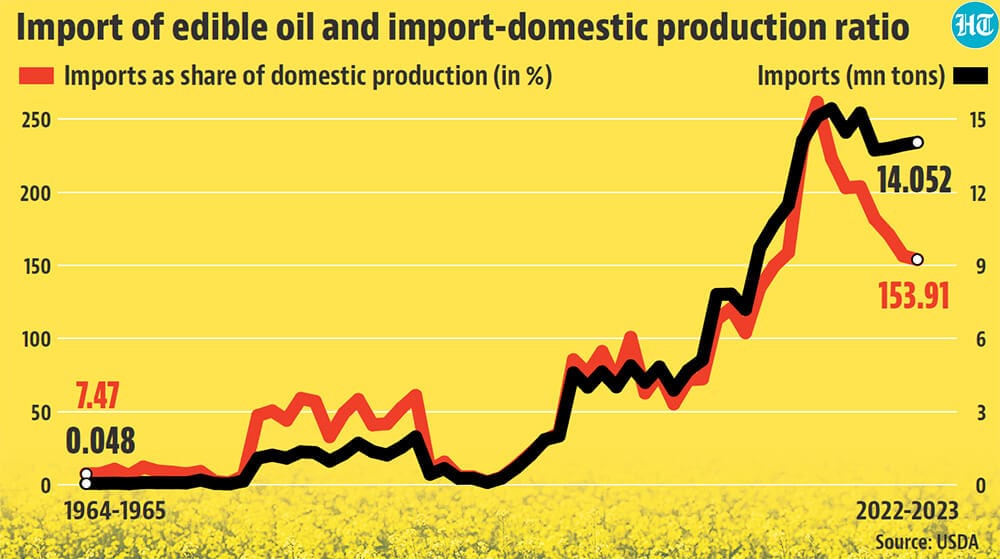
Import dependence for edible oil has become a huge problem for India
To put it simply, India imports more edible oil than it produces. Data from the US Department of Agriculture (USDA) shows that India is likely to import 14.1 million tonnes of vegetable oil in 2022-23, whereas domestic production is expected to be just 9.1 million tonnes. Things were not this bad at one point of time. USDA data shows that the import to domestic production ratio was just 0.07 in 1962-63. The import dependence increased drastically after the liberalisation process in 1990. Palm oil is the largest import when it comes to vegetable oils in India. In quantity terms, it was just 1% of total vegetable oil import in 1962-63 and now stands at more than 40% of our total vegetable oil imports.
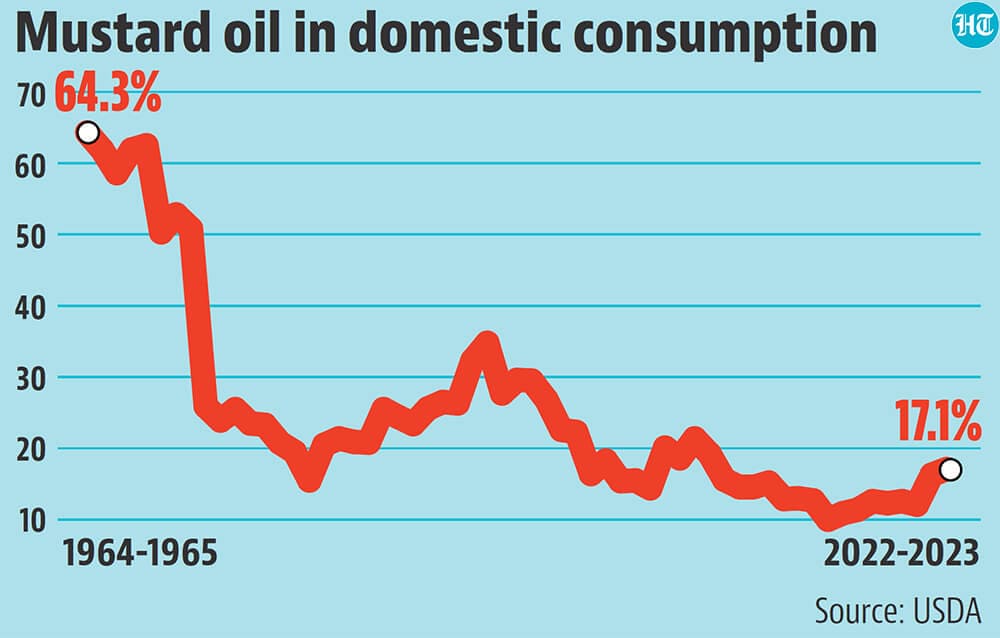
The growing import dependence has been accompanied by falling share of mustard oil consumption
In many ways, India’s import dependence in edible oil is also a story of falling domestic consumption share of mustard oil. According to USDA data, mustard oil had an almost two-third share in domestic consumption of edible oil in early 1960s. This fell sharply in the 1970s and has fallen even more in the last two decades, with mustard oil accounting for just about 12% at the beginning of this decade.
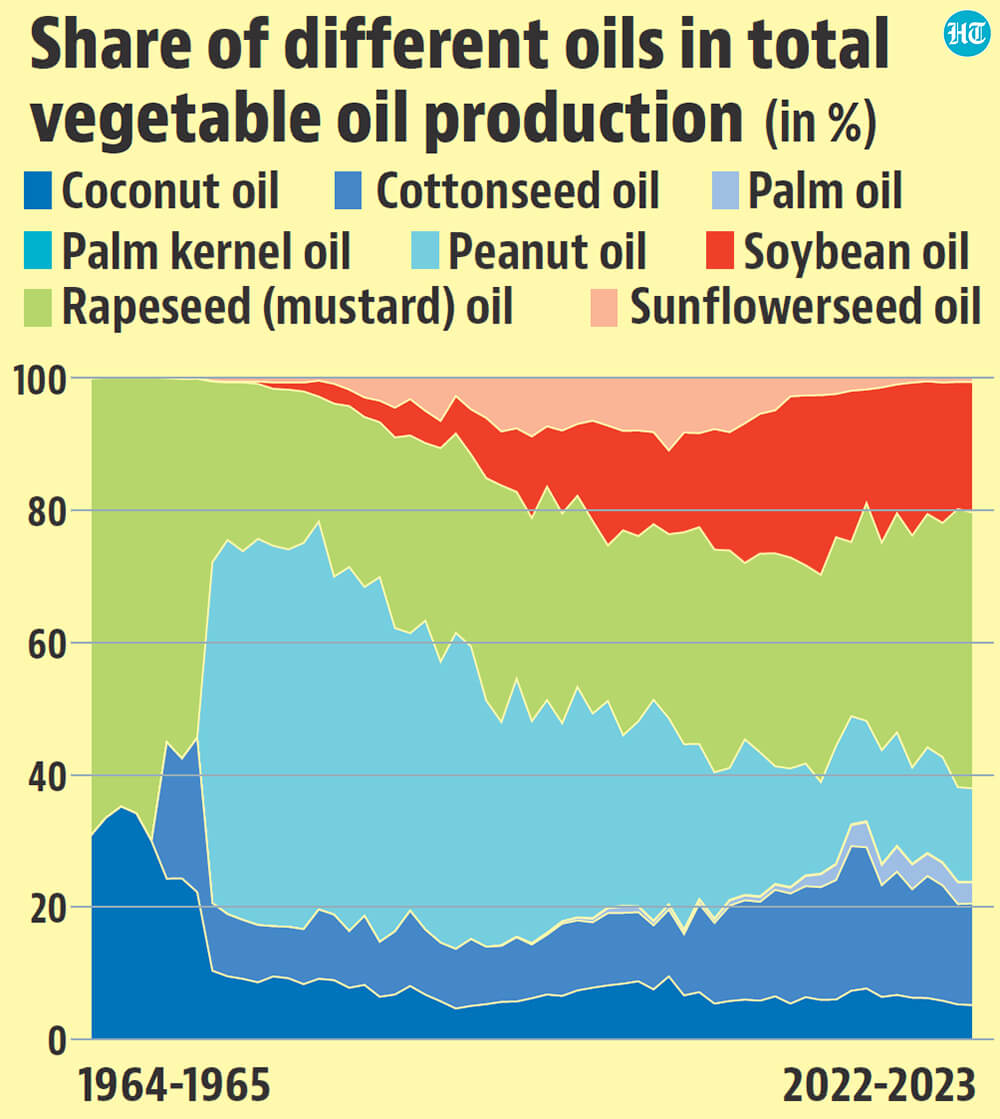
But mustard oil is the still the largest produced domestic edible oil in India
The proliferation of palm oil in domestic food consumption, notwithstanding, mustard oil continues to be the largest produced edible oil in India. USDA shows that it is expected to have a share of more than 40% in total vegetable oil production in 2022-23. This makes mustard the ideal candidate for any radical strategy to overhaul India’s edible oil economy and reduce our import dependence in edible oil.
Bt Cotton experience suggests that GM technology has a big potential to boost production
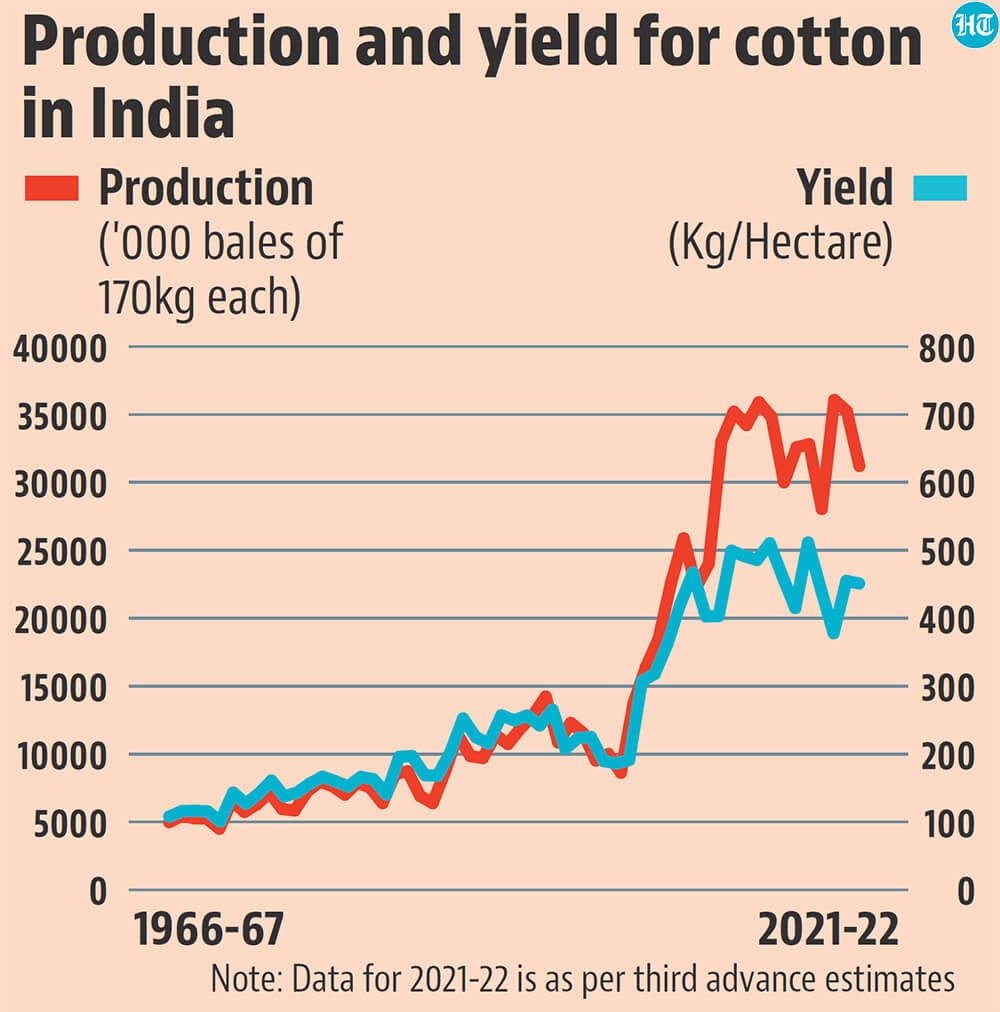
The only GM crop which is being cultivated on a large-scale basis in India at the moment is Bt Cotton. After it was introduced in 2002, cotton production and headline numbers for yield have improved significantly in India. If GM mustard were to have a similar effect in edible oil production in the country, India can hope to cut down drastically on its edible oil imports, give a boost a to farm incomes, and perhaps also substitute some environmentally unsustainable practices such as rampant rice cultivation in states like Punjab.
But the GM story might not as simple and unequivocally good as it sounds
Once again, Bt cotton is a good place to begin this argument. A 2020 article published in Nature, among the leading multidisciplinary science journals in the world, argues that the perceived yield gains from adoption of Bt Cotton in India are more a result of increased input intensity rather than a simple jump due to usage of the GM variety. “The changes in inputs to Indian cotton production in the early 2000s are not only important because they largely explain the surge in yields that has been uncritically attributed to Bt seed…It now appears that Bt cotton’s primary impact on Indian agriculture will be its role in this rising capital-intensiveness rather than any enduring agronomic benefits”. The study argues that this could make farmers economically vulnerable rather than unambiguously better off. “The rising input dependence of Indian cotton farming is also important because it has pushed farmers into an increasingly capital-intensive production regime, even as they continue to face considerable risk from year-to-year agroecological and market vagaries. Capital-intensive cotton farmers elsewhere in the world enjoy economic safety nets that are lacking in India”, it adds.
When read with the fact that global opinion is still divided on the long-term scientific ramifications of GM crops such as their effect on larger biodiversity – European countries still do not allow GM crops – and that even with GM mustard, some of the critical trials will continue to take place even as commercial cultivation has been allowed, there is more than enough reason to adopt a vigilant rather than exuberant stance to the promise of GM mustard being a silver bullet for India’s edible oil economy.


