E-Paper



Number Theory: Will Hemant Soren’s ST pitch aid JMM prospects?
The BJP performed much better than the JMM even in ST-reserved Lok Sabha constituencies during the 2019 general elections
Updated on: Feb 6, 2024, 07:39:20 IST


Share via


Copy link

With Champai Soren-led Jharkhand Mukti Morcha (JMM) government winning the trust vote in the assembly on Monday with a 47-29 margin, JMM and its allies have survived their first test after the arrest of Hemant Soren. Former chief minister Hemant Soren in his speech in the assembly – he was allowed by the courts to participate in the trust vote – leveraged his scheduled tribe (ST) status to attack the Bharatiya Janata Party (BJP). Will this approach work for the JMM in the 2024 general elections and the assembly elections which will follow late this year? Here is what an HT analysis shows.

Will Hemant Soren’s ST pitch aid JMM prospects?
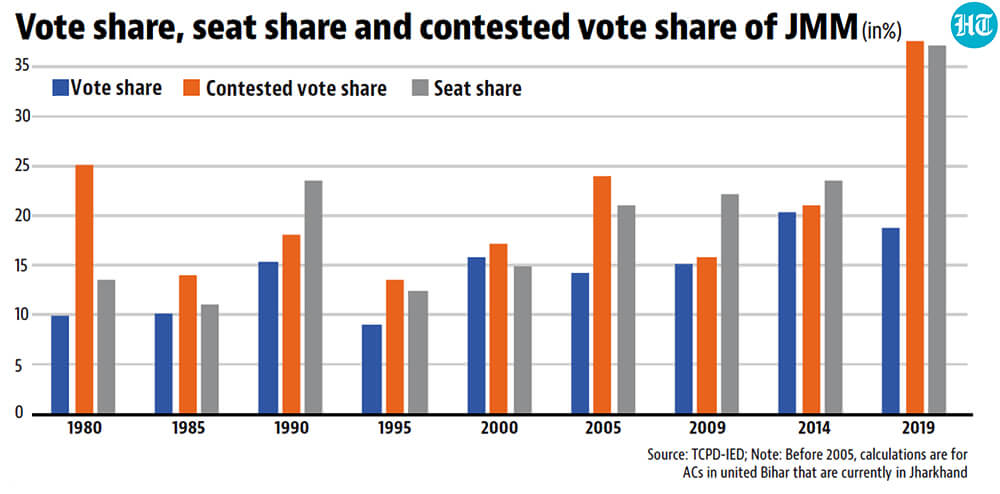
 JMM’s popular support seems to have surged after the 2014 electionsWhile the movement for creation of a separate Jharkhand state dates back to the period before independence, the JMM was only formed in 1972. An HT analysis of assembly constituencies (ACs) which were carved out to create Jharkhand in 2000 shows that the JMM’s vote share was in the ballpark of 10%-15% between 1980 and 2009. This number increased to more than 20% for the first time in 2014, and dropped slightly to 18.7% in the 2019 elections. In terms of seat share, 2019 was the JMM’s best ever performance in the state when it won 37% of the 81 ACs in the state. What explains the rise in JMM’s seat share in 2019 despite a fall in vote share? The contested vote share trend of the JMM, puts this in perspective. In 2019, JMM contested only 43 ACs spread across 18 out of 24 districts of the state. However, in the 2014 assembly elections, JMM contested on 79 ACs.
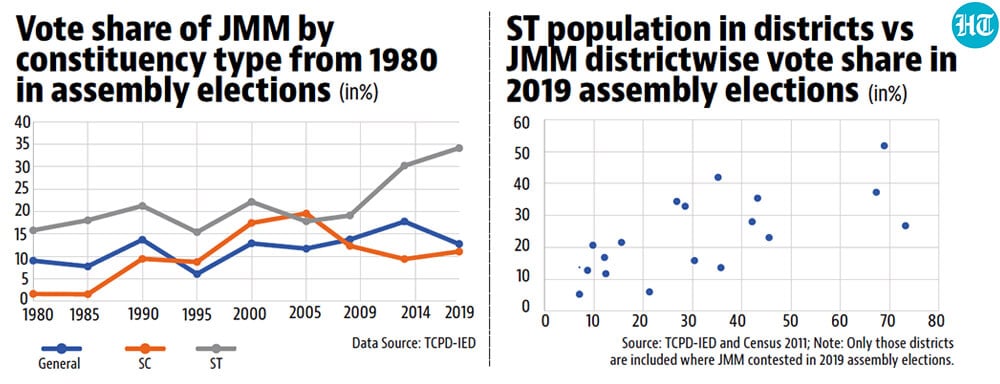
- How important are STs for JMM’s political fortunes?The JMM pretty much spearheaded the struggle for creation of Jharkhand since its inception and dubbed it as a political struggle for ensuring justice for STs who, it claimed, were denied their rightful claims under a united Bihar. Does this rhetoric match the JMM’s political support among ST voters? One way to look at this is to compare JMM’s vote share and seat share among ST and non-ST ACs in Jharkhand since 1980. Data shows that the JMM has always performed better in ST ACs than the non-ST ACs and the performance gap has actually increased in the recent period. In fact, there is good reason to believe that the JMM’s ST-voter advantage extends beyond just ST-reserved ACs, as can be seen from a positive correlation between JMM’s contested vote share and district-wise share of ST population in the state.
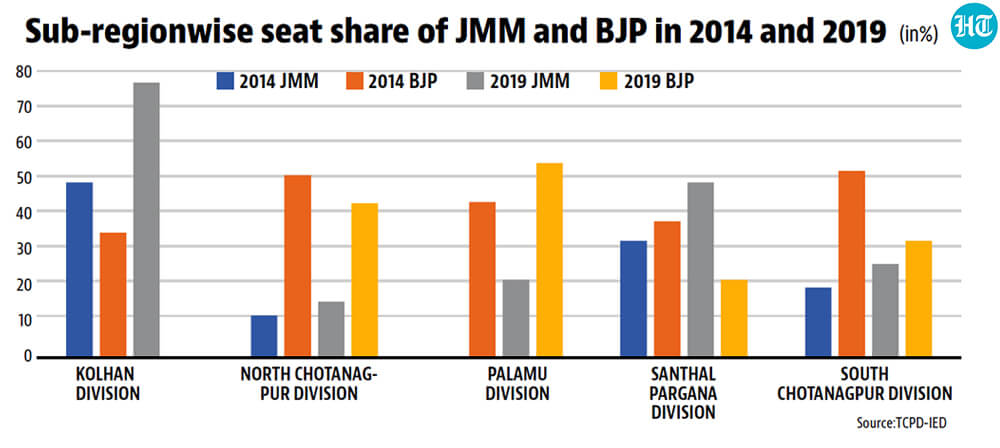
- Did the JMM’s gains in stronger ST pockets in 2019 come at the cost of the BJP?This is an important question to ask because if the STs have always voted for the JMM, then the BJP does not stand to lose much from such a consolidation. Ashoka University’s Trivedi Centre for Political Data database classifies Jharkhand into five sub-regions. The share of ST population in these sub-regions varies from just 9.5% in North Chotanagpur division to 51.1% in South Chotanagpur division. A comparison of the BJP’s sub-region wise seat share in 2014 and 2019 shows that it suffered its biggest losses in the sub-regions which have a bigger presence of ST voters. This suggests that JMM’s strategy of countering Hemant Soren’s arrest with a stronger ST pitch might not be a bad idea. To be sure, it needs to be remembered that the BJP went to the 2019 Jharkhand elections with a non-ST chief minister – the first in the history of state – and this might have alienated even the pro-BJP ST voters in the state. It remains to be seen whether the BJP will go to the 2024 polls with an ST face and whether it will eat into JMM’s ST support-base.
- But the Lok Sabha elections might be a different ballgame altogetherThis is because, unlike in assembly elections, the JMM does not drive the political narrative in the Lok Sabha elections in Jharkhand. For example, the JMM contested only four out of the 14 Lok Sabha constituencies in the state in the 2019 elections and left the rest for the Congress and Rashtriya Janata Dal. It managed to win just one Lok Sabha constituency in the 2019 elections. Even in the ST-reserved Lok Sabha constituencies, the BJP performed much better than the JMM in the state. However, it remains to be seen whether the JMM will ask for a larger number of seats from its alliance partner Congress in the Lok Sabha elections.