
 E-Paper



Women’s quota a fraught move tangled in political history
The history of this battle for greater representation calls for a deeper examination of the issue and potential reforms in India's democracy and institutions.

 Prefer HTon Google


The question of reservation for women in representative institutions in India has been entangled in chequered legislative history with impediments in all such efforts in Parliament even as the removal of institutionalised inequalities gradually became a political imperative.
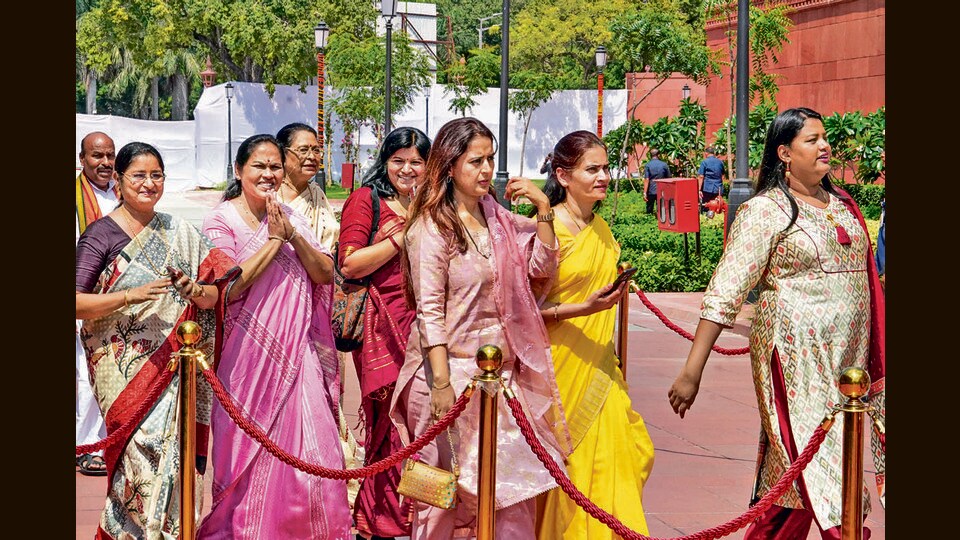
The Narendra Modi government’s decision to table a constitutional amendment bill in the Lok Sabha on Tuesday to reserve “as nearly as may be”, one-third of seats in Parliament and state legislatures across the country is the latest move in this direction, sparking a political and public debate in terms of women’s rights, located within a more complex matrix of political identities.
READ | What is women's reservation bill cleared by the Union Cabinet?
First proposed in 1996, proposals to have reservations for women have seen high drama, sharp resistance, physical scuffles and ill-tempered debates in Parliament, with concerns ranging from skewing the caste combination of elected candidates in favour of upper-caste women to unwillingness to share power to fear of losing bastions of electoral support. The draft bills since 1996 were also opposed for not including sub-quotas for Other Backward Classes (OBCs) and for proposing that reserved seats be rotated, contending this would undermine the ability of women to build a strong support base.
The deep-rooted history of the battle for greater representation to women in Lok Sabha and state assemblies and the bundle of draft legislations that has so far failed to make the cut call for a deep dive into the issue that may usher in reformulation of democracy and democratic institutions in India.
Pre-Independence and Constituent assembly debates
The issue of reservation for women in political institutions can be traced back to the days of the Indian national movement. In 1931, in their letter to the British Prime Minister on behalf of three women’s bodies, leaders Begum Shah Nawaz and Sarojini Naidu advocated for absolute equality of political status for Indian women. The joint memorandum issued on the status of women in the new Constitution, the women leaders wrote: “To seek any form of preferential treatment would be to violate the integrity of the universal demand of Indian women for absolute equality of political status.” It stated unequivocally that they look upon nominations, reservations of seats, and the co-option in any sphere of activity as a pernicious and humiliating system which must run counter to all real progress.
The issue of women’s reservation came up in Constituent assembly debates as well, but the idea was turned down, chiefly by women leaders who argued that this kind of preferential treatment is to underestimate the strength of women to compete as equals, and that it would imply an admission of inferiority.
READ | Hits and misses: Women’s quota in rural, urban local bodies a mixed bag
One of the members and noted freedom fighter, Renuka Ray, argued against it as she considered it an impediment to the growth of women and an insult to their intelligence and capacity. “We always held that when the men who have fought and struggled for their country’s freedom came to power, the rights and liberties of women too would be guaranteed...,” added Ray, citing the example of Vijaylaxmi Pandit and Sarojini Naidu.
Another member of the Constituent assembly, Hansa Mehta said: “The women’s organisation to which I have the honour to belong has never asked for reserved seats, for quotas, or for separate electorates. What we have asked for is social justice, economic justice, and political justice.”
Over 25 years later, the Committee for the Status of Women in India was set up to study dwindling women’s representation in Indian politics. In 1974, the panel published its report, revealing that while the participation of women as voters had been increasing, their representation as candidates was steadily decreasing and that despite progressive legal changes, women continued to be underrepresented. But the panel, by a majority vote, rejected the reservation of seats for women in Parliament and state assemblies. At the same time, the committee was unanimous in making the recommendation for reservation for women in panchayati raj institutions and local bodies.
READ | Women's reservation bill cleared at Cabinet meeting chaired by PM Modi; Congress reacts
In the late 1980s, the debate was reopened with the recommendations of the core group appointed by the Centre, to prepare the National Perspective Plan (1988- 2000). The National Perspective Plan (NPP) recommended reservation of seats for women in panchayats and in urban local bodies, including municipalities.
Between 1992 and 1993, the 73rd and 74th constitutional amendments were passed by Parliament, providing for “not less than one-third” reservation of seats for women in panchayati raj institutions and urban local bodies nationwide. Within these seats, one-third are reserved for Scheduled Caste and Scheduled Tribe (SC/ST) women.
The first attempt in 1996
The legislative journey of a proposed law to provide for reservation for women in Lok Sabha and state assemblies began on September 12, 1996, when the HD Deve Gowda-led United Front government introduced it in the Lok Sabha as the 81st Amendment Bill.
The bill called for reserving 33% of the seats in Lok Sabha and all state legislative assemblies for women. As per the draft, the seats were to be reserved for women on a rotation basis and would be determined by draw of lots, in such a way that a seat would be reserved only once in three consecutive general elections. It said reservation of seats for women would cease to exist 15 years after the commencement of the amendment Act.
With some of the constituents of the ruling coalition of 13 parties not in its favour, the bill was referred to a joint committee the following day.
The parliamentary panel, in its December 1996 report, flagged its concerns over the wording of the bill. It proposed that the phrase “not less than one-third” should be replaced with “as nearly as may be, one-third”. Other recommendations included reservation of seats in Rajya Sabha, consideration for OBCs “at the relevant time”, and a 15-year ceiling on reservation, with a review after that period to decide whether the reservations should continue. The committee also recommended that one of the Anglo-Indian members should be a woman, on a rotational basis. A rotation policy was also suggested for states that had existing reservations, in less than three seats, for SCs and STs.
The bill was taken up for discussion in the Lok Sabha in May 1997, only to face stiff opposition from within the ruling coalition. The discussion in Parliament saw late socialist MP Sharad Yadav making his infamous statement that “keval bal kati mahila bhar nahin rahne denge (only short-haired women won’t be allowed), suggesting women with short hair — a euphemism for educated and modern women —- would dominate the legislatures if the bill was passed. The bill eventually lapsed with the dissolution of Lok Sabha.
Attempts by NDA and UPA since 1998
In 1998, Atal Bihari Vajpayee, who headed the first National Democratic Alliance (NDA) government, reintroduced the bill in Lok Sabha. After Vajpayee’s law minister, M Thambidurai introduced it in the house, a Rashtriya Janata Dal (RJD) MP snatched it from the speaker and tore it into bits.
Thereafter, the bill lapsed with the fall of the Vajpayee government in April 1999. It was reintroduced in December 1999, and in 2002 and 2003 but met the same fate despite support from the Congress and the Left, the main Opposition parties at the time. The bills were countered by SP, BSP and RJD. In July 2003, an all-party meeting failed to build consensus, and the bill lapsed again.
Five years later, the bill again gained some traction during the Congress-led UPA government. Headed by PM Manmohan Singh, the government included it in its Common Minimum Programme and finally tabled it on May 6, 2008, this time in Rajya Sabha to prevent it from lapsing again.
READ | ‘God has given me the opportunity’, says PM Modi as women quota bill tabled in LS
The tabling of the bill yet again witnessed high drama with Congress parliamentarians forming a protective ring around then law minister HR Bhardwaj so as to enable him to introduce the bill while some SP leaders tried to snatch the copy of the bill.
Facing protests from RJD and SP, the bill was sent to a parliamentary panel, which submitted its report to Parliament in December 2009, recommending that the bill be passed without further delay. Like the parliamentary panel in 1996, it also suggested that the government should consider the demand for reservation within reservation for OBC women and some minorities “at an appropriate time”. The bill was subsequently cleared by the Union cabinet on February 25, 2010.
After two days of high-voltage discussion and some chaotic scenes that witnessed RJD and SP members uprooting the Rajya Sabha chairman’s microphone and tearing up copies of the bill, it was passed by the Upper House on March 9, 2010, with over a two-third majority. Chief Opposition parties, the BJP and the Left, supported it. However, the bill was never taken up for consideration in Lok Sabha and lapsed with the dissolution of the House in May 2014. At the time, the RJD, the JD(U) and the SP remained its most vocal opponents.
Analysis of 2008 and 2023 bills
The 2008 bill sought to reserve, as nearly as may be, one third seats of Lok Sabha and legislative assembly for women. At the same time, it provided that one third of the total number of seats reserved for SCs and STs shall be reserved for women of those categories in Lok Sabha and legislative assemblies.
Of the seven recommendations made by the parliamentary committee in 1996, the 2008 bill incorporated five, which included the 15-year reservation period and sub-reservation for Anglo Indians. The UPA government’s bill also included reservation in cases where a state has less than three seats in Lok Sabha (or less than three seats for SCs/STs); reservation for the Delhi assembly; and changing “not less than one-third” to “as nearly as may be, one-third”.
Two of the recommendations that the 2008 bill did not incorporate pertained to reserving seats in Rajya Sabha and legislative councils, and for sub-reservation for women of OBC category.
The 2008 bill proposed amendments in Article 239AA (relating to Delhi), and insertion of Articles 330A and 332A for reserving seats for women in Lok Sabha and state assemblies respectively.
The 2023 bill, introduced in Lok Sabha on Tuesday, also uses the words “as nearly as may be, one-third” and keeps the sub-quota for women under the SC and ST categories unchanged for the House of the People and state assemblies while proposing insertion of Articles 330A and 332A.
The 2023 bill, however, makes a departure from the 2008 bill in providing for rotation of seats, both for reserved as well as unreserved seats, based on delimitation. The 2008 bill laid down a rotation policy, prescribing that reserved seats were to be rotated after each general election. It meant that after a cycle of three elections, all constituencies would have been reserved once. The 2023 bill, however, has not linked rotation policy with general election. It states that rotation of seats reserved for women will take place after each subsequent exercise of delimitation.
Similarly, the 2008 bill envisaged a rotation policy for seats where there were existing reservations to SCs/STs in less than three seats and provided for a block of three general elections. No such stipulation finds a place in the 2023 bill.
Another key change that the 2023 bill has sought to introduce relates to Delhi. The 2008 bill proposed to have reservation for women in Delhi’s legislative assembly by simply adding that women, apart from SCs, will also have reservation. It, however, did not enumerate the extent of reservation. But the 2023 bill, incorporating a new clause in Article 239AA, clearly states that “one-third of the total number of seats that are to be filled by direct election in the assembly, including the number of seats reserved for SCs, will be reserved for women in a manner that Parliament may by law determine.”
The 2008 bill had also included reservation for women of Anglo-Indian community in Lok Sabha and state legislatures but the 2023 bill does not mention it because reserved seats for the Anglo-Indian community was done away with by a constitutional amendment passed in January 2020.
Both bills postulate insertion of Article 334A to put a cap of 15 years on reservation for women but they are differently drafted. While the 2008 bill said that provision for reservation will cease to have effect after 15 years of the amendment coming to force, the 2023 bill puts forth two conditions before the amendment could be enforced -- first, the census and second, the exercise of delimitation of seats. The 2023 bill stipulates that such reservation will take effect after a delimitation exercise, which is to be conducted following the publication of figures from the first census held after the Act commences. According to Article 82 of the Constitution, Parliament by law enacts a Delimitation Act after every census. Therefore, the proposed law has been linked to two future events that do not have a specific timeline in sight.
Interestingly, the 2023 bill also adds that the reservation shall continue till such date as Parliament may determine – a repository of residuary power with Parliament to continue such reservation even after 15 years even though a previous provision in Draft 334A holds that the reservation will cease to have effect 15 years after the commencement of the Act.
Only about 14% of the members in Indian Parliament are women, the highest so far. The issue of women’s reservation in Parliament and the state legislatures is complex and may warrant an extensive debate. At the same time, principles of affirmative action and the need to alter the entrenched interests in India’s polity through adequate spaces for women in mainstream political arena is equally imperative.



