
 E-Paper



World busy with Covid-19, Beijing pushes South China Sea agenda
India has an abiding interest in the peace and stability of the South China Sea and has backed peaceful resolution of disputes without use or threat of use of force

 Prefer HTon Google


A US warship sailed through the sensitive Taiwan Strait on a “routine” transit for the second time in a month, the US military said on Friday, hours after US Secretary of State Mike Pompeo accused China of taking advantage of the world’s focus on the Covid-19 pandemic to push its territorial ambitions in the South China Sea.
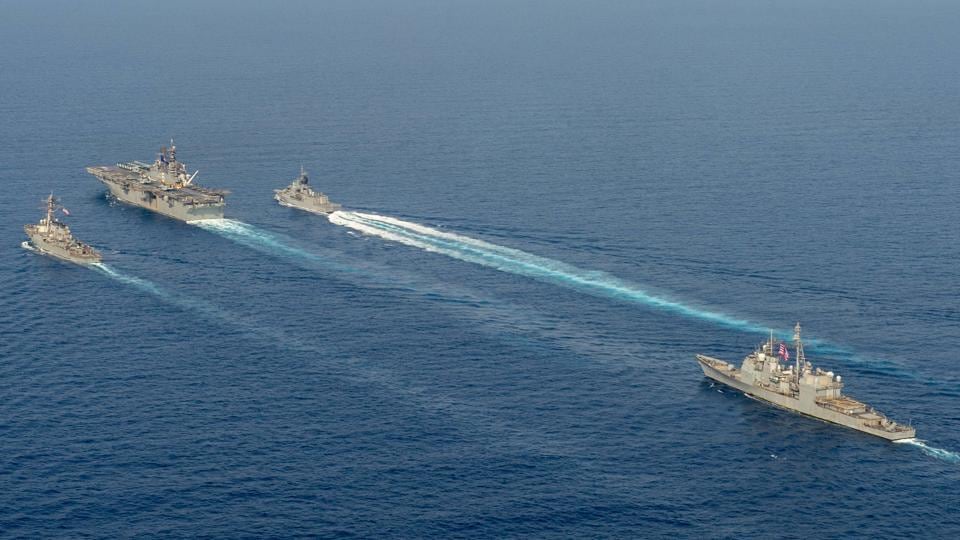
Pompeo’s statement spotlights Beijing’s effort to push the envelope in the South China Sea where its territorial claims conflict with those of Vietnam, the Philippines, Taiwan, Malaysia and Brunei.
At a video interaction with ministers of the 10-member Association of Southeast Asian Nations grouping to discuss the coronavirus pandemic, Pompeo pointed to China’s announcement of administrative districts over disputed islands and maritime areas in the South China Sea and sinking of a Vietnamese fishing vessel earlier this month.
“Beijing has moved to take advantage of the (Covid-19) distraction,” Pompeo said, accusing China of deploying militarised ships to intimidate others from developing offshore gas and oil projects.
Also Read: Explained: What the South China Sea dispute is all about
China claims almost the entire South China Sea and the islands and reefs that dot it. Earlier this month, Beijing announced setting up two districts to administer islands and reefs of Paracel Islands and the Spratly Islands to strengthen its claim to sovereignty over the area.
India tracks South China Sea developments
There has been no statement from India on recent developments in the South China Sea. Or Pompeo’s latest statement.
But New Delhi has an abiding interest in developments in the region.
For one, because about 55 percent of India’s trade passes through the Strait of Malacca, part of the South China Sea.
India has, on several occasions, called upon all parties to avoid unilateral action that lead to tensions in the region and called for peaceful resolution of disputes without threat of use of force.
Besides, state-run ONGC Videsh is also engaged in oil and gas production in cooperation with Vietnam and is directly impacted by China’s efforts to militarise the South China Sea.
Not just Pompeo
Chinese ships have also been accused of intruding in waters near the Japanese-controlled islets last week when four coast guard vessels sailed through the area for about 90 minutes before leaving. China claims the islets and calls them Diaoyu.
Japanese Foreign Minister Toshimitsu Motegi picked up the phone this Tuesday to lodge a protest for sending government ships into Japanese territorial waters near the Senkaku Islands in the East China Sea.
The Philippines also has filed two diplomatic protests with the Chinese Embassy in Manila over violations of international law and Philippine sovereignty in the West Philippine Sea.
Stand-off with Malaysia
There has been a standoff between Chinese and Malaysian vessels over Kuala Lumpur’s effort to explore energy blocks in its extended continental shelf. Those waters are also claimed by Vietnam and China, which immediately sent ships to shadow the boat.
According to news agency Bloomberg, the situation took a turn for the worse on April 16 with the arrival of a Chinese surveyor known as the Haiyang Dizhi 8, which last year was engaged in a standoff with Vietnam over offshore energy blocks.
This week, the dispute turned into a five-nation face off involving US and Chinese warships, raising the risk of a direct confrontation as broader tensions grow between the world’s biggest economies, Bloomberg reported.


