E-Paper



Second wave not over, says health secy, warns of festive season spike
The warning comes as Kerala witnesses a surge of infections from last week’s celebration of its biggest festival, Onam, which also marks the unofficial beginning of India’s festive season that lasts till the end of the year

 Prefer HTon Google


The second coronavirus disease (Covid-19) wave is not over yet in the country, said Union health secretary, Rajesh Bhushan, adding that festive months of September and October will be crucial to check the case load -- a warning that comes even as Kerala witnesses a surge of infections from last week’s celebration of its biggest festival, Onam, which also marks the unofficial beginning of India’s festive season that lasts till the end of the year.
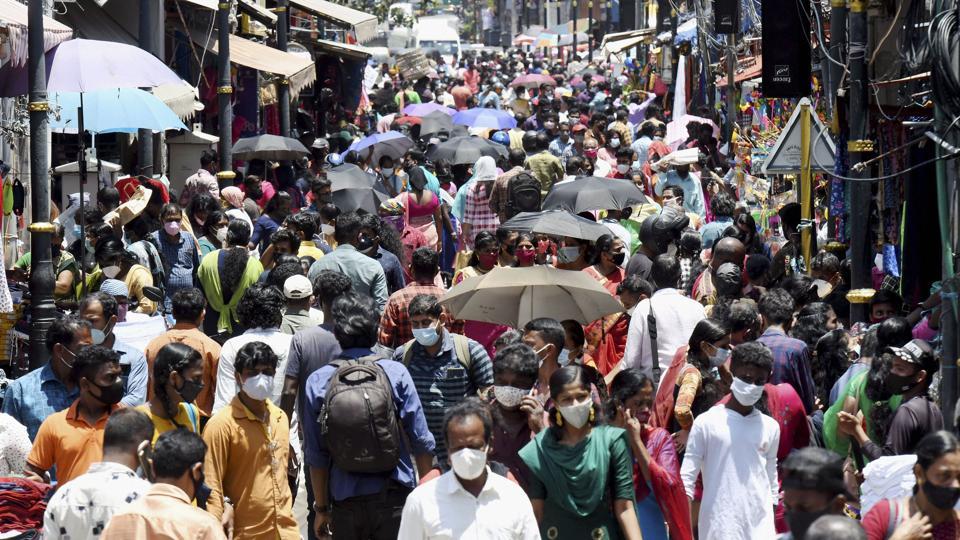
“We are still in the midst of the second surge of Covid-19; it has not concluded yet. Therefore, we have to maintain all necessary precautions, particularly in the light of our experience that shows that after every festival we see a spike. Therefore, the coming months of September and October are crucial for us because we will be celebrating a few festivals,” Bhushan said in a briefing on Thursday.
He warned the public that Covid-inappropriate behaviour could lead to a surge in cases.
Echoing Bhushan’s warning, Balram Bhargava, the director general of Indian Council of Medical Research (ICMR), said during the press briefing that 41 districts in the country are reporting a weekly average positivity rate of at least 10%.
“The second wave is still on in India and in some states an upsurge is being observed in some districts. Apart from the 41 districts with weekly test positivity rate of more than 10%, we have 27 districts with a weekly test positivity rate between 5% and 10%. Population density is causing the spread; so wherever Covid-19 appropriate behavior is not being observed, we are seeing an upsurge of cases,” said Bhargava.
A positivity rate below 5% and declining is considered an indicator of the infections being under control.
Kerala has at least 100,000 active cases, and four other states have between 10,000 and 100,000 active cases, Bhushan said, highlighting the need for people to not drop their guard. Bargava urged people to get vaccinated as it was crucial in containing the disease spread in the long run, and the need to keep wearing a mask.
“We know that these vaccines are disease modifying vaccines; these are not disease preventive vaccines, and therefore, it is very important to continue wearing a mask even after getting vaccinated. Mask usage has to continue. We know that vaccines reduce the disease severity; they reduce the possibility of hospitalization, and also avert death to the tune of nearly 98-99%,” he added.
India has administered 610 million Covid-19 vaccine doses since the national covid immunisation drive started on January 16 this year. Of the total doses administered, 6.8 million doses were administered till 7pm on Thursday.
He also said that mass gatherings have to be discouraged.
Experts agree that it is important for people to avoid crowded places and large gatherings for now and following Covid appropriate behavior.
“These things are basic when we talk about fighting an infectious disease that is as transmissible as Covid-19. Gatherings should be avoided and wearing a mask is mandatory. Vaccination is important. The vaccines also work against variants in circulation; therefore, people should take these,” said Dr GC Khilnani, former head, pulmonary department, All India Institute of Medical Sciences, Delhi.
As part of their preparations for any surge in cases, the Union government also asked states to create a buffer supply of oxygen.
The second wave of Covid-19 in April and May saw a significant shortage of oxygen in some states and Union territories.
“Public health facilities must have their own captive oxygen generation plant. About 1500 have been sanctioned and 900 of these have already been commissioned. Hospitals should also have medical oxygen storage tanks for which they can use the funds provided by the central government. Third element is to create equitably distributed oxygen storage units for any SOS situation,” said Bhushan.